How much does a flat roof rooflight cost?
The opening decides it more than the glass does.
Part of our Flat Roof Rooflight Installation guide
We give an indicative range by email and a fixed written price after survey. On a flat roof we will not give a fixed figure over the phone, because the kerb decides this job and a price given without seeing it is a guess with a number attached.
What moves it
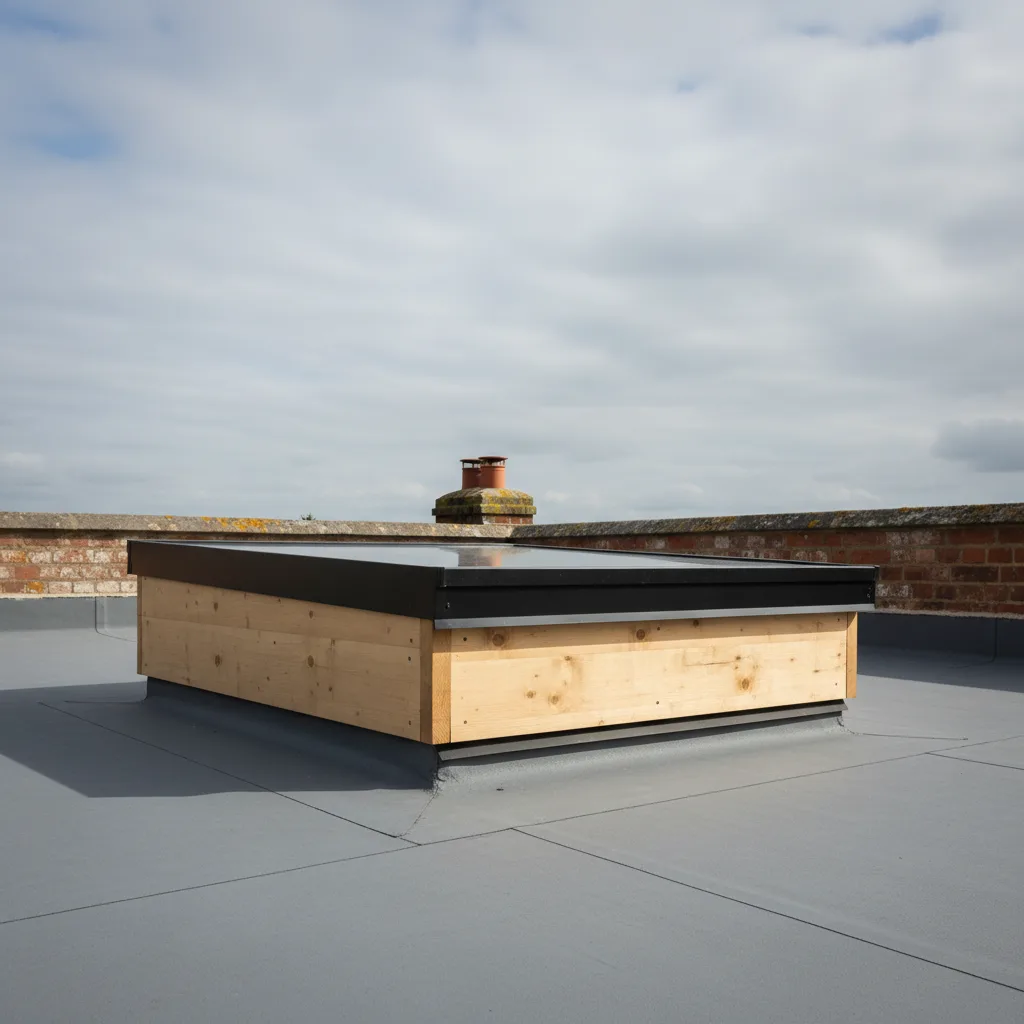
Whether the opening exists. Fitting into a sound existing kerb is the cheapest job in this trade. Forming a new opening in a finished roof is several times the work.
Stock or made to measure. On a new extension, designing the kerb to a stock size saves real money and weeks of lead time.
Structure. Trimming between joists is routine. A wide opening needs a steel designed by an engineer, and that is often the largest line.
The covering. Single ply and felt take a new joint well. GRP is harder to cut into and bond to, and sometimes the honest answer is that the roof wants recovering.
Access. Single storey from a tower costs nothing extra. Higher, or over a fragile roof, needs scaffold.
Glass. Solar control on anything facing south is worth the money. Triple glazing usually is not.
Two rather than one

Worth pricing. Two smaller units often light a long room better and may avoid a steel entirely, which can make them cheaper as well.
How we price is on the costs page.
Where the money goes

The unit is rarely the largest part of a flat roof rooflight quotation. The kerb and the access usually are, and that is why two quotations for what looks like the same job can differ so widely.
Whether a kerb already exists. The biggest single factor. Dropping a unit onto a sound, correctly built and insulated kerb is a straightforward day. Forming a kerb, insulating it, correcting the fall on the deck around it and dressing the covering over it is a different job.
Size. Cost rises steeply rather than proportionally, because a larger pane needs a heavier build up and heavier glass, which feeds back into the structure and into how it gets onto the roof.
Fixed or opening. An opening unit carries a premium for the actuator, control gear and heavier hinges. Where mains wiring has to be run into a finished room, that is a bigger line than the unit premium.
The glass. Solar control is close to essential on a substantial flat roof unit, because a near horizontal pane has no orientation to shelter behind and collects the midday sun directly. Acoustic laminate and obscure glazing are each a step up.
Access. Single storey reachable from a tower costs nothing extra. A large unit that cannot be manhandled needs a crane or a glass robot and a route to the roof, and that has to be established before anything is ordered.
The kerb, and why it is worth paying for

At least 150mm of upstand, the deck falling away from it so water cannot pond against the seal, rigid insulation on the outer face, and a continuous vapour control layer sealed to the frame.
The insulation is the item nobody mentions. A 1200 by 1800 rooflight has six metres of perimeter, and an uninsulated timber kerb punching straight through the roof insulation presents close to a square metre of poorly performing envelope at a U-value several times worse than the glass sitting on it. It costs a sheet of board and an hour, it disappears under the covering, and that is exactly why it is the first thing dropped from a cheap quotation.
Ask directly whether the kerb is insulated. It is the fastest way to tell who is detailing the job and who is fitting a unit.
Several small or one large

On a long narrow room, two or three flat units in a row light it more evenly than one large one, cost less in total, and sit lower from outside. They also fail independently, so a seal failure in twenty years means replacing one modest unit rather than a very large and very expensive pane.
One large unit wins where the room is broad and square and the effect wanted is a single opening to the sky.
What should be itemised

The unit with manufacturer, model, size and glazing specification. The kerb: height, insulation and whether forming it is included. The fall on the deck and any correction needed. Access and how the unit reaches the roof. Making good. Disposal. Building Control where notifiable.
We will not price a flat roof rooflight without seeing the kerb, because that is where the cost is.
Why we survey first
We will not fix a price on a flat roof rooflight from photographs. Whether a kerb exists, how high it is, whether it is insulated, and which way the deck falls are the four things that decide the cost, and none of them is reliably visible in a picture taken from the ground.
An indicative range by email costs you nothing and tells you whether to continue.
Ask us
Send a photograph showing how the flat roof meets the house. That shows us the kerb and the fall, which are the two things that decide the price, and it saves an appointment.
Fixed or opening
A fixed unit is cheaper, slightly better thermally and has nothing to maintain. An opening unit costs more for the actuator and the wiring, and on a south or west facing extension it is what makes the room usable in summer, because it lets accumulated heat leave at the highest point. On a north facing utility room, fixed is usually right.
One last point
Ask directly whether the kerb is insulated. It is the fastest way to tell who has detailed the job and who is simply fitting a unit, and it costs a sheet of board and an hour.


More on Flat Roof Rooflight Installation
Ready to bring the daylight in?
Tell us about your project and we’ll send a clear, fixed written quote, no pressure, no surprises.
- Fixed written price before any work starts
- No pressure, no obligation, no sales calls
- Flexible survey times that suit you
- A reply within one working day