Can you stand on a flat rooflight to clean it?
No. A standard rooflight is not rated for foot traffic and it is not a smaller walk-on unit.
Part of our Flat Roof Rooflight Installation guide
No, and it is worth being blunt about it because the surface looks solid and it is a thing people try.
Why not
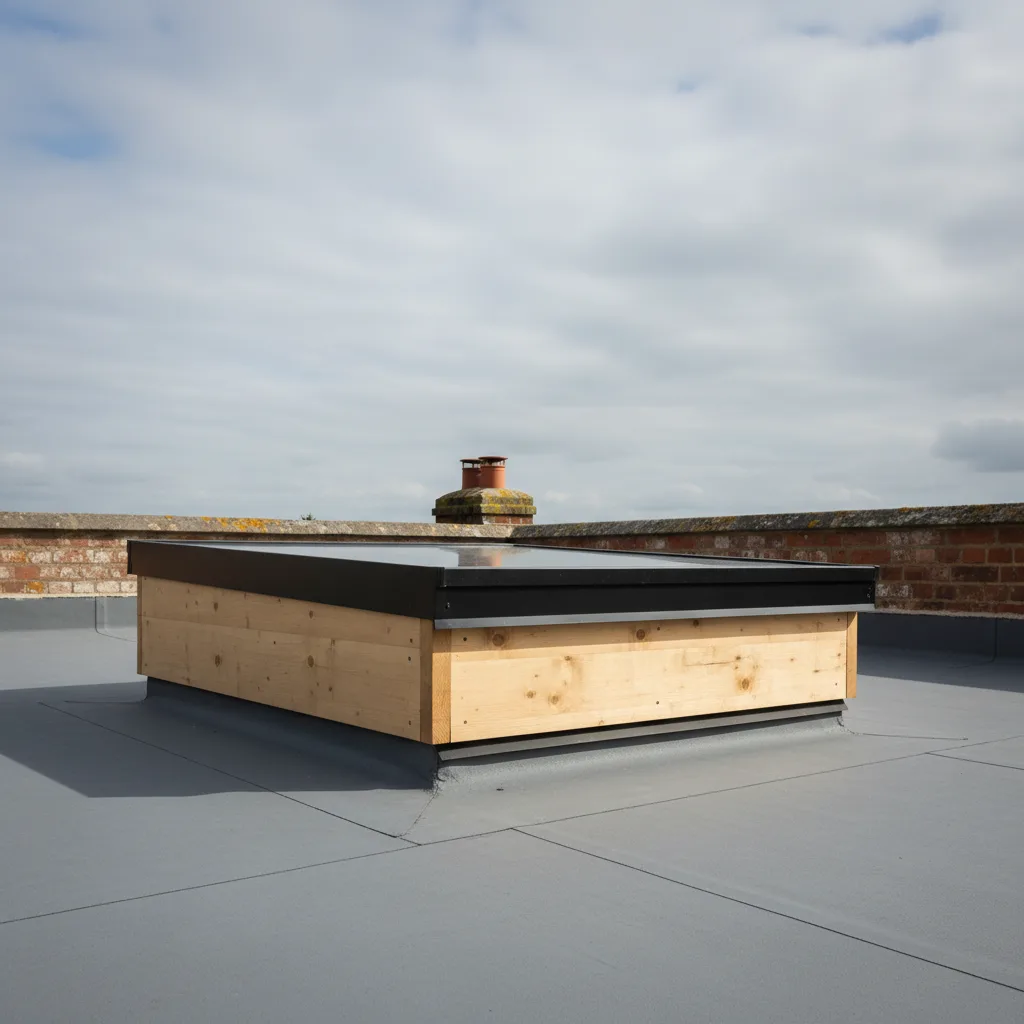
A standard rooflight is glazed for wind and snow load, which are distributed loads spread over the whole pane. A person is a concentrated point load, and the pane is not designed for it.
A walk-on unit is a different product: a laminated stack of several toughened plies, typically 40mm to 60mm thick against about 28mm for a standard unit, built so that if the top ply breaks the plies beneath still carry the load. That redundancy is the safety case, and a standard unit does not have it.
What actually happens

Usually nothing, which is the dangerous part, because people conclude it is fine. The failure, when it comes, is through the toughened outer pane. The laminated inner will normally hold together and stop somebody going through into the room, which is exactly what it is there for, but it is not a designed outcome and it is not something to rely on.
How to clean it instead

From the roof surface beside it, not from on it. A water fed pole from the ground reaches most single storey domestic rooflights and is what a window cleaner will use.
Where a unit genuinely cannot be reached, specify self cleaning glass at order. It reduces how often cleaning is needed rather than removing it, but on an unreachable unit that is the difference that matters.
If you need to walk on it

Say so at survey and we will specify a walk-on unit. It costs more, both in the glass and in the structure underneath, and it is the right answer where a roof is also a terrace.
No, unless it is specified as walk on

A standard flat roof rooflight is designed to keep weather out and let light in. It is not designed to carry a person, and standing on one to reach a gutter or clean the pane is exactly the sort of thing that causes serious accidents.
The risk is worse than it looks, because a rooflight that has become fragile looks identical to one that has not. Old polycarbonate degrades under ultraviolet and becomes brittle, and it gives no warning at all.
The three specifications

Standard. Do not stand on it, at all.
Non fragile. A safety rating meaning a person falling onto it will not go through. It is not permission to walk on it. It means it will not kill you if you fall.
Walk on. Designed for repeated foot traffic as a floor, with a laminated structural build up and an anti slip surface. Only these can be stood on, and only within the loading they were specified for.
Appearance tells you nothing. A thick pane looks reassuring and is not evidence of anything.
How to clean it safely instead

From the roof surface around it, with a soft brush and water, standing on the roof rather than the glass. On a single storey extension that is a tower job and it is straightforward.
With a telescopic pole, ideally water fed, from ground level or from the roof edge. This is what most people should be doing.
Professionally, where the unit is high or the roof is not safe to be on.
The other reason not to

Even where a unit would take your weight, standing on it stresses the perimeter seal and grinds grit into the surface. Both shorten the life of an installation that should give twenty five years.
What to do about an unknown unit
Treat it as fragile. Recognised guidance for roof work does exactly that with older rooflights unless there is evidence to the contrary, and it is a sensible default for a homeowner too.
If your roof has domes of unknown age and anybody needs to work up there, replacing them with a modern non fragile glass unit improves safety, security, thermal performance and appearance in one job.
How the load rating is actually written
A rooflight datasheet gives a load in kilonewtons per square metre, distributed. That describes snow and wind sitting evenly across the whole pane. A person is a point load concentrated on two feet, and it is a completely different calculation.
Non fragility is a separate rating again, and it is frequently misread. A non fragile designation means the unit will not let a body fall through in an accidental one off event. It is a fall protection classification for people working on a roof, not a permission to use the unit as a floor. A non fragile rooflight walked on weekly will still fail eventually, and it will fail in the seal or the frame long before the glass gives up.
Cleaning it without standing on it
From a ladder or a tower at the perimeter, with a soft brush on a pole and a hose. Nothing abrasive, no pressure washer close to the seal, and no chemical stronger than washing up liquid unless the manufacturer names one.
A water fed pole with a soft head reaches most domestic flat rooflights from ground level, which is how professional cleaners do it. On a large or awkward roof, a mobile tower gives safe access to the edge and takes a couple of hours.
Where the only realistic access involves being on the roof, the answer is a walk on unit specified from the start, not a standard rooflight used optimistically.
More on Flat Roof Rooflight Installation
Ready to bring the daylight in?
Tell us about your project and we’ll send a clear, fixed written quote, no pressure, no surprises.
- Fixed written price before any work starts
- No pressure, no obligation, no sales calls
- Flexible survey times that suit you
- A reply within one working day