Do flat rooflights hold water after rain?
A little on the glass is normal. Water standing against the kerb is not.
Part of our Flat Roof Rooflight Installation guide
Two different things get described this way and only one of them matters.
Water on the glass
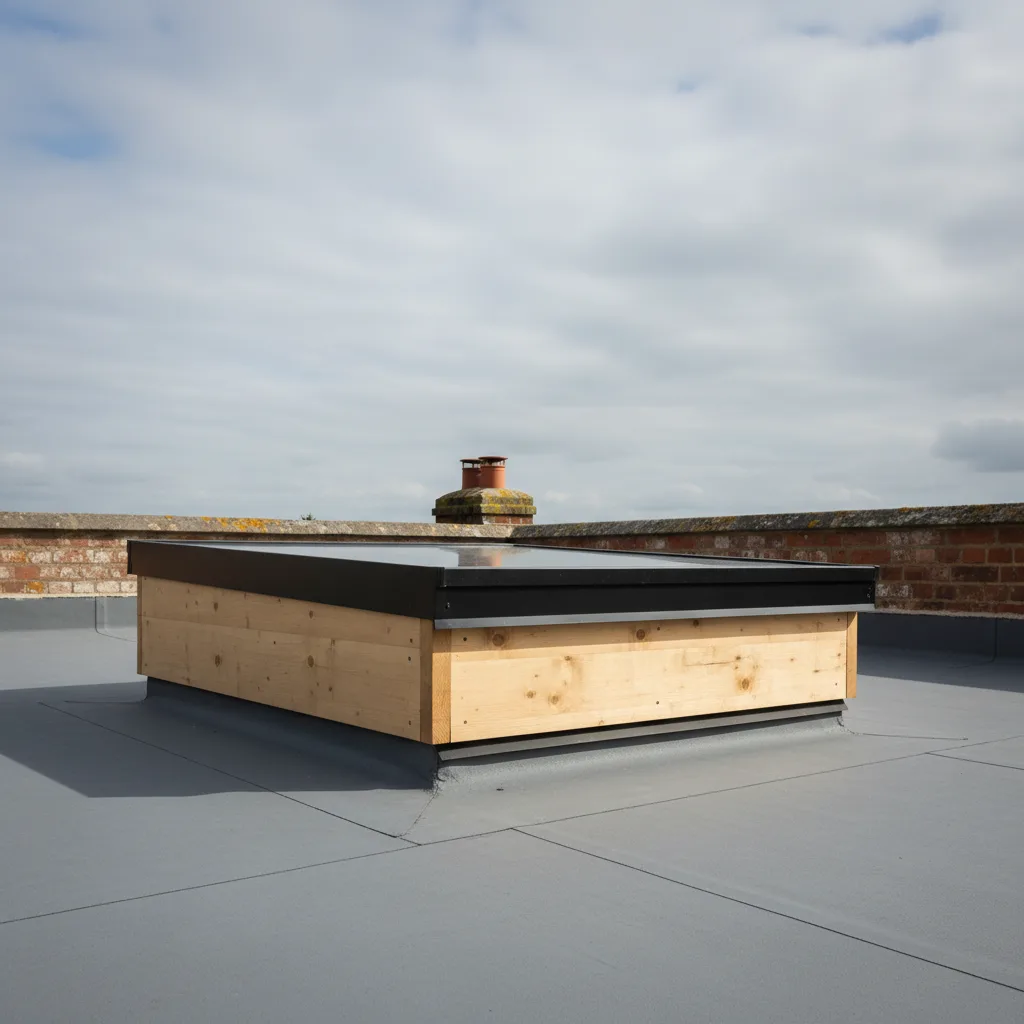
A level pane will hold a film and some droplets after rain, and on a still day they evaporate rather than running off. That is normal and harmless.
What it does affect is dirt. Evaporating droplets leave whatever they were carrying behind, so a level rooflight develops spotting that a sloped one does not. Self cleaning glass helps; a slight built-in slope helps more.
Water against the kerb

This one matters. If water is standing along the upslope face of the upstand hours after rain has stopped, the roof is not draining around the unit properly.
Standing water works at the termination where the covering turns up the kerb, it finds any pinhole or weak lap, and it is present for days rather than minutes. It is also heavy, and the load causes further deflection, which deepens the pond and makes it worse over time.
Why it happens

Inadequate fall, a unit positioned where water naturally collects, a wide unit sitting square across the flow, or a blocked outlet downstream.
What to do about it

It is fixable. Tapered firrings around the opening create local falls that carry water away even where the wider roof is flat. Sometimes the answer is clearing or enlarging an outlet.
The thing not to do is seal around the frame and hope. Sealant is not a drainage strategy, and a detail that is under standing water will defeat it.
A simple test

Look at the roof a few hours after heavy rain. Damp is fine. A visible pool against the kerb, or a tide mark showing where one sits, needs attention.
The roof does, and that is the issue

A flat rooflight itself sheds water reasonably, particularly where the kerb has been built with a slight pitch. What causes trouble is water standing on the roof around it.
Every flat roof holds some water. The design target is a minimum finished fall of 1 in 80, which in practice means designing to 1 in 40 so that deflection and workmanship tolerances do not leave a flat spot. Where that fall is absent, or runs the wrong way, water collects.
Why standing water matters

It attacks the seal. A perimeter seal designed to shed water is not designed to be submerged. Sitting in a puddle after every shower works it loose over a few winters, and that is the commonest cause of a leaking flat rooflight.
It leaves dirt. Water that sits and evaporates deposits everything it was carrying on the glass. A pane that never drains becomes permanently dull and no cleaning schedule keeps up.
It defeats self cleaning glass. The coating relies on rain sheeting off to carry away the deposits it has broken down. On a pane where water sits rather than runs, it does very little.
It freezes. Ice against a seal and a frame is a different loading case from water.
Water on the pane itself

A truly flat unit will hold a film and, after heavy rain, small pools. That is normal rather than a fault, and it clears by evaporation.
Where it bothers you, the answer is a pitched flat rooflight: several manufacturers offer units with a built in pitch of around 5 degrees, achieved in the frame or by building the kerb higher on one side. They shed water and dirt considerably better and look almost identical from the ground.
The trade is that a pitched unit collects more direct sun through the middle of the day, which argues for solar control glass on a south facing installation.
What to check on your own roof
Look at it after rain. Where the water goes, and where it does not, tells you everything. Standing water anywhere near the opening is a problem to solve before the rooflight rather than after.
Then check the outlet it drains to. A perfect fall discharging into a gulley full of leaves and silt produces exactly the same pond, and clearing it costs nothing.
Correcting it
Locally around the kerb, using tapered insulation or firrings under a new deck section. It is normal work, it belongs in the quotation, and it is far cheaper than replacing a unit that has failed because it was sitting in water.
We look at the fall before anything else on a flat roof enquiry, which is why we will not price one from a photograph taken from the ground.
A truly horizontal one will
Water on a level pane has nowhere to go, so it sits and evaporates. What it was carrying stays behind.
Over a few years that builds into a dulled, streaked surface that no longer reads as glass, and on a rooflight nobody can reach it simply gets worse.
It also defeats self cleaning glass entirely, because that coating relies on rain sheeting off and carrying the residue away.
The fix is a slope
A modest pitch is enough for water to run rather than sit. It is achieved either by building the kerb with a fall, or more neatly by using a pitched glass unit on a level kerb, which keeps the kerb square and easier to build accurately.
Manufacturers publish a recommended minimum for their own products. It is worth following, because a token slope that disappears into construction tolerance achieves nothing.
The more serious version of this question
Water standing on the roof around the rooflight, rather than on the glass.
That is a falls problem, and it matters far more. Water ponding against the kerb accelerates the ageing of the waterproofing, freezes and expands in winter working every joint, and keeps the perimeter permanently wet.
The cause is either inadequate fall, or falls arranged so water is directed into a dead corner beside the unit rather than past it.
What to look at after heavy rain
Where puddles form on the roof, and whether they form in the same place every time. A repeating puddle is telling you the fall is wrong there, and it is far cheaper to correct while it is only a puddle.
More on Flat Roof Rooflight Installation
Ready to bring the daylight in?
Tell us about your project and we’ll send a clear, fixed written quote, no pressure, no surprises.
- Fixed written price before any work starts
- No pressure, no obligation, no sales calls
- Flexible survey times that suit you
- A reply within one working day