Telling a failed unit from a failed installation
Different problems, different remedies, and replacing the wrong one means paying twice.
Part of our VELUX Window Installation guide
The distinction decides what needs doing, and getting it wrong is expensive: a new unit fitted onto a failed installation reproduces the fault.
Signs the unit has failed

Misting between the panes. Haze you cannot wipe from either side. The seal has gone. Definitive.
A cracked or broken pane.
A frame that has warped or split, so the sash no longer closes square.
All of these mean the unit, and none of them is affected by how it was fitted.
Signs the installation has failed

Water entering during rain, particularly driving rain from one direction. The unit is not the water barrier; the flashing or the kerb termination is.
Staining or damp at the reveal, especially at the head. Usually the underlay collar, or the vapour control layer.
Condensation at the reveal or on the frame in cold weather. A missing insulation collar or an uninsulated kerb.
Damp appearing some distance from the rooflight, which means water is travelling on the membrane or along a joist.
The test that separates them

Does it happen when it has not rained? Rain leaks follow rain. Condensation follows cold weather and internal humidity.
Both at once

Common on an old installation. A unit at the end of its life in an opening that was never detailed properly. Then replacement is the right answer, and the detailing is corrected while the opening is exposed.
What we do

Establish which before quoting a remedy. Selling a replacement to fix a kerb problem is a way of taking money for a problem that will still be there.
Four situations, and only two need us

Water at a rooflight is reported to us as a leak far more often than it is one. Working out which of these you have takes a minute and it frequently saves a callout.
Condensation on the glass

Appears on cold mornings, worst in deep winter, forms evenly across the inner face of the glass, and bears no relation to whether it rained. Clears as the day warms.
This is not a fault and no work on the window will fix it. It means the room is producing moisture and not losing it, and the answer is ventilation: an opening at the highest point of the room lets warm moist air leave and draws drier air in through anything open lower down.
Misting inside the sealed unit
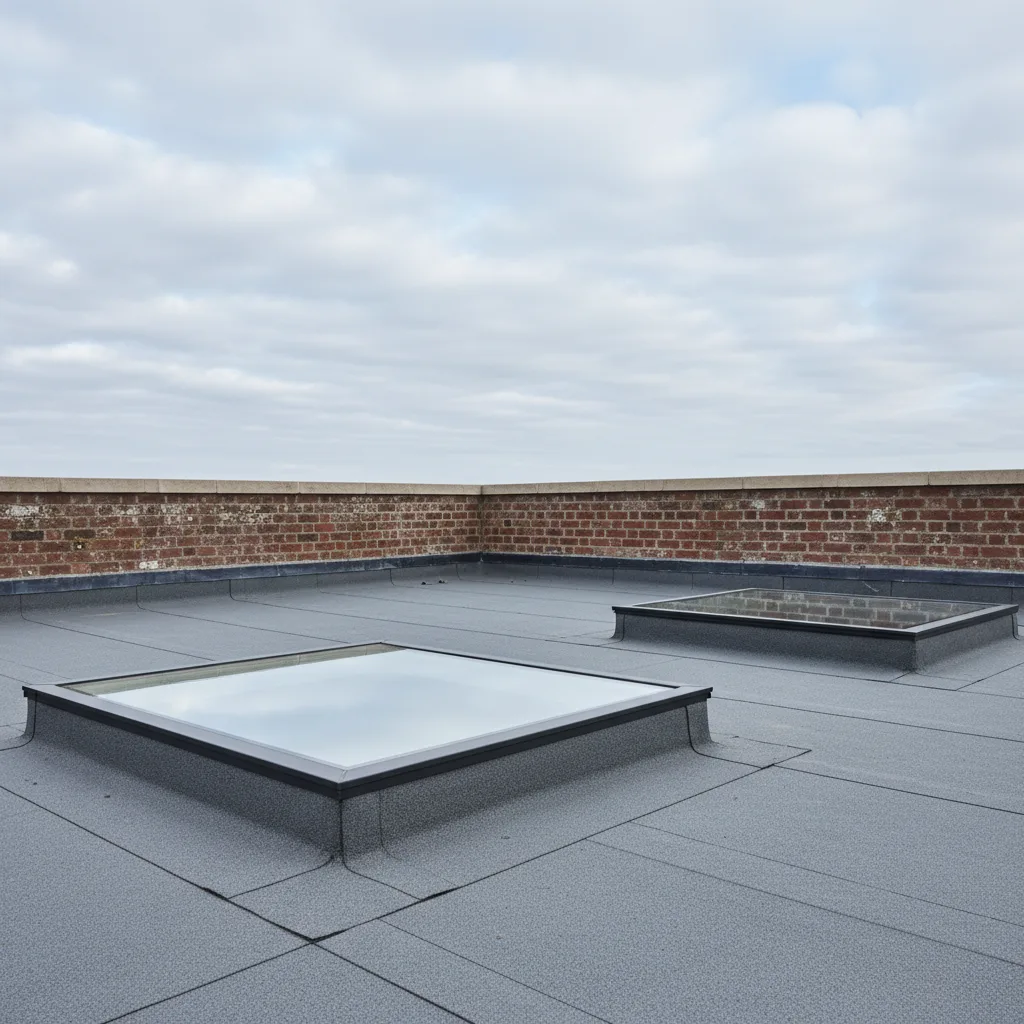
The moisture is between the two panes and cannot be wiped off either face. Frequently it appears as a band around the edge of the glass on cold mornings while the centre stays clear.
That is a failed perimeter seal, and it is end of life rather than an installation fault. Sealed units last fifteen to twenty five years, and once the seal has gone the argon has escaped, the desiccant is saturated and the low emissivity coating starts to degrade.
Product failure, addressed by replacing the unit. Where the window is under a manufacturer’s warranty, that is a claim, and where we fitted it we handle that claim rather than leaving you to argue about it.
Water on the plaster reveal rather than the glass
This one usually is an installation fault, and the cause is almost always a missing insulation collar.
The collar closes the gap between the frame and the structure. Without it the reveal is cold enough for room air to condense on it. It is a separate order line on any quotation, it is the first thing dropped from a cheap one, and the symptom does not appear until the first cold spell months after the work.
Installation failure, addressed by opening up the reveal and fitting the collar.
A genuine leak
Follows rain, and usually rain driven from one particular direction. Arrives at one point rather than spread evenly. Leaves a mark that is still there when everything has dried.
Nearly always an installation fault, and nearly always one of three things: the wrong flashing kit profile for the covering, the underlay collar not lapped correctly, or the covering reinstated under the flashing rather than over it.
None of those is visible once the job is finished, which is exactly why they get skipped on cheap work.
What to send us
A photograph of where the water appears and, if it is safe, one of the outside of the unit. Say whether it follows rain or cold mornings, and whether it can be wiped off.
Between those we can usually tell you which situation you are in, and two of them do not need anybody to come out at all.
Who pays
A failed sealed unit at fifteen to twenty five years is end of life, and if it is within a manufacturer’s warranty that is a claim. Where we fitted it, we handle that claim rather than leaving you to argue about a product we chose.
A missing insulation collar or a badly lapped flashing on work we did is covered by our ten year workmanship guarantee, and we come back and put it right at no charge.
Ask us
Send a photograph of where the water appears and say whether it follows rain or cold mornings. Two of the four situations do not need anybody to come out, and we will tell you which one you are in.
Why misting appears suddenly
The perimeter seal frequently fails years before anybody notices. The desiccant in the spacer bar absorbs the moisture that gets in until it is saturated, and only then does condensation start forming in the cavity. That is why a unit can go from apparently fine to visibly misted in a single winter.
One last point
Condensation on the glass and water on the reveal look similar from across a room and mean completely different things. Look at where exactly the water is forming before concluding anything.
More on VELUX Window Installation
Ready to bring the daylight in?
Tell us about your project and we’ll send a clear, fixed written quote, no pressure, no surprises.
- Fixed written price before any work starts
- No pressure, no obligation, no sales calls
- Flexible survey times that suit you
- A reply within one working day