Can a flat rooflight be opened?
Yes, and on a flat roof it is above reach by definition, so electric is the version that gets used.
Part of our Flat Roof Rooflight Installation guide
Yes. Most manufacturers offer opening versions, and they come in two arrangements.
Hinged
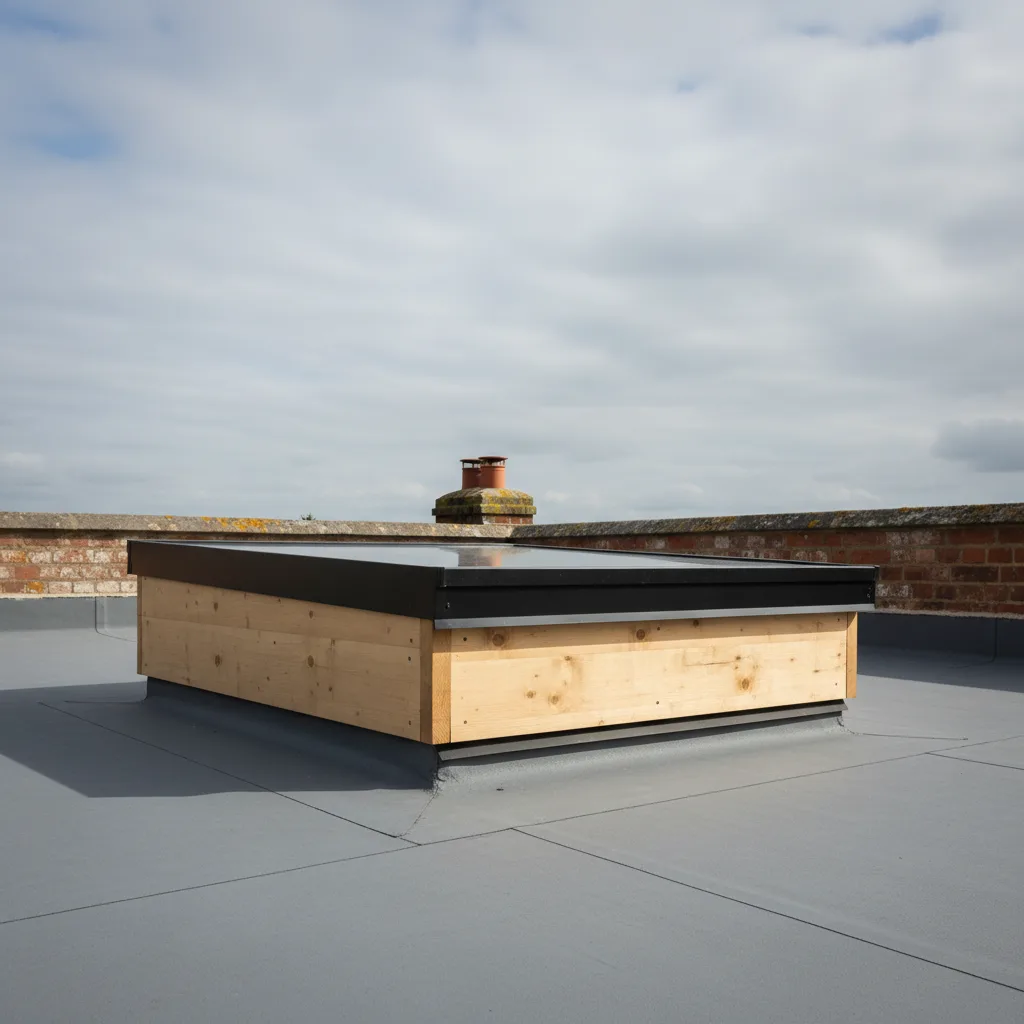
The whole pane lifts on an actuator, usually opening 200mm to 400mm at the far edge. Simple, well proven, and enough for ventilation.
Sliding

The pane slides sideways over an adjacent fixed pane, giving a genuine opening you could climb through. More expensive, needs roof space beside the opening for the pane to travel into, and used where roof access is wanted rather than just air.
Manual or electric

A flat roof rooflight is above reach by definition. Manual means a pole, and a manual unit on a flat roof is generally opened once and then left.
Electric means a chain actuator with a remote or a wall switch. On a flat roof this is not a luxury, it is what makes the opening function useful at all.
Rain sensors

Worth having if you will ever open it and leave the room. It reacts to the first drops, so it is closing as the rain starts rather than predicting it. It turns a small mistake into a non-event.
Decide before the kerb is built

An opening unit is heavier than a fixed one, so the structure and kerb specification differ, and it needs a power feed. Running a cable at first fix costs almost nothing; running it after the ceiling is finished means lifting boards.
Even if you fit a fixed unit, a capped cable to the position is cheap insurance against changing your mind.
Why it is worth it

An opening at the highest point of a room removes warm humid air by stack effect and draws cooler air in behind it. In a kitchen it does more for summer comfort than anything except solar control glass.
Yes, and it is worth doing on most of them

Opening flat roof rooflights are a standard product rather than a special order. The sash lifts on an actuator, usually a chain type, giving a clear opening around the perimeter.
Because they sit at the highest point of a room, they ventilate better than any window in a wall, which is the real argument for specifying one.
Manual or motorised

Almost always motorised. A flat rooflight sits above a flat roof and therefore above a room with a normal ceiling height at least, and a pole operated vent at that height is a chore. A vent that is a chore stays shut.
Mains gives the fastest operation and allows a wall switch, and the wiring is where the cost sits: twenty minutes at first fix during a build, a day and a half plus decoration into a finished room.
Solar carries its own panel and battery, needs no connection at all, and fits in a couple of hours. It is usually the right answer for a retrofit and it keeps working in a power cut.
What to specify with it
A rain sensor. More important on a flat unit than a pitched one, because a horizontal opening left open in a shower admits considerably more water than a sloped one. It is what makes the vent get used.
A wall switch beside the light switches at the room entrance, not under the rooflight. Always in the same place, usable by anyone, and it works when a battery is flat.
The free open area figure, because Part F purge ventilation is calculated on that rather than on the size of the unit.
The trade against a fixed unit
A fixed rooflight is cheaper, marginally better thermally, has a slimmer sightline and nothing to maintain. On a north facing utility room that never overheats, fixed is the right answer.
An opening unit costs more and it is what makes a south or west facing extension usable in summer, because it lets accumulated heat leave at the highest point.
Maintenance
Clean the gasket once a year, because grit on the compression seal stops the sash seating and both lets water past and makes the actuator work harder. Wipe the rain sensor. Cycle the unit fully a few times a year including in winter.
The actuator is the shortest lived component, ten to fifteen years, and it is a serviceable part that unbolts and is swapped.
The types available
Hinged electric. The whole unit lifts on an actuator at one edge. Gives a large clear opening, good for purge ventilation and for smoke escape where that is required. The most common powered option.
Sliding. The unit slides back over the adjacent roof, giving a full opening without anything projecting upward. Suits a large aperture and a roof terrace.
Manual hinged. Operated by a pole or a crank. Cheaper, and realistic only where the unit is within reach and light enough to move.
Trickle or comfort vent. A small flap rather than the whole unit, giving background ventilation without opening the roof.
What an opening unit needs that a fixed one does not
A power supply, which is far easier to run while the roof is open than afterwards.
A compression gasket doing real work every cycle, which becomes a maintenance item.
A rain sensor, in almost every case, because the unit will otherwise be open when the shower arrives.
And a control position that makes sense. Grouping matters: one control for the pair over the kitchen and another for the one on the landing is far more usable than everything on a single switch.
Whether it is worth it
An opening rooflight vents at the highest point in the room, which is where warm air collects, and combined with an opening at low level it produces genuine stack ventilation rather than just an open window.
On a single storey extension that overheats in summer, that is the most effective thing you can do short of changing the glass specification.
More on Flat Roof Rooflight Installation
Ready to bring the daylight in?
Tell us about your project and we’ll send a clear, fixed written quote, no pressure, no surprises.
- Fixed written price before any work starts
- No pressure, no obligation, no sales calls
- Flexible survey times that suit you
- A reply within one working day