Can a roof lantern go on a flat roof with no fall?
Not safely as it stands. The fall gets built into the kerb instead.
Part of our Roof Lantern Installation guide
No flat roof should have no fall, but plenty do: older roofs that have settled, roofs laid without firrings, and decks that have deflected over time.
Why it matters for a lantern

The lantern sits on a kerb standing proud of the roof, which interrupts water flowing across the surface. On a roof with fall, water arrives moving and goes around it. On a roof with none, water arrives slowly, ponds along the upslope face of the kerb, and sits there.
Standing water against a termination finds any weakness eventually. It is also heavy, and ponding causes further deflection, which makes the ponding worse.
What can be done
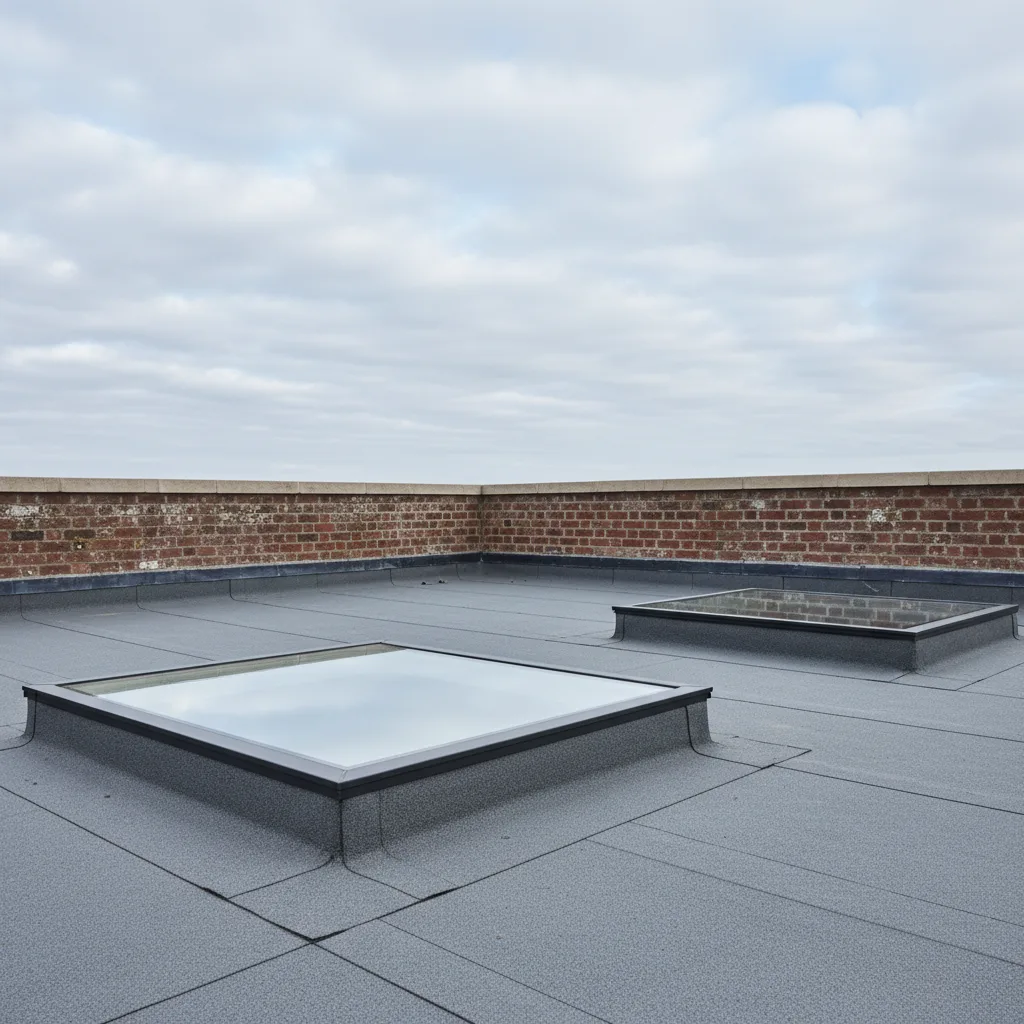
Build the fall into the kerb. The top of the kerb must be level for the lantern, but the roof around it does not have to be. Tapered firrings around the opening create local falls carrying water away.
Re-lay the roof to a proper fall if it is due for recovering anyway. Building Regulations expect a finished fall of at least 1:80, and most roofs are designed to 1:40 so they still clear it after deflection. If the covering is near the end of its life, doing both at once is far cheaper than doing them separately.
Reposition the lantern to where water does not naturally collect, which is sometimes possible and sometimes not.
What we will not do
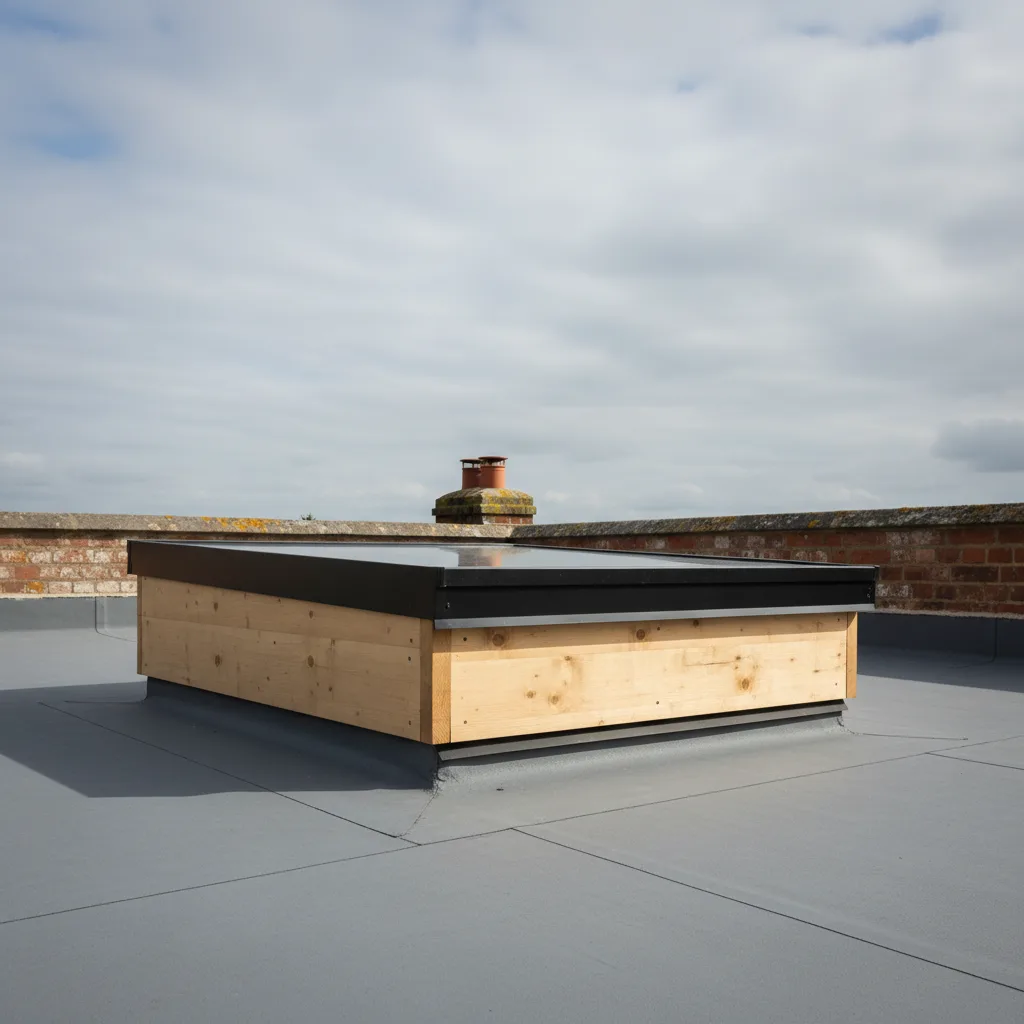
Fit a lantern into standing water and call it done. If the roof cannot be made to drain around the unit, we will say so and quote the work that makes it possible, rather than take the job and leave you a leak with a warranty argument attached.
Not until the fall is corrected

A lantern sitting on a roof with no fall is a lantern sitting in water after every shower, and standing water against a perimeter seal is what kills these installations early.
The design target for a flat roof is a minimum finished fall of 1 in 80, which in practice means designing to 1 in 40 so that deflection and workmanship tolerances do not leave a flat spot.
Why it matters more with a lantern

A flat roof membrane on its own is designed to be waterproof rather than merely water shedding, so it tolerates a certain amount of ponding.
A lantern introduces a kerb and a perimeter seal into that roof, and it introduces a much larger area of glass discharging water onto a small area of covering at the base. Both make standing water a problem where it was previously only untidy.
How it gets corrected

Locally around the kerb, using tapered insulation or firrings under a new deck section, so that water moves away from the opening and toward an outlet that actually runs.
On an older roof where the fall was never built in, that correction may extend beyond the immediate area of the opening, and it has to be priced rather than discovered on the day.
It is normal work, it belongs in the quotation, and it is far cheaper than replacing a lantern that has failed because it was sitting in water.
What raising the kerb does and does not do

Building the kerb higher buys margin: the seal sits further above whatever water collects. It does not solve the underlying problem, because water still stands on the roof, still soaks the covering and still freezes in winter.
It is a sensible additional measure and not a substitute for a fall.
The other question: can the roof carry it

A roof with no fall is frequently an older or self built one, and a lantern is heavy. The structure has to be checked as well as the drainage, and where joists are being cut a designed trimmer and possibly steel are needed.
Both questions are answered by the same survey.
If the roof is near the end of its life
Doing the covering and the lantern together is considerably cheaper than doing them separately, because the access, the setting up and the making good are shared, and the falls and the kerb can be designed as one job rather than one retrofitted into the other.
Why a flat roof should never actually be flat
Every flat roof needs a fall, because standing water is what ends flat roof coverings. Water sitting on a membrane accelerates its ageing, freezes and expands in winter, and finds every weakness in every joint.
Current guidance is that a flat roof should be designed with a fall sufficient to guarantee drainage after construction tolerances and deflection are taken into account, which in practice means designing to more than the theoretical minimum so the finished roof still drains.
A roof described as having no fall is either an old roof where the fall has been lost through deflection, or one that was built without one. Either way it is a problem that exists whether or not a lantern is added.
What the lantern does to it
A lantern sits on a kerb, and that kerb is an obstruction in the middle of the roof. Water that was moving slowly across the surface now has something to pond against.
On a roof with no fall, that means standing water permanently against the kerb upstand, which is precisely the condition that ends a waterproofing detail.
The right sequence
Fix the fall before fitting the lantern. On a warm roof that usually means tapered insulation, which creates the fall within the insulation layer and improves the thermal performance at the same time.
Doing it in the other order means the lantern goes in, the roof is recovered a few years later, and the lantern has to come out to do it.
More on Roof Lantern Installation
Ready to bring the daylight in?
Tell us about your project and we’ll send a clear, fixed written quote, no pressure, no surprises.
- Fixed written price before any work starts
- No pressure, no obligation, no sales calls
- Flexible survey times that suit you
- A reply within one working day