Can a sun tunnel be fitted to a flat roof?
Yes, with a raised collector on a small kerb, and flat roof installations often perform best.
Part of our Sun Tunnel Installation guide
Yes. Manufacturers make flat roof versions with the collector mounted on a small kerb rather than flashed into a pitched covering.
Why they often perform better

On a flat roof the ceiling below is usually directly beneath the roof, with only a shallow void between. So the run is short and straight, which is exactly what a sun tunnel wants.
A 250mm tunnel with a 400mm straight drop delivers a great deal more light than the same tunnel on a two metre run with two elbows through a pitched loft.
The kerb
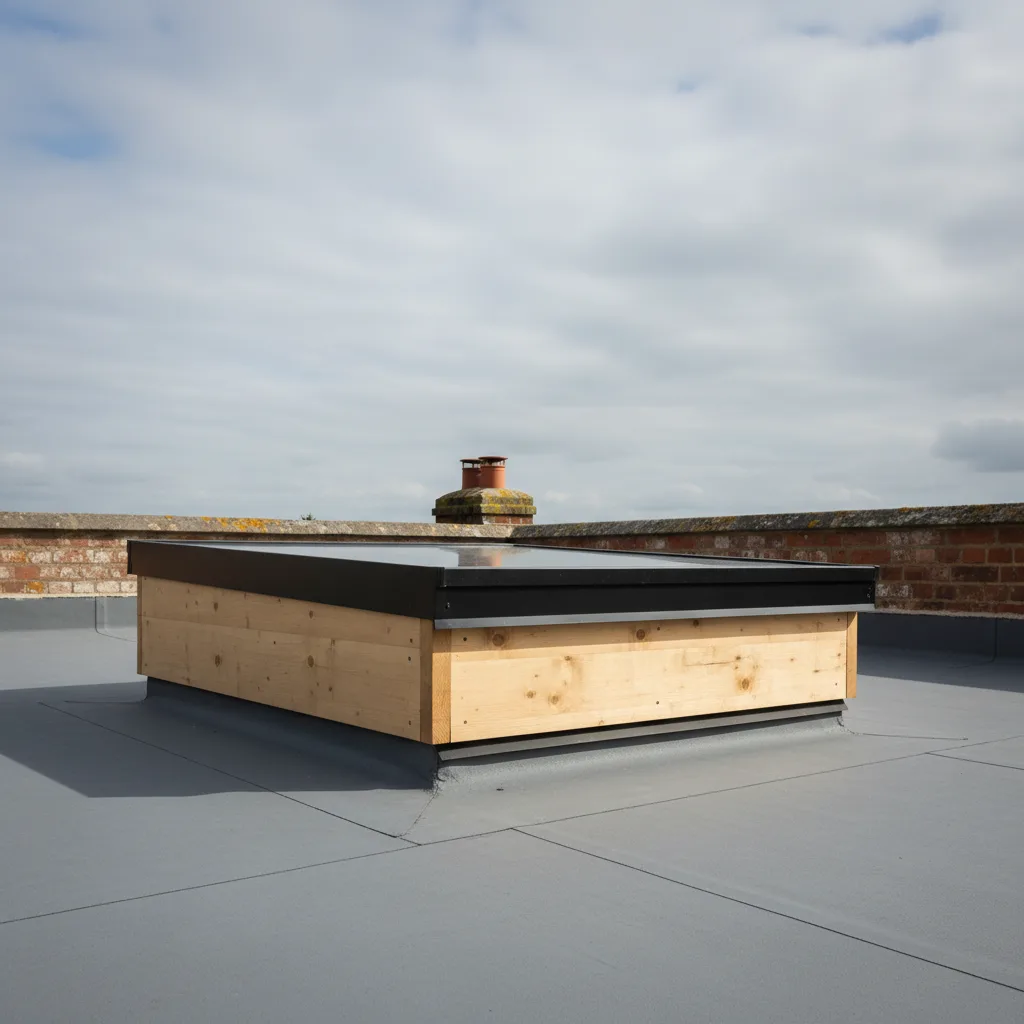
The collector sits on a small upstand so the roof covering can be dressed up it and terminated, exactly as with any flat roof rooflight. The same rules apply: adequate height, square, and positioned where water reaches it moving rather than ponding against it.
The collector shape

Usually domed on a flat roof, which gathers light from a wide angle including low morning and evening sun. On a flat roof that matters more than on a pitch, because a flat collector facing straight up gathers less at the ends of the day.
Warm and cold roofs

Same distinction as any flat roof rooflight. In a warm roof the kerb is insulated on its outer face so the perimeter is not a cold bridge. In a cold roof the ventilation path must not be blocked.
The short run means less tube in cold space, which reduces the condensation risk compared with a long pitched loft run.
Where it is useful

Internal rooms in single storey extensions, and flat roofed garages converted to habitable space where the plan leaves an internal room dark.
Where the room is directly under the flat roof and a rooflight would fit, a rooflight is the better answer. The tunnel is for where it will not.
Yes, with a flat roof kit

Manufacturers make flat roof versions of sun tunnels, with a dome or a low profile glazed top mounted on a small upstand rather than a pitched roof flashing.
The principles are the same as any flat roof rooflight: the upstand lifts the unit clear of standing water, the covering is dressed up it and terminated properly, and the unit sits on top with its own flange overlapping.
The upstand height

The detail that decides whether it lasts. Every flat roof holds some water, and a small dome bedded straight onto the deck sits in it after every shower.
The same 150mm working minimum applies as on a rooflight, with the deck falling away from it and an outlet that actually runs. On a green roof the upstand has to clear the growing medium as well, which means considerably more.
Why the run is usually short

Flat roofs are most often over single storey extensions, so the tunnel drops directly into the ceiling below. That is the ideal condition: a short straight run loses very little light, which is why flat roof tunnels frequently perform better than the same diameter in a two storey house.
What still applies
Rigid rather than flexible. A rigid mirrored tube reflects far better than a foil concertina, and on a short run it is easy to route.
Diameter decides output. It goes with area rather than width, so 350mm passes roughly twice the light of 250mm.
Insulation and sealing. On a warm flat roof the tube passes through insulated construction rather than a cold loft, which helps, and the vapour control layer still has to be carried up and sealed to the unit so moist air cannot get into the build up.
Dome or flat glazing
A domed top collects light from lower sun angles and sheds water better. A flat glazed top is more discreet, which matters where the roof is overlooked from an upper window or where planning is a consideration.
On a listed or conservation property, the flat low profile option is what an officer will want to see.
Where a rooflight would be better
If the room below has a ceiling directly under the flat roof and you want a view, ventilation or a lot of light, a small flat roof rooflight does more for a modest additional cost.
The tunnel earns its place where the light has to travel to a room that is not directly under the opening.
Yes, with a different top
The tunnel and the ceiling diffuser are the same. What changes is the roof end.
On a pitched roof the dome sits on a flashing that interleaves with the covering. On a flat roof it sits on a kerb, with the waterproofing dressed up the kerb and terminated into the unit, exactly as a flat rooflight would be.
Manufacturers make flat roof versions with the appropriate top assembly, and it is not an adaptation of the pitched product.
Why it works well here
The run is usually very short. On a flat roof over a single storey extension, the ceiling void is shallow, so the tunnel travels a short straight distance with no bends.
That matters enormously, because light loss increases with length and with every bend. A short straight run delivers far more light than a long dogleg through a loft.
The detailing that must be right
The kerb needs insulating on its outer face, continuous with the roof insulation, or it becomes a cold bridge in the middle of a warm ceiling.
The vapour control layer needs sealing to the tunnel where it passes through, so warm damp air from the room cannot get into the void or the tube.
And the falls have to take water past the kerb rather than into a dead corner beside it. A small obstruction on a roof with marginal fall still creates a pond.
The one thing to think about
A horizontal dome does not shed dirt the way a pitched one does, so it dulls faster. A domed rather than flat top helps, and so does a position that can be reached for occasional cleaning.
More on Sun Tunnel Installation
Ready to bring the daylight in?
Tell us about your project and we’ll send a clear, fixed written quote, no pressure, no surprises.
- Fixed written price before any work starts
- No pressure, no obligation, no sales calls
- Flexible survey times that suit you
- A reply within one working day