Snow and standing water on a flat rooflight
Both are designed for. Neither should be cleared by climbing onto the glass.
Part of our Flat Roof Rooflight Installation guide
Both are normal conditions and both are designed for. The question people are really asking is whether to do anything about them, and the answer is usually no.
Snow
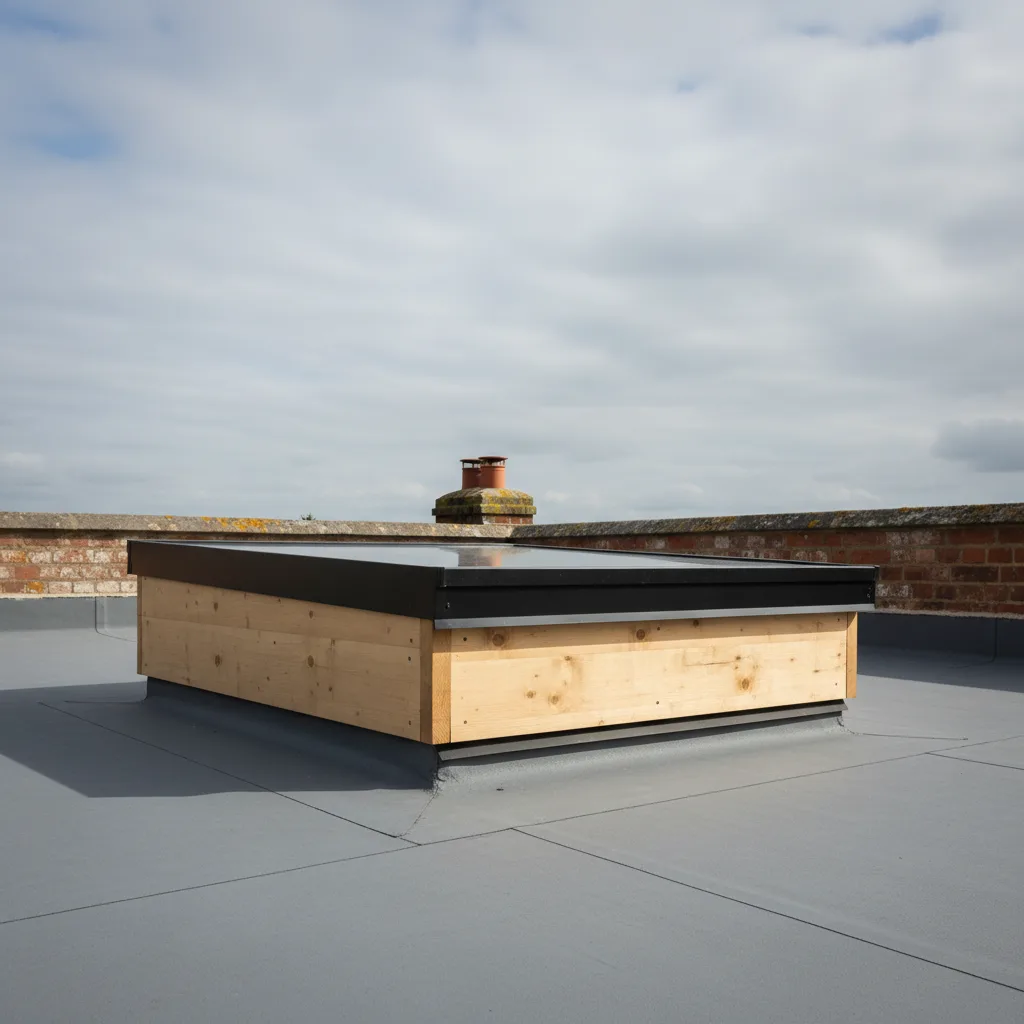
Rooflights are designed for the snow load appropriate to the location, and in Essex that is modest by national standards. A domestic unit will carry a substantial snow depth without difficulty.
What snow does that is worth knowing: it insulates. A rooflight under snow loses much less heat, so snow on a well insulated roof stays put rather than melting off, which is a good sign rather than a bad one.
Do not climb up to clear it. A standard rooflight is not a walk-on unit, and snow makes the surrounding roof surface treacherous. It will melt.
The exception is exceptional drifting against a wall or a lantern, where depth is well beyond anything typical. That is rare here and it is a conversation rather than a DIY job.
Standing water

A different matter. Water on the glass after rain is normal on a level unit and it evaporates. Water standing against the kerb hours after rain has stopped is not normal.
That means the roof is not draining around the unit: inadequate fall, a poor position, or a blocked outlet. It sits against the termination for days, it finds weaknesses, and its weight causes deflection which deepens the pond.
What to check

A few hours after heavy rain. Damp glass is fine. A pool against the upstand, or a tide mark showing where one sits, wants attention.
Ice

Ice on the glass is harmless. Ice in a blocked outlet is not, because it turns a drainage problem into a standing water problem for the duration of a cold spell. Clearing outlets before winter is the useful maintenance.
Snow is not the problem people expect

Rooflights are designed for snow load as part of their structural specification, and in this part of the country the loads are modest. A correctly specified unit will carry what an English winter puts on it without difficulty.
What matters more is what happens as it melts.
Melting and refreezing

A rooflight is warmer than the roof around it, because it loses more heat from the room below. Snow on the glass melts first, runs to the edge, and can refreeze at the perimeter where the surface is colder.
Ice sitting in the perimeter detail is a different loading case from water, and it is one more reason the deck needs to fall away from the kerb so meltwater has somewhere to go.
It also means a rooflight will frequently be the first clear patch on a snowy roof, which is normal rather than a sign of poor insulation.
Standing water, which is the real issue

Every flat roof holds some. The design target is a minimum finished fall of 1 in 80, designed at 1 in 40 so that deflection and tolerances do not leave a flat spot.
Where the deck does not fall away from the kerb, the unit sits in a puddle after every shower. A seal designed to shed water is not designed to be submerged, and over a few winters it works loose. That is the commonest cause of a leaking flat rooflight.
What to check on your roof

Look at it after rain. Where the water goes, and where it does not, tells you everything. Then check the outlet it drains to, because a perfect fall discharging into a gulley full of leaves and silt produces exactly the same pond.
Water on the pane itself
A truly flat unit will hold a film and, after heavy rain, small pools. That is normal and it clears by evaporation, leaving behind whatever it was carrying, which is why flat units get dirtier than pitched ones.
Where it bothers you, a unit with a built in pitch of around 5 degrees sheds water and dirt considerably better and looks almost identical from the ground.
Clearing snow
Do not walk on the roof to do it unless you know the rooflight is walk on specified, which most are not. Snow melts on its own and a rooflight that needs clearing is very unusual in this climate.
Snow is a design load, and it is accounted for
Rooflight datasheets give a distributed load capacity in kilonewtons per square metre, and snow is exactly what that figure describes: an even weight across the whole pane.
A correctly specified unit carries the snow load for its location without difficulty. The failures that do occur are usually not the glass but the surrounding structure, or a unit specified for a milder exposure than the site actually has.
Drifting is the case worth thinking about. Snow that blows against a kerb or a parapet builds much deeper than the general fall, and a rooflight in a corner where drifts collect sees a considerably higher load than one in the open.
Standing water is the real problem
Snow melts. Standing water stays, and it is what actually damages installations.
Water ponding against the kerb accelerates the ageing of the waterproofing, freezes and expands in winter working every joint, and provides a permanent wet environment for the perimeter seal.
The cause is nearly always inadequate fall, or falls arranged so that water is directed into a dead corner beside the rooflight rather than past it.
What to do about both
Get the falls right before the rooflight goes in, designing to more than the bare minimum so the finished roof still drains after deflection.
Keep outlets clear. A blocked outlet turns a well drained roof into a pond in one autumn.
And do not clear snow off a rooflight by climbing onto it. A distributed snow load is one thing; a person is a point load and a different case entirely.
More on Flat Roof Rooflight Installation
Ready to bring the daylight in?
Tell us about your project and we’ll send a clear, fixed written quote, no pressure, no surprises.
- Fixed written price before any work starts
- No pressure, no obligation, no sales calls
- Flexible survey times that suit you
- A reply within one working day