Does a rooflight need a vapour barrier?
The roof does, and it has to be sealed to the rooflight frame or the hole defeats it.
Part of our Replacing a Failed or Misted Rooflight guide
The roof needs one, and a rooflight puts a hole in it. Whether the installation is any good depends on how that hole is treated.
What it does

The vapour control layer stops warm moist air from inside the building entering the roof build up. In a warm roof it sits on the deck, below the insulation; in a cold roof, at ceiling level.
It only works if it is continuous.
What has to happen at the opening

The layer is cut, carried up the inside face of the kerb or the opening, and sealed to the underside of the rooflight frame with tape or a compatible sealant, forming a closed junction all the way round.
What happens when it is not

Warm moist air enters the build up at the perimeter, cools as it moves outward and condenses inside the insulation on the underside of the waterproofing.
That water then appears as a damp patch on the ceiling near the rooflight, or runs along a joist and shows up somewhere else entirely.
Why it is diagnosed wrongly

Because it presents exactly like a leak and the rooflight is the obvious suspect. The unit gets resealed, then replaced, and the damp continues, because the water was never coming from outside.
The test: rain leaks follow rain, condensation follows cold weather and internal humidity.
Where it matters most

Kitchens and bathrooms. A rooflight over a hallway tolerates a sloppy junction for years; one over a shower does not.
Retrofit

Where we cut into an existing warm roof we make good the junction as part of the work. Where the existing layer has failed generally, sealing perfectly around one opening solves very little, and we will say so.
Yes, and continuity is the whole point

A vapour control layer sits on the warm side of the insulation and stops moist air from inside the building passing into the construction, where it would reach a cold surface and condense inside the build up.
That kind of condensation, interstitial condensation, is worse than the sort you see on glass, because you do not see it. It shows up eventually as staining, damp insulation, or decayed timber.
Why a rooflight is a risk point
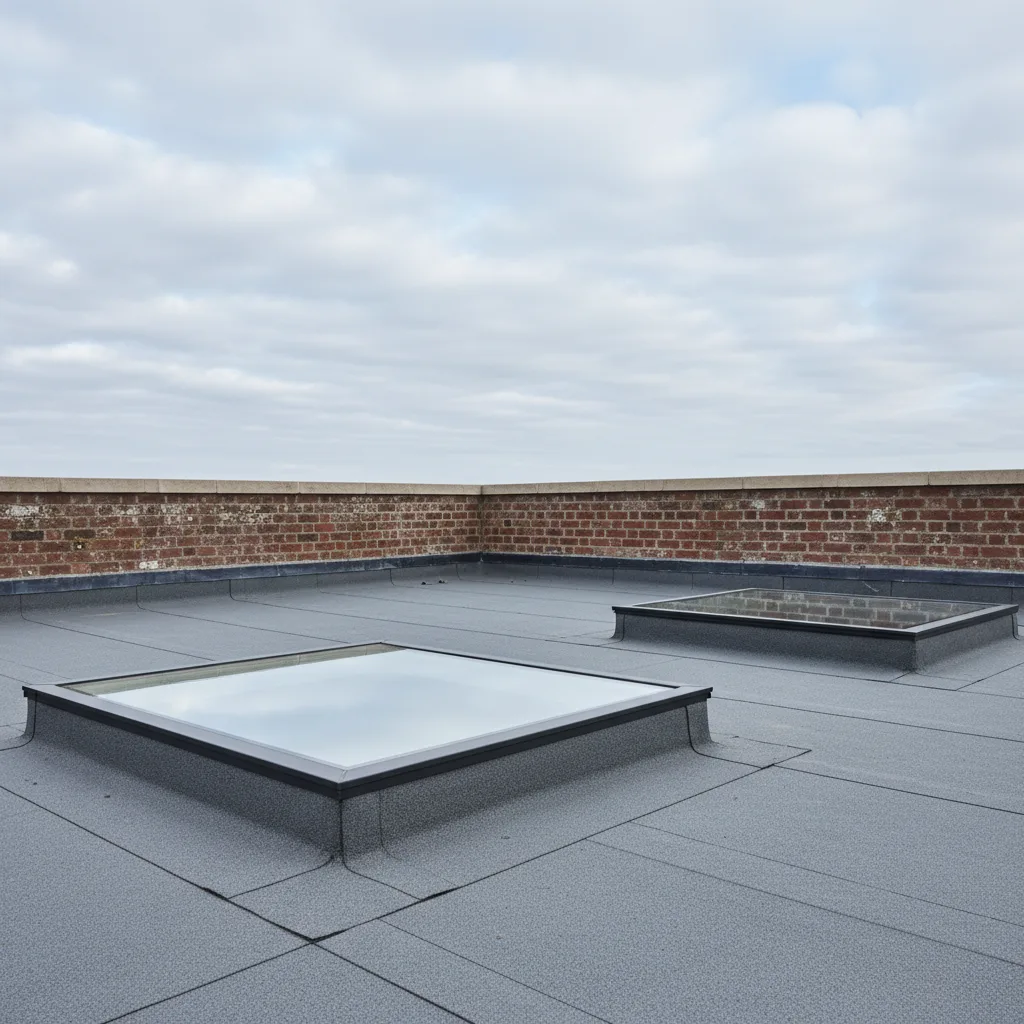
Because it is a hole in the layer. Wherever the vapour control layer is cut, it has to be brought back to the frame of the rooflight and sealed to it, so the barrier is continuous around the opening.
An unsealed edge is not a small defect. Air leakage carries far more moisture into a construction than diffusion through an intact membrane does, so a taped edge and a loose one behave very differently.
On a pitched roof
The vapour control layer runs behind the plasterboard on the warm side of the insulation. At the rooflight it is dressed to the frame and taped.
The insulation collar goes in alongside it, closing the gap between frame and structure. The two work together: the collar keeps the reveal warm, and the sealed vapour control layer stops moist air getting behind it.
Where the collar is missing, the reveal runs cold and condenses. Where the vapour layer is not sealed, moisture gets into the roof construction. Both are invisible at handover.
On a flat roof
The arrangement depends on whether it is a warm roof, with the insulation above the deck, or a cold roof with it between the joists.
On a warm roof, the vapour control layer sits below the insulation and above the deck, and it has to be carried up the kerb and sealed to the rooflight frame. Combined with insulation on the outer face of the kerb, that keeps the whole perimeter out of trouble.
Getting this wrong on a warm roof is how you end up with wet insulation, which is expensive and slow to discover.
What to ask
Whether the vapour control layer is being sealed to the frame, and on a flat roof whether the kerb is insulated on its outer face. Both are named lines on our quotations rather than assumptions.
They are the sort of detail nobody can check once the job is finished, which is exactly why they are worth asking about before it starts.
What it is and where it sits
A vapour control layer is a sheet on the warm side of the insulation whose job is to stop moist internal air getting into the construction, where it would meet cold surfaces and condense.
It is not a waterproofing layer and it is not a draught seal, though it helps with the second. It controls moisture moving from inside outward.
Why the rooflight is the weak point
Because the layer has to be interrupted to make the opening, and then reconnected around it.
That means it is carried around the reveal, up the inside face of the kerb on a flat roof, and taped to the rooflight frame continuously all the way round. Every corner, every overlap, every service penetration nearby.
Where it is not sealed to the frame, warm humid air from the room travels straight into the coldest part of the construction and condenses there, inside the build up, where nobody can see it. Over a few winters that rots timber silently.
The symptom that identifies it
Damp appearing around a rooflight in cold weather without rain. That is not a leak, and chasing it on the roof will not find anything.
A leak follows rain. Interstitial condensation follows temperature.
How to be sure it was done
Photographs, taken before the plasterboard goes on. Ask for them.
It is a cheap detail, it takes minutes, and it is entirely invisible afterwards, which is precisely why it gets skipped. A photograph of taped, continuous vapour control at the frame is the only record that will exist.
Downlighters cut into a ceiling around a rooflight puncture the same layer. A ring of them is a genuine problem, not a theoretical one, and they need sealed fittings.
More on Replacing a Failed or Misted Rooflight
Ready to bring the daylight in?
Tell us about your project and we’ll send a clear, fixed written quote, no pressure, no surprises.
- Fixed written price before any work starts
- No pressure, no obligation, no sales calls
- Flexible survey times that suit you
- A reply within one working day