How is a rooflight made watertight?
By overlapping layers that shed water, not by sealant. If sealant is doing the work, it is wrong.
Part of our Replacing a Failed or Misted Rooflight guide
By lapping, in the same way a roof is. Each layer directs water onto the layer below it, all the way to the gutter. Sealant is a secondary detail, never the mechanism.
On a pitched roof

Four elements, working together.
The apron at the bottom carries water from the window onto the covering below.
Soakers up each side are interleaved with the covering course by course, so water running down the roof is directed around the opening.
The head flashing above takes water from the covering and pushes it to the sides.
The underlay collar connects the roofing membrane to the frame, so anything that gets past the tiles, which in driving rain is a surprising amount, is carried around the opening and back onto the membrane below.
The kit must match the covering profile. A flat kit on a profiled tile leaves a gap under every roll.
On a flat roof

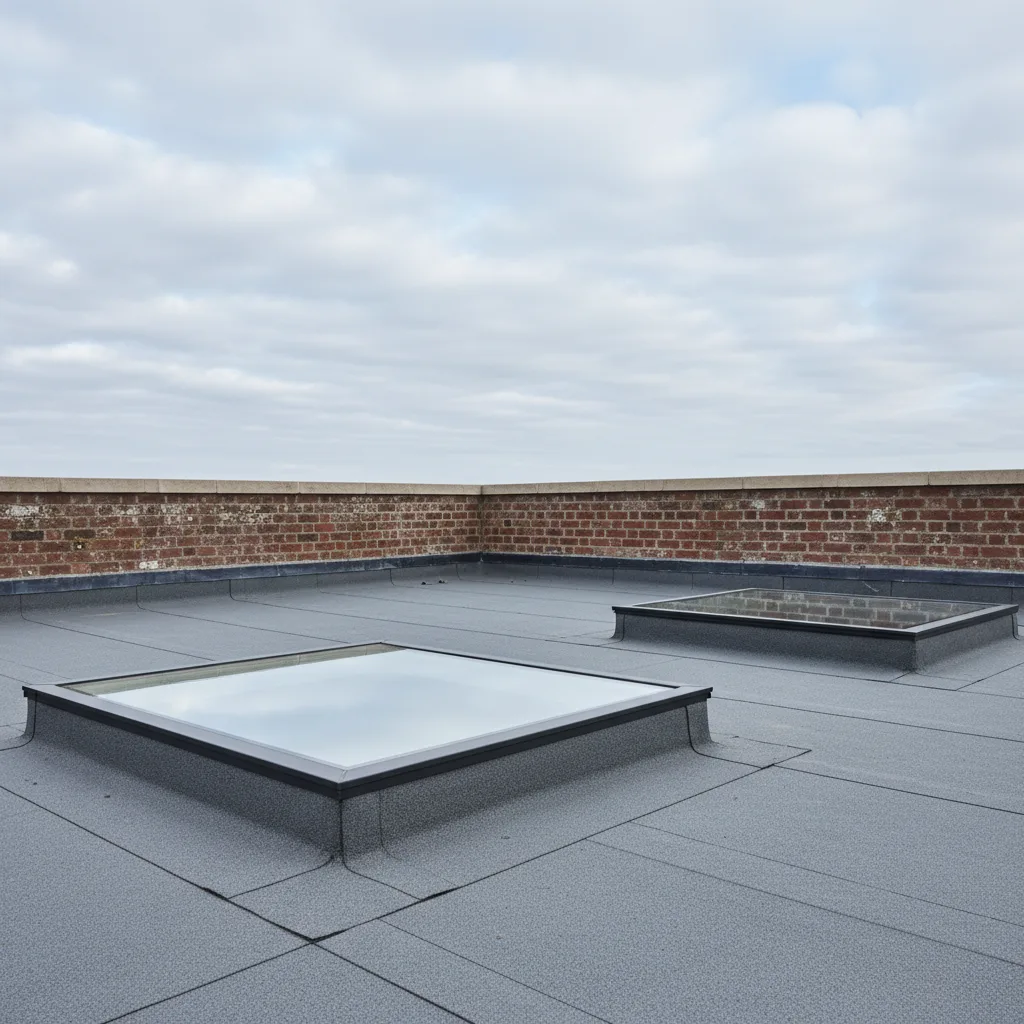
The unit sits on a kerb standing proud of the water line. The covering is dressed up the full height of that kerb and terminated under the frame flange.
So water crossing the roof is directed around the base of the kerb by the fall and never reaches the joint at all.
Where sealant belongs

As a secondary seal at frame junctions, not as the waterproofing. A detail that relies on sealant will fail when the sealant does, which is a matter of years.
If somebody is fixing a leaking rooflight with a tube of sealant, they are treating a symptom.
Why position matters

All of this assumes water arrives moving. A unit sitting in standing water defeats every detail above, because the water is present for days rather than seconds and it will find any imperfection.
Three components and one sequence

A rooflight does not keep water out by being sealed to the roof. It keeps water out by being layered into it, so that water reaching any level is carried away and downhill rather than stopped.
Three components do that work, and the order they go in matters as much as the components themselves.
1. The underlay collar

Every tiled or slated roof has a membrane beneath the covering, and some water always gets past tiles in driving rain. That water runs down the membrane, and if the membrane simply stops at the opening it funnels straight in.
The underlay collar is dressed and lapped so the membrane above the window drains onto the collar, the collar carries the water around the opening, and it discharges onto the membrane below. Get the laps the wrong way round and the roof delivers water into the opening rather than past it.
This is invisible once the covering is back, and it is where a great many leaks originate.
2. The flashing kit

Metal components sealing the junction between the window and the covering: an apron at the sill, side sections or soakers up each side, and a head flashing at the top.
The profile is matched to the covering and they are not interchangeable. A flat kit intended for slate, fitted to a profiled interlocking tile, leaves open voids under the tile channels where it crosses them, and water gets under within a season.
That is the most common installation fault we find on other people’s work, and it is exactly where a cheap quotation economises.
3. The covering
Reinstated over the flashing, never under it. Water runs down the tiles onto the flashing and off it; reverse that and it runs under the flashing and into the roof.
Reversing the sequence is a guaranteed leak and it happens more often than it should on rushed work.
Flat roof weathering
The same principle in a different form. The kerb lifts the unit clear of standing water, the roof membrane is dressed up the full height of the kerb and terminated properly, and the rooflight sits on top with its own flange overlapping that termination.
Water landing on the glass runs onto membrane rather than into a joint. The 150mm kerb height, and a deck falling away from it, are what give that arrangement its margin.
What is not doing the work
Sealant. A properly detailed rooflight does not depend on it, and a rooflight that needs a bead of sealant to stay dry is one that has not been detailed correctly.
Four layers, working in order
Weathering a rooflight is not one seal. It is a sequence, and each layer catches what the one above it misses.
The covering. Tiles or slates, or the membrane on a flat roof. The primary barrier, shedding the great majority of water by gravity.
The flashing. Interleaved with the covering around the opening, turning water away from the frame and back onto the roof. Profile specific: a flat kit for slate, a deep profile kit for pantile. The wrong profile leaves voids that driven rain finds.
The underlay collar. On the membrane below the covering, dressed and lapped so water that does get past the covering passes around the opening and continues down the roof rather than arriving at the hole.
The unit seal. The gasket between sash and frame on an opening unit, or the bonded edge on a fixed one.
The sequence is the whole thing
Underlay collar first, then the flashing, then the covering reinstated over the flashing rather than under it.
Every layer laps over the one below in the direction water travels. Reverse any one of those laps and water is being asked to climb, which it will not do reliably and will not do at all in wind.
The kerb detail on a flat roof
The waterproofing is dressed up the kerb and terminated into the unit, with the unit set on afterwards. Membrane first, unit second, any deck build up third.
A membrane dressed over the top of an installed unit runs the wrong way and cannot be corrected without lifting everything.
What sealant is not for
Sealant. A bead of silicone is a detail finish, not a weathering strategy, and any installation relying on one is temporary.
More on Replacing a Failed or Misted Rooflight
Ready to bring the daylight in?
Tell us about your project and we’ll send a clear, fixed written quote, no pressure, no surprises.
- Fixed written price before any work starts
- No pressure, no obligation, no sales calls
- Flexible survey times that suit you
- A reply within one working day