Single ply, felt and GRP roofs around a rooflight
Three coverings that terminate at a kerb in three different ways, and one of them is much harder to alter later.
Part of our Flat Roof Rooflight Installation guide
The covering decides how the kerb is weathered, how a retrofit is done, and how easy it is to make a good joint years later. It is worth knowing which you have.
Single ply membrane

A sheet membrane, usually PVC or TPO, mechanically fixed or adhered, with joints hot air welded.
The best of the three to work with. It is dressed up the kerb and terminated under the frame flange, and a new joint can be welded into existing membrane cleanly. Retrofitting a rooflight into a single ply roof produces a joint as good as the original.
Torch-on felt
Reinforced bitumen membrane in two or three layers, bonded with heat.
Robust, well understood, and straightforward to detail at an upstand. New work bonds to old reasonably well provided the surface is sound and clean. On an older felt roof the top layer may be weathered enough that a new bond is less reliable, and at that point recovering is the honest recommendation.
GRP, or fibreglass

A glass fibre mat laid in resin and cured in place, forming a single continuous shell with no joints.
Excellent when new. The difficulty is alteration. Cutting into a cured GRP roof and bonding new to old produces a joint that is chemically weaker than the original monolithic layer, because the existing resin has fully cured. GRP also moves differently from timber with temperature, and a poorly made joint is where cracking starts.
Retrofitting a rooflight into GRP is entirely possible and it is the covering where we are most likely to say the roof would be better recovered than patched, particularly if it is more than a few years old.
Asphalt
Occasionally found on older properties. Durable, heavy, and specialist to work with. Fewer contractors handle it and that is reflected in cost.
The practical point

If you are building a new flat roof and think you might add a rooflight later, single ply gives you the most options. If you have GRP and want a rooflight, budget for the possibility that the roof wants recovering rather than cutting.
Four coverings, one principle
Flat roofs in this area are finished in one of four systems, and a rooflight can go into all of them. The principle is identical in every case: the covering is dressed up the full height of the kerb and terminated properly, and the unit sits on top with its flange overlapping that termination, so water landing on the glass runs onto membrane rather than into a joint.
What varies is how each system is terminated, what it is compatible with, and how it behaves when it is disturbed.
Built up and torch on felt

The traditional covering and still very common on extensions and garages across the district.
The membrane is dressed up the kerb and finished under a welted edge or a trim. On a torch on system the upstand is bonded with heat, and around a rooflight that creates a fire risk near combustible material and near the unit itself.
Competent roofers work cold close to the frame or use a heat resistant detail there, and that is worth confirming rather than assuming.
Compatibility matters. Bitumen reacts badly with certain plastics and some sealants, and a rooflight system detailed for single ply may need a different arrangement on felt. It is a specification question and one reason we survey.
Age is the real issue. Older built up felt becomes brittle. On a roof approaching the end of its life, disturbing it around an opening will crack it well beyond the working area, and dressing a new termination into failing material is not a repair.
Where a felt roof is over fifteen years old and a rooflight is being considered, price both together. The access, the setting up and the making good are shared, and the falls, the kerb and the covering can be detailed as one job rather than one retrofitted into the other.
Single ply membranes
PVC, TPO and similar. Now the default on new flat roof work and increasingly common on recovering.
The upstand is welded rather than bonded with heat from a torch, which is a cleaner and safer detail around a rooflight, and the terminations are neat.
Most single ply manufacturers publish details for rooflight upstands, and following them matters, because the systems are approved as systems rather than as materials. A weld done to the manufacturer’s detail is covered by their warranty; an improvised termination is not.
Compatibility again. PVC in particular reacts with certain materials, including some plastics and some bitumen based products. Where a roof was previously felt and is being partly recovered in single ply, that junction needs designing.
Single ply is thin, which makes it easy to work with and easy to damage. Debris under it during installation, or a dropped tool, is a puncture rather than a dent.
GRP, glass reinforced polyester

Laid wet as a laminate over a plywood deck and cured in place, forming a seamless surface. Popular on smaller extensions and garages, and it produces a hard, rigid finish.
Around a rooflight the laminate is taken up the kerb and terminated at a trim. Because it is applied wet and cures rigid, the detail has to be got right first time: it is not a system you can lift and re dress.
Two characteristics matter at a rooflight.
It does not tolerate movement. GRP is rigid and the deck beneath it has to be stiff enough not to flex, particularly around an opening where the structure has been cut and trimmed. Deflection produces cracking, and cracking in GRP is a repair rather than a re dress.
Cutting into an existing GRP roof to form a new opening means grinding through a cured laminate and then bonding a new termination to it. That is a specialist operation and it is done by a GRP installer rather than improvised.
On a GRP roof it is worth having the roofing contractor and the rooflight installer talk before either starts.
Liquid applied systems
Polyurethane and similar, painted or rolled on and curing to a seamless membrane, frequently used for detailing and for recovering.
They excel around complex shapes, which makes them useful at a rooflight upstand, and they are the usual answer for detailing around an awkward existing kerb.
Substrate preparation is everything: they bond to what is beneath them, so a contaminated or damp substrate produces a failure that is not visible until it lifts.
Green roofs

Not a covering in themselves but a build up over one, and the rooflight detail changes fundamentally.
The effective surface level is the top of the growing medium, not the deck, so the kerb has to clear the substrate depth plus the usual 150mm margin. On a sedum roof with 80mm of substrate that is 230mm or more, and considerably more on a deeper build up.
A vegetation free margin of gravel or paving around the kerb, typically 300mm or more, keeps roots and growing medium off the upstand, allows the flashing to be inspected, and gives somewhere to stand when cleaning the glass.
A root resistant membrane is standard in the build up and it has to continue correctly at the upstand rather than stopping short.
What applies to all of them
Kerb height: at least 150mm above the finished surface, measured from the finished surface rather than the deck.
Fall: the deck falling away from the kerb, to an outlet that runs. Standing water against a perimeter seal is the commonest cause of a failed flat roof rooflight whatever the covering is.
Insulation on the outer face of the kerb, continuous and lapped into the roof insulation.
A vapour control layer sealed to the frame, carried up the kerb on a warm roof.
Sequence: covering up the kerb and terminated first, then the unit on top.
Recovering while you are there

Worth raising as a genuine option rather than an upsell.
Where a covering is more than about fifteen years old, doing it at the same time as the rooflight is considerably cheaper than doing them separately, because the access, the setting up and the making good are shared.
It also allows the falls to be corrected properly, the kerb to be formed and insulated as part of the build up rather than retrofitted into it, and the whole roof to be detailed as one system rather than two.
If your flat roof is approaching the end of its life and you are considering a rooflight, ask for both to be priced together before deciding. It is frequently a smaller step than people expect, and it removes the awkward outcome of a new unit sitting in a covering that gets replaced three years later.
Three systems, three ways of terminating
Built up felt. Layers of bitumen membrane bonded together. At a rooflight the layers are dressed up the kerb and terminated into the unit, each lapped correctly. On a torch on system that means heating and bonding the upstand detail properly rather than improvising around a unit already fixed.
Single ply. A sheet membrane, mechanically fixed or adhered, with joints welded rather than bonded with bitumen. At a rooflight the membrane is welded to a preformed corner or a purpose made flashing piece, and the quality of that weld is the detail.
Single ply corners are the place these roofs fail, because a corner is a three dimensional weld and it is harder than a flat seam.
GRP. Glass reinforced polyester laid wet and cured in place, forming a continuous seamless layer. At a rooflight the laminate is taken up the kerb and terminated, and because it cures as one piece there is no lap to run the wrong way.
GRP is unforgiving of movement and of application conditions. It needs a dry day and a competent applicator, and cracks at movement joints are its characteristic failure.
What is common to all three
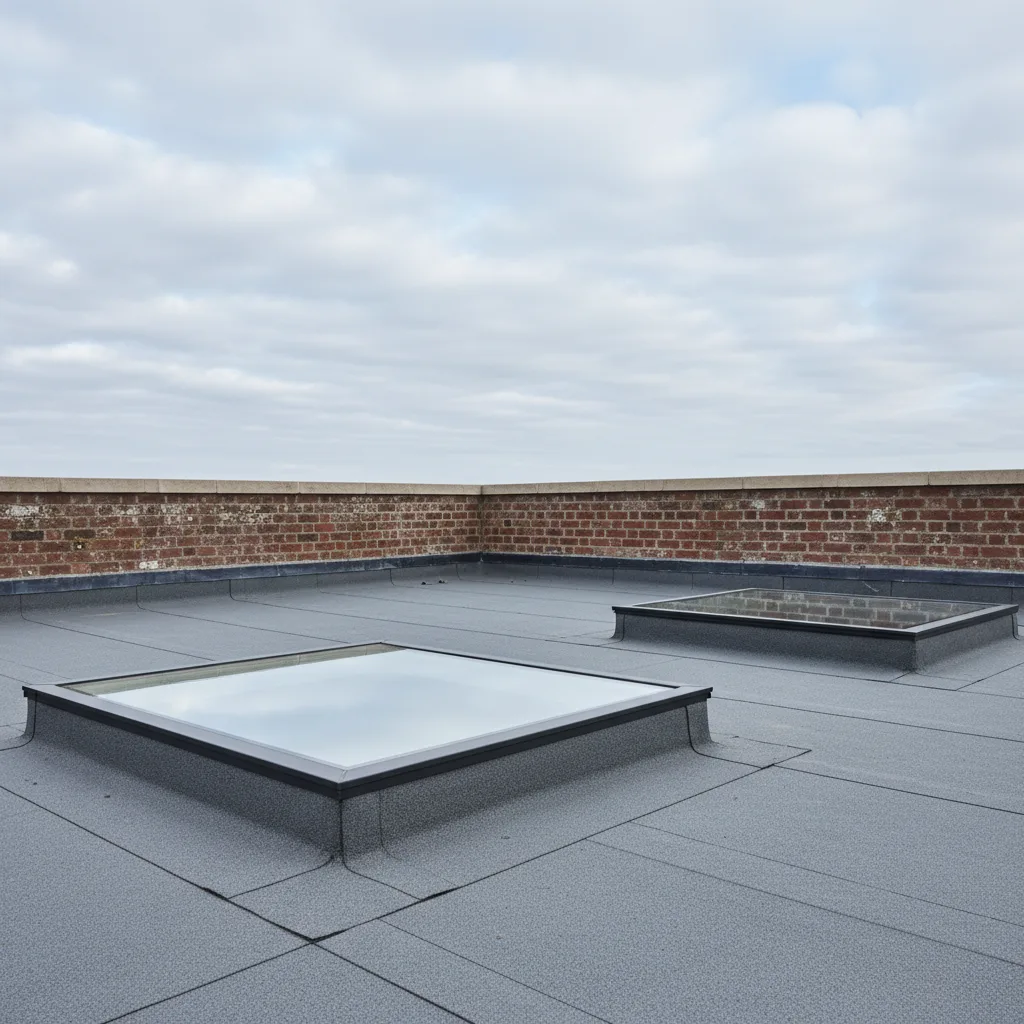
The sequence. Kerb built, square, level and insulated. Waterproofing dressed up the kerb and terminated. Then the unit set on and sealed.
Waterproofing dressed over the top of an already installed unit runs the wrong way and cannot be corrected without stripping back.
The question to ask before any of it
How old the covering is.
Cutting a new opening and forming a new detail in a covering with a few years left means the rooflight comes out again when the roof is recovered.
Where the covering is due, do both together. The detail is then formed as part of a new roof rather than patched into an old one, and it costs less than doing them separately.
Compatibility
Materials matter here. Some membranes are not compatible with some insulations or sealants, and a solvent or plasticiser migrating between materials degrades one of them over years.
Use the system manufacturer detail and their approved components rather than mixing products because they were on the van.
Fall, in every case
A kerb is an obstruction in the water path. On a roof with marginal fall, water ponds against it permanently, and standing water ends all three of these systems.
Correct the fall first with tapered insulation or firrings, because doing it afterwards means the unit comes out.
More on Flat Roof Rooflight Installation
Ready to bring the daylight in?
Tell us about your project and we’ll send a clear, fixed written quote, no pressure, no surprises.
- Fixed written price before any work starts
- No pressure, no obligation, no sales calls
- Flexible survey times that suit you
- A reply within one working day