Falls, drainage and standing water around a rooflight
Flat roofs are not flat, and where the rooflight sits in the flow decides whether it lasts.
Part of our Flat Roof Rooflight Installation guide
Every flat roof is laid to a fall so water leaves it. Building Regulations expect a finished fall of at least 1:80, and because timber deflects over time most roofs are designed to 1:40 so the finished fall still clears the minimum once everything has settled.
What a rooflight does to that

A rooflight sits on a kerb standing proud of the surface, which is an obstruction in the path of water crossing the roof. Water arriving at the upslope face has to get around it.
On a well laid roof with a rooflight positioned sensibly, that happens without thought. On a shallow roof, or a wide unit sitting square across the flow, water slows, spreads and ponds along the upslope edge.
Why ponding matters
Standing water is the enemy of any termination detail. It sits against the covering where it turns up the kerb, it works into any pinhole or lap, and it is present for days rather than minutes.
It is also heavy. A hundred millimetres of ponded water over a couple of square metres is a substantial load, and it causes further deflection, which deepens the pond. That feedback is why a small ponding problem gets worse rather than staying constant.
Position, not product

The fix is almost always positional. A rooflight placed where water reaches it already moving, with the long axis running with the fall rather than across it, sheds water past itself.
Where the ideal position for light and the sensible position for drainage differ, that is a real trade and we will explain it rather than quietly choosing one.
Where there is no fall
Older roofs that have settled, or roofs laid without firrings, sometimes have effectively none. The answer is to build local falls into the roof around the opening with tapered firrings, so water is directed away from the kerb even though the wider roof is flat.
What we will not do is set a unit into standing water and call it finished.
Outlets

Worth checking at the same time. A rooflight added to a roof with one outlet may sit between the outlet and half the roof area, and blocked or undersized outlets cause ponding that gets blamed on the new unit.
The single commonest cause of a failed flat rooflight
Not the glass, not the frame, and not the fixing. Water standing against the perimeter seal.
A sealed unit’s perimeter seal is designed to shed water. It is not designed to be submerged, and sitting in a puddle after every shower works it loose over a few winters. That is why units on badly drained roofs fail at ten or twelve years where units on well drained ones reach twenty five.
Everything in this guide follows from that one fact.
What the fall should be

The design target for a flat roof is a minimum finished fall of 1 in 80.
In practice a roof is designed to 1 in 40, because deflection in the structure, tolerances in the joinery and workmanship variation all eat into the theoretical figure. Designing to the minimum leaves you with flat spots, and flat spots are where water sits.
The word finished matters. A fall measured on a bare deck is not the fall you end up with once insulation, membrane and any deflection under load are accounted for.
Direction matters as much as amount
The deck must fall away from the kerb, not toward it.
A roof with a perfectly adequate overall fall can still pond against a rooflight if the unit sits on the low side of the slope, or if the kerb interrupts the drainage path and creates a dead area behind it.
Where a kerb sits across the direction of fall, water arriving from upslope has to get around it. The detail should let it, and where it does not the upslope side of the kerb becomes a permanent puddle.
That is one of the arguments for positioning a rooflight toward the high side of a roof rather than the low side, and it is worth raising at design stage rather than accepting a position chosen for the room below alone.
The outlet

A fall is only as good as where it drains to.
A perfect 1 in 40 discharging into a gulley full of leaves and silt produces exactly the same pond as no fall at all. So does an outlet that has been overwhelmed by a roof area larger than it was sized for, or one that has settled.
Check the outlet before assuming anything is wrong with the roof or the rooflight. It costs nothing and it is the first thing to eliminate.
On a plot with trees, clearing it twice a year is the single most valuable maintenance job on the whole roof.
How to read your own roof
Look at it after rain, or an hour after rain stops.
Where water has gone, and where it is still sitting, tells you everything you need before anybody quotes. Ponding is visible as a dark patch, a tide line of silt, or a green algae bloom in a defined shape.
Ponding anywhere near the proposed opening is a problem to solve before the rooflight rather than after, and it is why we will not price a flat roof rooflight from a photograph taken from the ground.
Correcting a poor fall

Locally around the kerb, using tapered insulation or timber firrings under a new deck section, so water moves away from the opening toward an outlet that runs.
It is normal work, it belongs in the quotation, and it is far cheaper than replacing a unit that has failed because it was sitting in water.
On an older roof where the fall was never built in, that correction may extend beyond the immediate area of the opening. That has to be priced rather than discovered on the day, which is another reason for a survey.
What raising the kerb does and does not do
Building the kerb higher buys margin: the seal sits further above whatever water collects, and on a roof with marginal falls that is worth doing.
It does not solve the underlying problem. Water still stands on the roof, still soaks the covering, still freezes in winter, and still shortens the life of the membrane.
It is a sensible additional measure and not a substitute for a fall.
Water on the pane itself

A separate matter and worth distinguishing.
A truly flat unit holds a film and, after heavy rain, small pools. That is normal rather than a fault, and it clears by evaporation, leaving behind whatever the water was carrying.
That is why flat units get dirtier than pitched ones, and why self cleaning glass does very little on them: the coating relies on rain sheeting off to carry deposits away, and on a flat pane it does not sheet.
Where it bothers you, a unit with a built in pitch of around 5 degrees, achieved in the frame or by building the kerb higher on one side, sheds water and dirt considerably better and looks almost identical from the ground.
The trade is that a pitched unit collects slightly more direct midday sun, which argues for solar control glass on a south facing installation. That is worth having on a substantial flat rooflight anyway.
Flush and walk on units, where the rules change
A walk on rooflight sits flush with the surrounding surface, because a raised kerb in a walking route is a trip hazard. That removes the 150mm defence entirely.
Everything then depends on the surrounding surface falling away from the unit and a perimeter drainage channel discharging into a working outlet.
Because that protection is dynamic rather than static, maintenance matters more here than anywhere. A 150mm kerb keeps working while you ignore it; a drainage channel does not. Leaves, silt and grit collect in it, and a blocked channel produces exactly the standing water the design existed to prevent.
Twice a year on a plot with trees, annually otherwise, and check the outlet at the same time.
Snow and ice
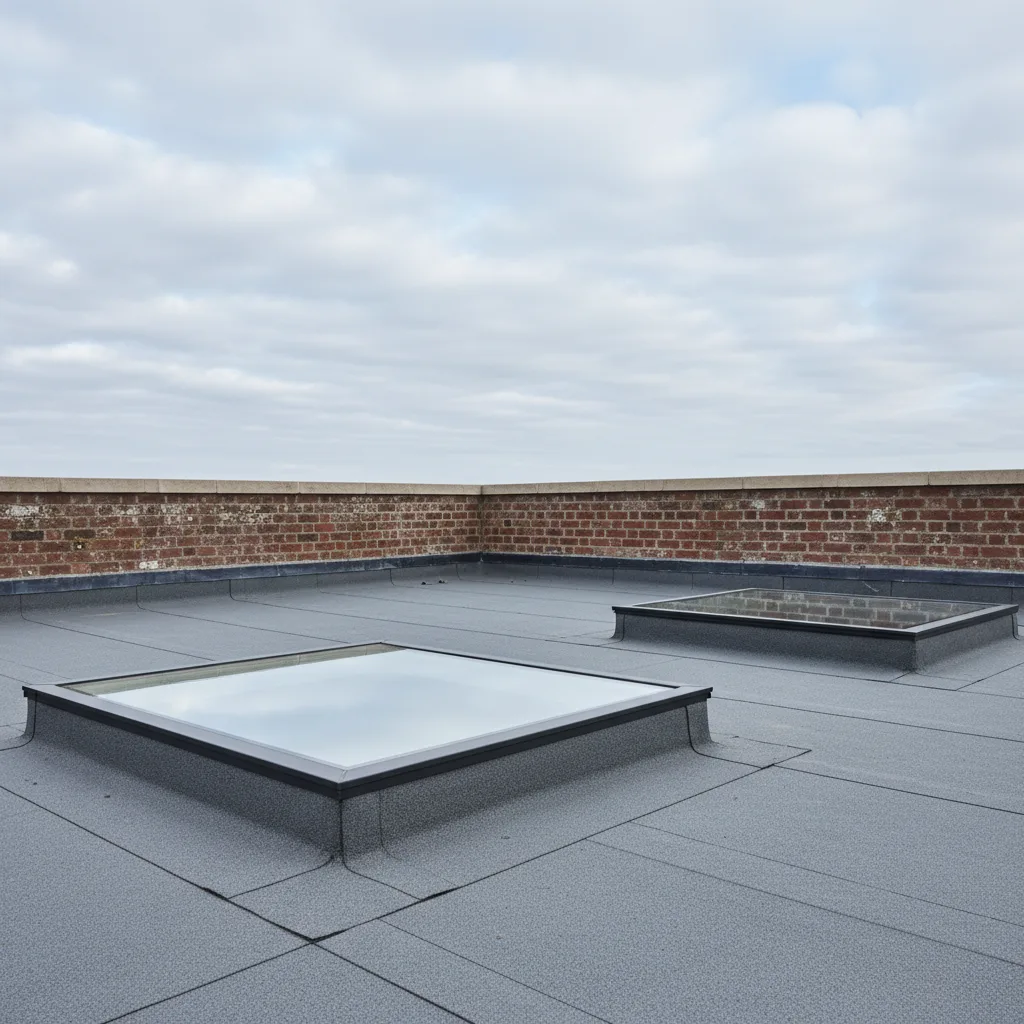
A rooflight is warmer than the roof around it, because it loses more heat from the room below. Snow on the glass melts first, runs to the edge, and can refreeze at the perimeter where the surface is colder.
Ice sitting in the perimeter detail is a different loading case from water, and it is one more reason the deck needs to fall away from the kerb so meltwater has somewhere to go.
It also means a rooflight will frequently be the first clear patch on a snowy roof, which is normal rather than a sign of poor insulation.
What to establish before ordering
Which way the roof falls and where the water goes. Whether the outlet runs. Whether there is an existing kerb and how high it is. And whether any correction to the falls is included in the price or excluded from it.
Those four questions decide more about whether a flat roof rooflight lasts twenty five years than the choice of unit does.
Design fall and finished fall
The distinction that explains most flat roof failures.
Guidance sets a minimum finished fall, and then advises designing to roughly double it, because construction tolerances, timber deflection and long term settlement all eat into the gradient you drew.
A roof designed to the bare minimum will not achieve the minimum once built and loaded. It will have flat spots, and flat spots hold water.
What standing water does
Accelerates the ageing of the waterproofing, because a membrane permanently wet degrades faster than one that dries between showers.
Freezes and expands in winter, working every joint and every termination.
Keeps the rooflight perimeter seal wet permanently, which is what ages it fastest.
And grows algae and organic matter that holds more water and traps debris.
Why the rooflight makes it worse
The kerb is an obstruction in the middle of the water path. Water that was moving slowly across the roof now has something to pond against.
So the falls have to be arranged to take water past the rooflight to an outlet, not merely to have a gradient somewhere on the roof.
That is a layout question as much as a gradient one, and it should be drawn rather than left to the roofer on the day.
The classic failure is a rooflight positioned so that the area upslope of it drains into a dead corner beside the kerb with nowhere to go.
Achieving the fall
On a warm roof, tapered insulation creates the gradient within the insulation layer. It is the standard modern answer, it does not raise the structure, and it improves thermal performance at the same time.
On an existing roof where the fall has been lost through deflection, firrings on top of the deck are the usual remedy.
Either way, it happens before the rooflight goes in. Correcting it afterwards means the unit comes out.
Keeping outlets running
A blocked outlet turns a well drained roof into a pond in one autumn.
They need to be accessible, they need leaf guards where there are trees, and they need checking. Pour a bucket of water in and watch it go.
Where there is one outlet and it is critical, an overflow is worth having, because it announces a blockage before the water reaches the kerb.
What to look for after heavy rain
Where puddles form, and whether they form in the same place every time. A repeating puddle is telling you the fall is wrong there, and it is far cheaper to correct while it is still a puddle.
More on Flat Roof Rooflight Installation
Ready to bring the daylight in?
Tell us about your project and we’ll send a clear, fixed written quote, no pressure, no surprises.
- Fixed written price before any work starts
- No pressure, no obligation, no sales calls
- Flexible survey times that suit you
- A reply within one working day