Flat rooflights over a bathroom or wet room
The wettest air in the house meeting the coldest surface in the room. Detailing and ventilation matter more here than anywhere.
Part of our Flat Roof Rooflight Installation guide
A rooflight over a bathroom is a good idea, particularly in an internal bathroom with no window. It is also the hardest environment in the house for one, and it rewards getting three things right.
Condensation
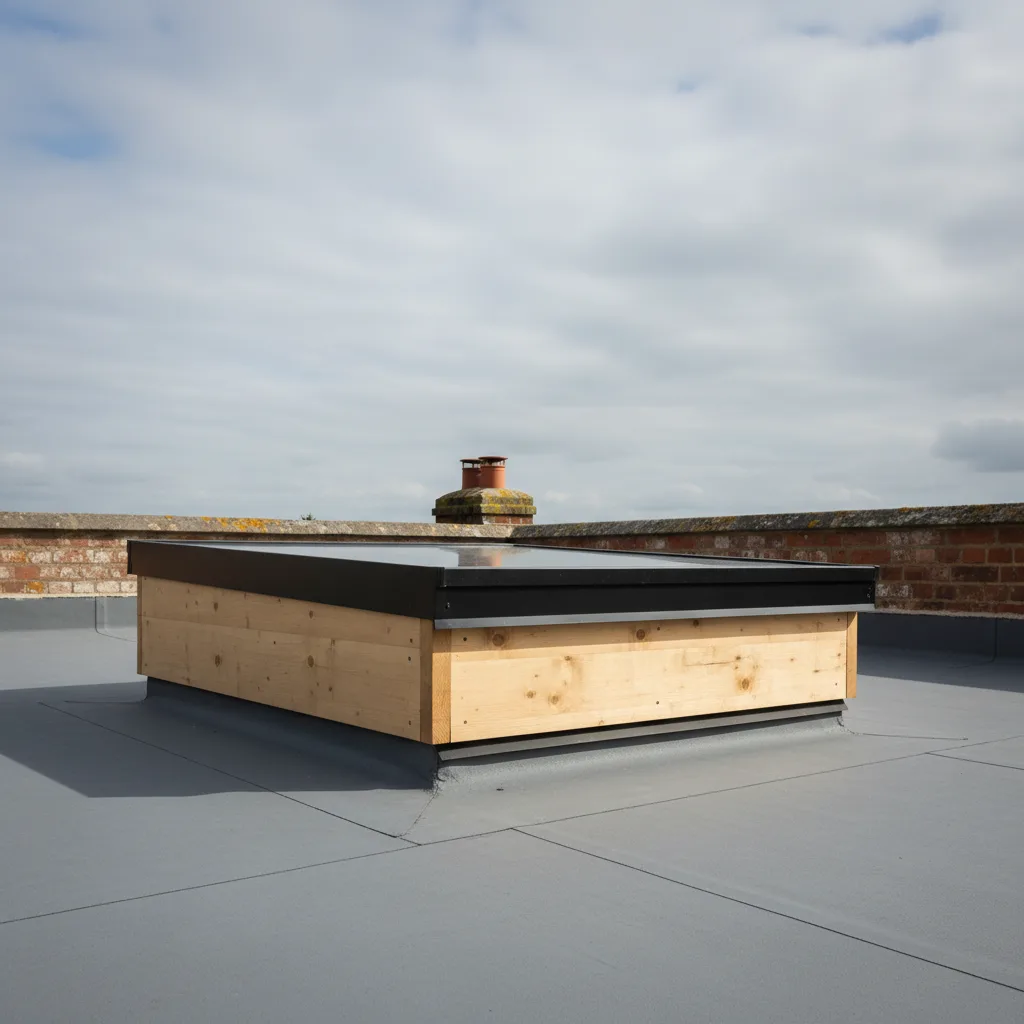
A bathroom generates more moisture per hour than any other room, in warm air that rises straight to the highest surface, which is the rooflight.
Everything on the detailing side matters more here than elsewhere: a warm edge spacer so the glass perimeter is not the coldest point, an insulated kerb so the upstand is not a cold bridge, and a vapour control layer properly sealed to the frame so wet air does not enter the roof build up.
Skimp on any of those over a bathroom and you get condensation running down the frame within the first winter.
Ventilation
A rooflight is not ventilation. It is daylight. Building Regulations require mechanical extraction in a bathroom regardless of whether there is a window or a rooflight.
An opening rooflight helps a great deal on top of that, because it lets the wettest air out at the highest point of the room. Over a shower it is above reach, so electric with a rain sensor is the version that gets used.
Privacy

Usually less of an issue than people expect, because a rooflight over a single storey extension is generally not overlooked. Where it is, obscured or acid-etched glass solves it without losing daylight, and it costs little.
Worth checking the actual sightlines from neighbouring upper windows at survey rather than assuming either way.
Electrical zones
If the rooflight is electric and sits over or near a shower, it falls within the bathroom zoning rules and the fitting and its wiring have to be specified accordingly. That is an electrician’s decision and it belongs in the specification from the start rather than being discovered at second fix.
Wet rooms specifically

A wet room has no shower enclosure, so the moisture is spread through the whole room rather than contained. Everything above applies, more so.
Why a bathroom is the hardest room for a rooflight
It produces more moisture than any other room in the house, in short intense bursts, and the rooflight is the coldest surface in it.
Warm wet air rises, meets a pane that has been radiating toward the night sky, and condenses. Water forms, runs down the glass, and collects at the frame or drips.
From below that is indistinguishable from a leak, and it is one of the commonest things reported to us as one.
None of that is an argument against a rooflight over a bathroom. It is an argument for specifying one properly, because a bathroom is also frequently the darkest room in a house and daylight transforms it.
The four measures, in order of effect

1. Extract ventilation that actually works. Nothing else on this list compensates for its absence.
A fan sized for the room, running on an over run timer or a humidity sensor, and ducted to outside rather than into a loft or a void.
That last point catches a great many older installations. A bathroom extract discharging into a roof space simply relocates the moisture to somewhere it can condense unseen, and it is worth checking while somebody is up there.
2. An opening rooflight. An opening at the highest point of a room lets steam leave directly rather than circulating, and it is the fastest way to clear a bathroom after a shower.
It does not replace the fan. It supplements it, and it does something the fan cannot: it lets a large volume of air out quickly through the top of the room, drawing drier air in through anything open lower down.
Above easy reach that means motorised, and it means a rain sensor, because a bathroom rooflight left open in a shower is a wet floor. Where running mains cable through a tiled wall would be disruptive, a solar powered opener needs no connection at all.
3. Warmer glass. A good whole unit U-value with a low emissivity coating, argon fill and a warm edge spacer means the inner surface runs warmer and condensation forms less readily.
The warm edge spacer matters particularly here. An aluminium spacer conducts heat around the perimeter of the pane so the edge runs several degrees colder than the centre, producing a band of condensation at the edge of the glass on cold mornings. In a bathroom that band is a permanent feature all winter.
4. An insulated kerb. On a flat roof, the kerb is the perimeter of the opening, and an uninsulated timber kerb punches straight through the roof insulation around all of it.
The inner face of that cold bridge is where water forms on the plaster around the unit. That is not condensation on the glass, it is condensation on the reveal, and it is an installation fault rather than a fact of physics.
The vapour control layer, which matters more here
A bathroom pushes moist air into any gap it can find.
On a warm flat roof the vapour control layer sits below the insulation and above the deck, and at the rooflight it has to be carried up the kerb and sealed to the frame. An unsealed edge over a bathroom is a direct route for humid air into the insulation layer.
Wet insulation is expensive, slow to discover and difficult to remedy without stripping the roof. Over a bathroom it is a realistic outcome rather than a theoretical one, which is why the detail deserves naming on a quotation.
Overlooking, and why it rarely arises

Usually a non issue, because a rooflight faces the sky. Where it arises it is because the property sits below higher ground or a taller building looks down onto the roof.
Obscure glazing solves it permanently and it is the right answer in a bathroom, because a blind in a wet room gets wet and stays wet.
It costs a modest premium at the point of order and it cannot be added later, so it is worth deciding rather than deferring.
On a side elevation facing a boundary, permitted development rules may require obscure glazing and restrict how far the unit opens, which is a legal requirement rather than a preference.
The wet room case
More demanding again, because the whole room is a shower.
Everything above applies with more force, and two things are added.
Electrical zones. A wet room has defined zones and any equipment has to be rated for the zone it occupies. A motorised rooflight above a wet room needs the electrician to know exactly where it sits, and that is settled at design stage rather than on the day.
Materials. Frame finishes matter more in continuous humidity. A moulded polyurethane frame has a continuous surface with no joints and no grain, and in a wet room it is the sensible specification over timber.
Cleaning access

Think about it before the unit goes in, because a bathroom is an awkward room to work in.
Standing in a bath or a shower tray on a stepladder is not a good arrangement, and a wet floor makes it worse. Where the rooflight is above reach, that is an argument for a design that can be cleaned from below or for accepting that it gets done rarely.
Self cleaning glass helps on a pitched unit where rain sheets off. On a flat rooflight it does very little, because water sits rather than runs.
Fixed or opening
Opening, in almost every bathroom.
A fixed rooflight is cheaper, marginally better thermally and has nothing to maintain, and in a room whose defining problem is moisture, giving that moisture a route out at the highest point is worth the difference.
The exception is a bathroom with excellent mechanical ventilation and a rooflight that would be genuinely unreachable, where a fixed unit and a good fan is a defensible specification.
What to specify, summarised

An opening unit at the highest point, motorised with a rain sensor if above reach, solar powered if the room is already finished.
Obscure glazing if there is any overlooking, decided at order.
A warm edge spacer and a good whole unit U-value.
An insulated kerb and a vapour control layer sealed to the frame, both named on the quotation.
And a working extract fan ducted to outside, which is a separate trade and the most important item on the list.
Why it is a good idea
A bathroom is frequently the darkest room in the house, because privacy has reduced the window to a small obscure pane or removed it entirely.
A rooflight gives daylight with no overlooking at all, and it puts any ventilation at the highest point in the room, which is exactly where steam collects.
In a wet room, where the whole space gets wet, the extra light also makes the room considerably easier to keep clean and to use safely.
The moisture load, which is the whole design problem

A shower produces a large quantity of water vapour very quickly and it rises straight to the ceiling. The rooflight is the coldest surface up there, so it collects that moisture first.
Get the detailing wrong and it will drip, every time the shower is used, and the owner will report it as a leak.
Three things prevent it.
A good whole unit U value with a warm edge spacer, so the internal glass surface is warm enough not to condense readily and the edge band is pushed back.
An insulated kerb, continuous with the roof insulation. An uninsulated timber kerb over a shower runs with water. This is not a marginal improvement, it is the difference between working and not.
A vapour control layer sealed to the frame, so humid air cannot enter the construction and condense out of sight, where it rots timber silently.
Extraction working with the rooflight
An opening rooflight helps a great deal, venting at the top of the volume where the steam is.
It does not remove the requirement for mechanical extraction where the regulations call for it. The two work together: the extract handles the shower itself, running on for long enough to be useful, and the rooflight handles the rest.
Where the unit is powered and out of reach, a rain sensor is essential.
Specification details
Choose a moisture resistant frame finish. A polyurethane encased frame has no joints for water to enter and needs no redecoration, which in a bathroom is worth the modest premium over lacquered timber.
Choose a blind that tolerates humidity if one is wanted at all. A venetian or a moisture resistant pleated blind rather than fabric.
And clear glass rather than obscure, unless the rooflight is genuinely overlooked from a higher building, which is rare. There is usually nothing to see in through a window facing the sky.
More on Flat Roof Rooflight Installation
Ready to bring the daylight in?
Tell us about your project and we’ll send a clear, fixed written quote, no pressure, no surprises.
- Fixed written price before any work starts
- No pressure, no obligation, no sales calls
- Flexible survey times that suit you
- A reply within one working day