Laminated glass and flat rooflight security
A properly specified rooflight is one of the harder ways into a house, and the laminated pane is already there for safety.
Part of our Flat Roof Rooflight Installation guide
The concern is reasonable, particularly on a single storey rear extension where the roof is reachable from a garden. The reassuring part is that the specification which makes a rooflight safe overhead also makes it difficult to break through.
What is already in the unit
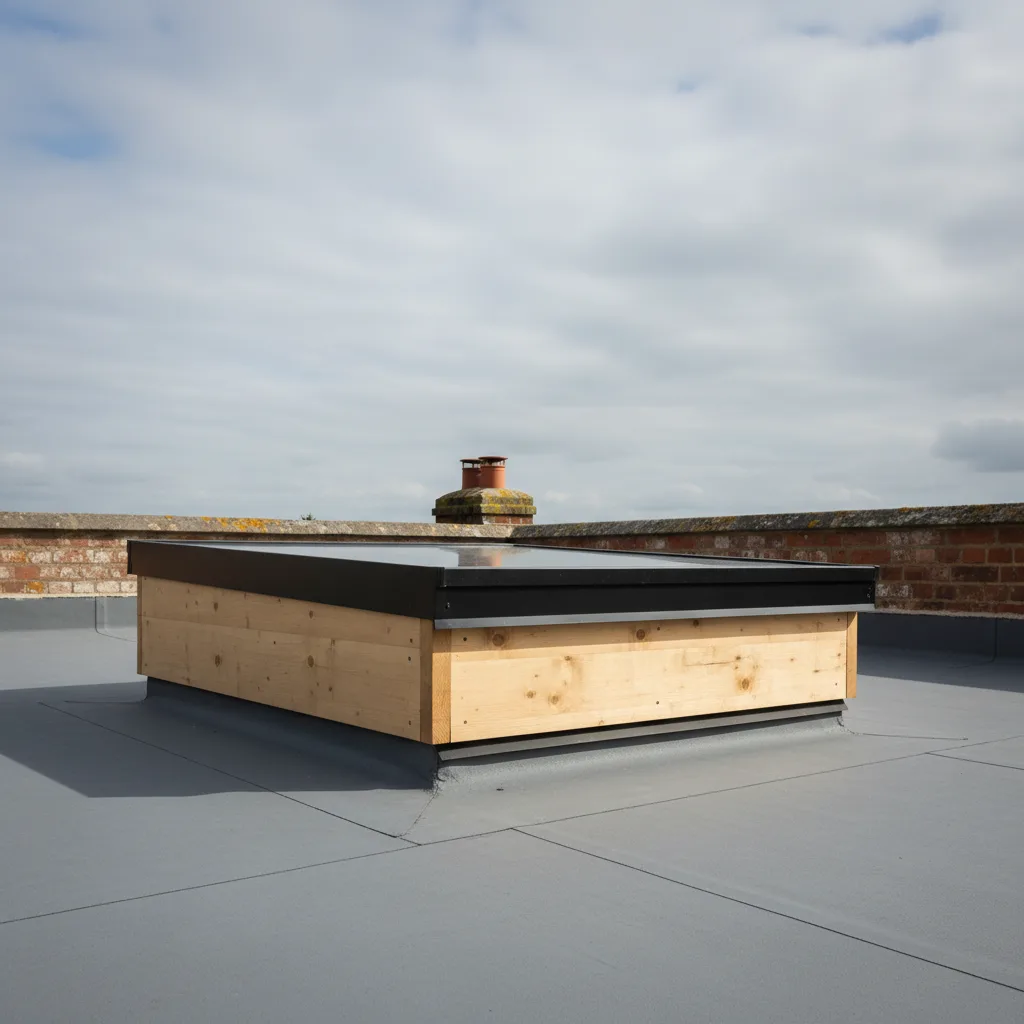
Overhead glazing is normally toughened outer and laminated inner. That build exists for safety: if the outer breaks, the laminated inner holds together and stays in the frame rather than falling into the room.
The same property defeats a casual break-in. Toughened glass shatters loudly into granules; the laminated pane behind it then has to be cut through rather than smashed, because the interlayer holds the fragments together. It is slow, extremely noisy, and obvious.
Where the weakness actually is
Not the glass. Two other places matter more.
The fixings. A unit held down by accessible screws can be unfixed. Proper installation uses concealed fixings that cannot be reached from outside.
Opening units. An opening rooflight has a mechanism, and a mechanism can be forced. Multi-point locking and, on an electric unit, an actuator that holds position under load, are what matter. A fixed unit has none of this exposure.
When to specify more

On a ground floor or garage roof, on a property that has been targeted before, or where the rooflight is genuinely secluded from view, a thicker laminated inner pane is worth specifying. It is a modest cost on the unit.
Insurers occasionally ask about accessible glazing. Where a policy specifies a standard, tell us at survey and we will specify to it, because the requirement is easy to meet at order and expensive to meet later.
What we would not bother with
Bars or grilles over a domestic rooflight. They defeat the point of the thing, they are a fire escape problem, and the glass specification already does the job.
What laminated glass is

Two or more panes of glass bonded together with a plastic interlayer, usually polyvinyl butyral, under heat and pressure. The result behaves as a single pane until it is broken, at which point the interlayer holds the fragments in place rather than letting them fall out.
That is a completely different failure behaviour from toughened glass, which when broken shatters completely and instantly into small fragments and leaves an empty aperture.
Most quality rooflights use both: a toughened outer pane, which resists impact and weather, and a laminated inner pane, which stays in place if it breaks.
Why the inner pane is laminated
Primarily for safety rather than security, and the reason is geometry.
A rooflight is overhead. Glass falling downward into a room is a different proposition from glass falling outward onto a path, and a laminated inner pane means that even a serious impact leaves the glazing hanging in its frame rather than in the room below.
That is why it is standard on quality units and why it is worth confirming rather than assuming on a cheaper one. Ask specifically whether the inner pane is laminated; a quotation that says toughened without qualification may mean both panes are toughened, which is not the same thing.
Why it matters for security too

The security benefit falls out of the same property.
Toughened glass, once broken, is gone. A single blow produces an open aperture and no further work.
Laminated glass does not behave that way. It cracks and stays in place. Getting through it means repeatedly striking the same area and then cutting or tearing the interlayer, which is slow, loud, physically demanding and visible.
An opportunist is not going to do that on a roof.
Where flat rooflights sit in a house’s security
Better than most people assume, and there are four reasons that have nothing to do with the glass.
Access is itself an obstacle. Getting onto a flat roof takes effort, and doing it is conspicuous.
Exposure. Somebody working on a roof is visible from further away, for longer, from more directions than somebody at a back door.
Fixing. A modern unit is mechanically fixed to a kerb and bonded, not clipped in. There is no bead to lever off from outside as there is on some older window designs.
Awkwardness. Even with the glazing removed, getting through a rooflight opening and down into a room is not straightforward.
The genuine weak point

Old polycarbonate domes, and this is what gives flat rooflights their reputation.
Multiwall polycarbonate degrades under ultraviolet: it yellows, it becomes brittle and it loses impact resistance progressively over fifteen or twenty years. On older installations it is sometimes simply screwed down or held by clips.
It is genuinely the easiest way into many domestic flat roofs, and it is also a serious safety hazard, because it looks the same the day before it fails as the day it was fitted.
If that is what you have, replacing it with a modern glass unit improves security, safety, thermal performance and appearance in a single job, and it is among the cheaper things on a roof to put right.
The other weak points worth checking
Opening units with a catch rather than a lock. A manual vent that latches is not locked. Check what yours actually does.
Single point locking. Multipoint locking on an opening unit engages at several places around the sash and is meaningfully harder to force than a single central catch.
Fixing method. Mechanical fixing to the kerb rather than bonding alone. Worth specifying rather than assuming.
Controls left accessible. On a motorised unit, a remote or an app is a means of opening the window. Not a reason to avoid motorising, and a reason to keep the remote indoors and to specify a wall switch.
What to specify

A laminated inner pane as a minimum, which most quality units have as standard.
A security rated laminate where the rooflight is genuinely accessible: a single storey flat roof reachable from a garden wall, an outbuilding, or a property where the rear is not overlooked. Interlayers are available in thicker grades tested against forced entry, and the premium is modest.
Multipoint locking on any opening unit.
Mechanical fixing named on the quotation.
And on any flat roof rooflight, non fragile as a baseline, which is a safety specification tested by dropping a weighted bag onto the unit. It costs relatively little, it removes the hazard the old dome represented, and it should be the default rather than an upgrade.
The measure that matters more than any of them
Lock the ladder away.
The commonest way anybody gets onto a domestic flat roof is a ladder left in the garden, and no glazing specification compensates for that. The same applies to wheelie bins against a wall, garden furniture stacked near a lean to, and a flat garage roof that gives easy access to a house roof.
It costs nothing and it does more than the difference between one laminate grade and another.
Insurance

Insurers do not generally treat a rooflight as a special risk, and a modern glass unit properly fitted will not prompt any question.
Where a policy specifies glazing standards for accessible openings, tell us at quotation stage and we will specify to it rather than leaving you to check afterwards. That is easier to do at order than to demonstrate retrospectively.
The trade off nobody mentions
Laminated glass is heavier than toughened glass of the same thickness, and on an opening unit that is a marginal additional load on the actuator, which is already the shortest lived component at ten to fifteen years.
It is not a reason to avoid it, and it is a reason not to compound it by specifying triple glazing on the same opening unit, where the accumulated weight starts to matter to the mechanism.
Why laminated and toughened fail differently

This is the whole subject in one comparison.
Toughened glass is heat treated so that when it breaks it shatters into small blunt granules. That is excellent for injury: there are no large sharp shards. It is poor for security, because the entire pane clears in one event and leaves an empty opening.
Laminated glass is two or more sheets bonded to a plastic interlayer. When it breaks, the fragments stay stuck to the interlayer. The pane cracks and stays in place.
An attacker facing laminated glass has to work through it repeatedly, making noise, taking time, and still not producing a clear opening. That combination is what deters, far more than any particular thickness.
Where it matters on a rooflight
Access is the whole question. A flat rooflight on a single storey extension that can be reached from a garden wall, a bin store or a neighbouring flat roof is a plausible entry point. The same unit two storeys up on a pitched slope is not.
Walk round the building and ask whether somebody could get onto that roof without bringing a ladder. If they could, the rooflight is worth specifying properly.
Garages and outbuildings deserve particular attention, because they hold tools and bicycles and are unoccupied for long periods.
The other things laminated glass gives you
People buy it for security and get three further benefits.
Overhead safety. A pane above your head that holds together when broken is safer than one that showers the room, and laminated inner panes are standard practice on overhead glazing for exactly that reason.
Rain noise. The interlayer damps vibration, and an acoustic laminate does it considerably better. On a rooflight over a bedroom this is frequently the reason people wish they had specified it.
Fade protection. The interlayer blocks a large proportion of ultraviolet, which protects furnishings and flooring below.
Where to put it in the build up
The inner pane at minimum, which handles overhead safety and rain noise.
Both panes where security is a genuine concern, because an attacker meeting laminated glass on the outer face is stopped at the first layer rather than the second.
The rest of the unit
Glass is only part of it. On an opening rooflight, the locking and the hinges matter, and a powered unit should not be capable of being driven open from outside.
A structurally bonded fixed rooflight has an advantage here: there are no external beads to lever off, which is a weakness on mechanically glazed units.
Where security is a real requirement rather than a general preference, ask for a rating against a recognised standard rather than an assurance.
The decision to make now
Laminated glass is a modest addition at order and cannot be added afterwards without replacing the unit. On any rooflight that could be reached, it is worth taking.
Insurance and the specification
Where a property has been targeted, or is in an area an insurer treats as higher risk, the glazing specification of accessible rooflights may be relevant to cover.
Worth asking the insurer directly, because a specification that satisfies them is decided at order and cannot be added afterwards without replacing the unit.
More on Flat Roof Rooflight Installation
Ready to bring the daylight in?
Tell us about your project and we’ll send a clear, fixed written quote, no pressure, no surprises.
- Fixed written price before any work starts
- No pressure, no obligation, no sales calls
- Flexible survey times that suit you
- A reply within one working day