Vapour control layers sealed to the frame
Invisible, cheap, skipped constantly, and responsible for most damp that gets blamed on a rooflight.
Part of our Flat Roof Rooflight Installation guide
The vapour control layer is the sheet that stops warm moist air from inside the building getting into the roof build up. In a warm roof it sits directly on the deck, below the insulation.
It only works if it is continuous. A rooflight puts a hole in it.
What has to happen

The layer is cut at the opening, carried up the inside face of the kerb, and sealed to the underside of the rooflight frame with tape or a compatible sealant, forming a closed junction all the way round.
Done properly, the airtight line is continuous from the roof deck, up the kerb, and into the frame.
What happens when it is not
Warm moist air from the room enters the insulation layer at the perimeter of the opening. It cools as it moves outward and condenses inside the build up, on the underside of the waterproofing.
That water then appears as a damp patch on the ceiling near the rooflight, or runs along a joist and shows up somewhere else entirely.
Why it is diagnosed wrongly

Because it presents exactly like a leak, and the rooflight is the obvious suspect. The rooflight gets resealed, then replaced, and the damp continues, because the water was never coming from outside.
The distinguishing test is the same one as always: rain leaks follow rain, condensation follows cold weather and internal humidity.
Kitchens and bathrooms
Both produce large volumes of moist air, and both are where this detail matters most. A rooflight over a hallway will tolerate a sloppy junction for years. One over a kitchen will not.
Retrofit

On an existing roof the layer may be old, brittle or absent altogether. Where we cut into an existing warm roof we make good the junction to the frame as part of the work. Where the existing layer has failed generally, we say so, because sealing perfectly around one opening in a roof with no functioning vapour control elsewhere solves very little.
The layer that stops moisture getting into the roof
A vapour control layer sits on the warm side of the insulation. Its job is to stop moist air from inside the building passing into the construction, where it would reach a cold surface and condense out of sight.
That kind of condensation, interstitial condensation, is worse than the sort you see on glass, because it happens where nobody is looking. You discover it eventually as staining on a ceiling, as insulation that has slumped and gone dark, or as timber that has decayed.
By then it has been going on for years.
Why a rooflight is the weak point

Because it is a hole in that layer.
Everywhere else the vapour control layer is a continuous membrane. At a rooflight it has to be cut, brought back to the frame and sealed to it, so the barrier is unbroken around the opening.
An unsealed edge is not a minor defect. Air carries far more moisture into a construction than diffusion through an intact membrane does, so a taped edge and a loose one behave completely differently. A gap a few millimetres wide, running around the perimeter of an opening, moves a surprising volume of moist air over a winter.
Where it sits on a pitched roof
Behind the plasterboard, on the room side of the insulation.
At the rooflight it is dressed to the frame and taped. The insulation collar goes in alongside it, closing the gap between frame and structure.
The two work together and it is worth understanding how. The collar keeps the reveal warm, so room air touching the plaster does not find a cold surface. The vapour control layer stops that same air getting behind the plaster to somewhere colder still.
Where the collar is missing, you get condensation on the reveal, which is visible and gets reported. Where the vapour layer is unsealed, you get moisture in the roof construction, which is not visible and does not.
Where it sits on a flat roof

This depends on the build up, and the distinction matters.
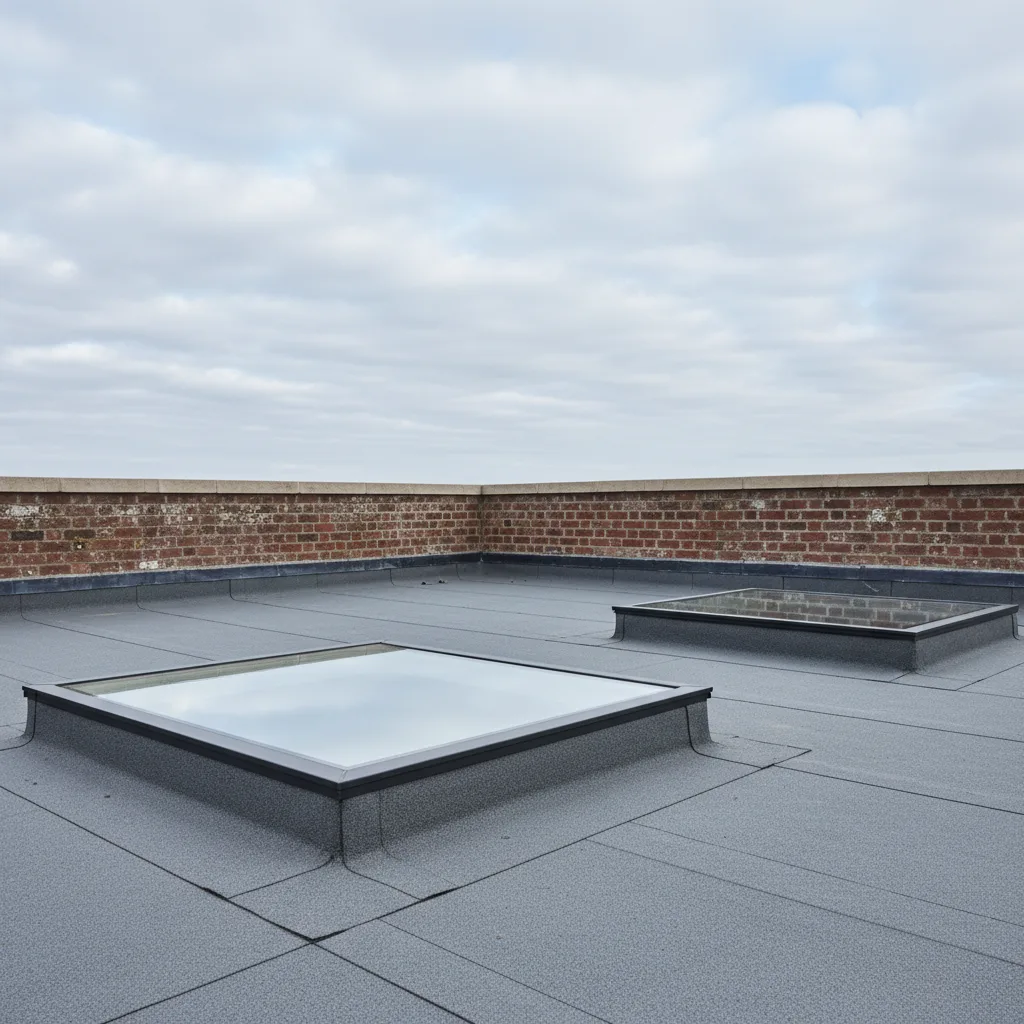
A warm roof, with the insulation above the deck, is the modern standard. The vapour control layer sits below the insulation and above the deck, and at a rooflight it has to be carried up the kerb and sealed to the frame.
Getting that wrong puts moist air into the insulation layer itself, and wet insulation is expensive, slow to discover and difficult to remedy without stripping the roof.
A cold roof, with the insulation between the joists and a ventilated void above it, is older practice. The vapour control layer sits at ceiling level, below the insulation, and is sealed around the opening there.
On a cold roof the ventilation above the insulation is doing part of the work, carrying away moisture that gets past. That is why blocking ventilation paths while working around an opening is a genuine mistake rather than a tidiness matter.
Why sealing to the frame specifically
The frame is the fixed element the barrier can be made continuous against.
The membrane is dressed up to it and taped with a tape rated for the purpose, not general purpose tape that will lose adhesion in five years at the temperatures a roof reaches.
On some rooflight systems the frame has a designed detail for this, a flange or a groove the membrane is taped to. Using it is a great deal better than improvising, and it is one of the small ways a properly detailed installation differs from a hurried one.
What happens when it is skipped

Nothing, for a while. That is the difficulty.
The first winter produces a small amount of moisture in the construction which dries in spring. The second adds to it. Over several years, on a warm flat roof in particular, insulation absorbs moisture and stops performing, and timber decking or joists stay damp long enough for decay to start.
The symptoms arrive late and they are frequently blamed on a leak, which produces a search for a hole in the covering that does not exist.
Airtightness and heat
The same detail does a second job.
Air leakage around an opening loses more heat than conduction through a small area of glass. A sealed vapour control layer is also an air barrier, and closing that path improves how the room performs by more than the difference between one good glazing specification and another.
That is why the three details keep appearing together on this site: the insulation collar or the insulated kerb, the sealed vapour control layer, and a warm edge spacer. Between them they account for most of the avoidable loss at a rooflight, and none of them appears in a U-value.
Sun tunnels

Same principle, smaller penetration.
The ceiling ring has to be sealed airtight so warm moist room air cannot get into the tube. Without it, that air condenses on the cold metal above and the water runs down and arrives at the diffuser looking exactly like a leak.
In a converted loft, where the insulation is at rafter level, the tube crosses both the insulation and the vapour control layer, and both have to be maintained and sealed to it.
What to ask for
That the vapour control layer is being sealed to the frame, as a named line on the quotation rather than an assumption.
On a flat roof, whether the build up is warm or cold, and where the layer sits in it.
And alongside it, whether the insulation collar or the kerb insulation is included.
All of these are invisible when the job is finished, which is precisely why they are worth asking about before it starts. An installer who has thought about the installation will answer immediately; one who has priced a window and a day’s labour will not.
The failure this prevents, described properly
Warm internal air carries water vapour. Vapour moves from high concentration to low, which in winter means from inside the house outward through the construction.
If it reaches a surface within the build up that is below the dew point, it condenses there. Inside the insulation, on the back of the plasterboard, on the cold face of a timber trimmer. Nobody sees it. It wets the timber, and over successive winters that timber rots.
This is interstitial condensation, and it is the most damaging moisture problem in a roof because it is entirely invisible until something structural gives.
The vapour control layer sits on the warm side of the insulation and stops the air carrying that vapour from getting in.
Why a rooflight is where it fails
Because the layer has to be cut to make the opening and then reconnected around it, and reconnecting is fiddly work at the end of a long day that will be covered up in ten minutes.
It has to be carried around all four faces of the reveal, up the inside of the kerb on a flat roof, and taped to the rooflight frame continuously. Every corner. Every overlap. Every service that passes nearby.
A layer that is ninety percent continuous is not ninety percent effective. Air finds the gap, and a small gap under a pressure difference moves a surprising volume of moist air.
What good looks like
Membrane lapped generously rather than butted, with the laps taped rather than merely overlapped.
Tape rated for the purpose, applied to a clean dry surface, pressed down properly. Not gaffer tape, and not applied over dust.
At the frame, the membrane dressed onto the frame face and taped to it, so the seal is to the frame itself rather than to the plasterboard that will later be fixed over it.
Corners cut and folded rather than stretched, because a stretched membrane at a corner tears in the first year of thermal movement.
Downlighters
Worth naming specifically, because a ring of them around a rooflight is common and each one is a hole in the layer you have just sealed.
Sealed fittings, or hoods, or lighting that does not penetrate the ceiling at all. A perfect vapour control layer with six unsealed downlighters cut into it is not a vapour control layer.
The diagnostic
Damp appearing around a rooflight in cold weather, without rain, is interstitial condensation. A leak follows rain; condensation follows temperature.
Getting that distinction right before anybody goes on the roof saves a great deal of money, because a roofer sent to find a leak that does not exist will find nothing and charge for looking.
Proving it happened
Photographs before the plasterboard, and ask for them as a matter of course.
The request itself tends to sharpen attention. An installer who knows a photograph is expected tapes the corners properly.
Choosing the tape
Tape rated for the purpose, applied to a clean dry surface and pressed down properly.
Not gaffer tape, and not applied over dust. A tape that lets go in five years leaves a gap in exactly the place that mattered, and by then the plasterboard is over it.
More on Flat Roof Rooflight Installation
Ready to bring the daylight in?
Tell us about your project and we’ll send a clear, fixed written quote, no pressure, no surprises.
- Fixed written price before any work starts
- No pressure, no obligation, no sales calls
- Flexible survey times that suit you
- A reply within one working day