Underlay and sarking around a roof window
The layer under the tiles is the real waterproofing, and how it meets the window frame decides whether the job lasts.
Part of our Roof Window Installation guide
Tiles and slates are not the waterproof layer. They are the weathering layer: they shed most water and take the wind and sun. The membrane beneath them is what catches whatever gets past, and on a driving rain day a surprising amount does.
How that membrane meets the window frame is the detail that decides whether an installation lasts.
The underlay collar
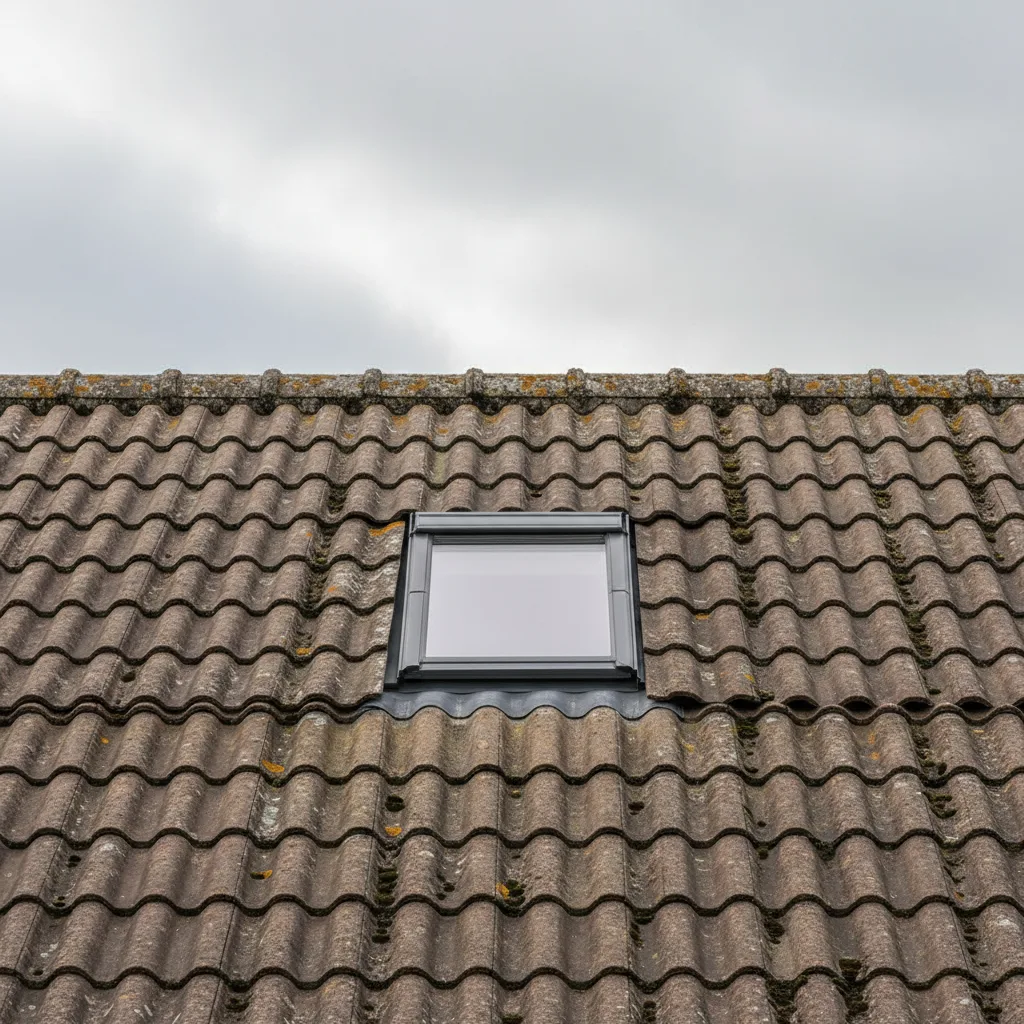
Manufacturers supply a collar with the flashing kit. It is dressed from the cut edge of the existing membrane onto the window frame, forming a continuous drainage path so any water on top of the membrane is carried around the window and back onto the membrane below it.
Omit it, or fit it badly, and water travelling down the membrane arrives at the opening and goes into the roof rather than around it. The leak then appears below the window and everybody blames the flashing, which is visible and innocent.
Breathable against bitumen
Older roofs have bitumen felt underlay: impermeable, stiff, and it perishes. Cutting into brittle old felt is difficult and the repair is only as good as the material it is bonded to. On a roof with failing felt, that is worth knowing before the job rather than after.
Modern roofs have breathable membrane, which is easier to work with, more forgiving, and takes tape well.
They are also ventilated differently. A cold roof with bitumen felt relies on ventilation at the eaves; a breathable membrane roof may not have that ventilation because it does not need it. Cutting into one and detailing it as if it were the other causes problems that show up as condensation.
Sarking boards

Some roofs, more common in Scotland but found here on older and better built properties, have timber sarking boards under the membrane. That is helpful: it gives a solid surface to fix to and support the opening.
It also means more cutting, and the boards are structural in a way membrane is not.
Battens
Cut battens either side of the opening have to be supported, usually by the trimmers. A batten left cantilevered over an opening will drop, and the tiles it carries drop with it, opening a gap right at the head of the window.
The layer nobody sees and everything depends on

Beneath the tiles or slates on any modern roof is a membrane, and its job is to catch the water that gets past the covering.
Because water always does. Driven rain finds its way under tiles in a way it never does in still conditions, and on an exposed site the underlay is doing real work several times a winter.
That water runs down the membrane to the eaves and out into the gutter, which works perfectly well until you cut a hole in the roof.
Why a rooflight is a problem for it
Cut an opening and the membrane above the window has nowhere to discharge. Water running down it arrives at the cut edge and goes straight into the roof.
The roof has been turned from a system that sheds water into a funnel that delivers it into the opening.
That is why the underlay collar exists, and it is why an installation can be perfect above the covering and still leak.
What the collar does

It is a purpose made apron, supplied with the window or formed from membrane, dressed around the opening so that water is carried past rather than into it.
The membrane above the window drains onto the top of the collar. The collar carries the water down and around both sides of the opening. And it discharges onto the membrane below the window, which continues to the eaves as before.
The critical thing is the direction of the laps. Every overlap has to be arranged so water runs over the joint rather than into it, exactly as tiles lap. Get the laps the wrong way round and you have built a very effective water collection device inside the roof.
Once the covering is back, none of it is visible. That is why a great many leaks originate here and why they are so hard to diagnose from below.
The sequence
Underlay collar first, dressed and lapped. Then the flashing kit. Then the covering reinstated over the flashing, never under it.
Three layers, each shedding onto the one below, each lapped in the direction water travels. That is the whole of how a rooflight stays dry, and reversing any part of it is a guaranteed leak.
Roofs with no underlay at all

Common on any pre war property that has never been stripped and reroofed: tiles or slates hung on riven battens with the rafters visible from inside.
That is not a fault. It is how roofs were built, and it worked because those roofs were ventilated and because the coverings were laid to steep pitches with generous laps.
Modern rooflight weathering assumes a membrane to lap into. Where there is none, the detail is built around the opening instead: an apron is formed and dressed to carry water past the opening onto the battens and the covering below.
Entirely workable, more time, and it should be priced rather than discovered on the day. On a period property in this area it should be anticipated as a matter of course.
Sarking
Boarding fixed over the rafters beneath the covering: traditional in Scotland, uncommon in Essex, and found here occasionally on higher status buildings and on some later reroofing work.
Where it is present it changes the job. The opening has to be cut through the boarding as well as the covering, and the boarding is frequently doing structural work by bracing the rafters, so cutting it needs the same consideration as cutting a rafter.
Sarking also means the underlay, where there is one, sits above the boards rather than draped between rafters, so the collar detail differs.
Types of membrane, and why it matters

Traditional bitumen felt, on roofs from the mid twentieth century onward. It becomes brittle with age. On a roof of forty or fifty years, disturbing it around an opening will crack it beyond the working area, and that has to be made good rather than ignored.
Breathable membranes, standard on modern work. They allow water vapour out while keeping liquid water in, which is what permits an unventilated or partially ventilated roof build up.
That matters at a rooflight because a collar detail that blocks the breathable path locally can create a damp spot. Manufacturers publish details for their own products and following them is better than improvising.
Non breathable membranes, which require the roof void to be ventilated. Where a rooflight opening obstructs an eaves or ridge ventilation path, that is a real problem rather than an aesthetic one.
What we find on strip out
Three things, regularly.
An underlay cut and not dressed. Somebody made an opening, cut the membrane square and fitted the window. It is the most common cause of a rooflight that has been leaking since it was fitted.
Laps reversed. The collar in place and dressed the wrong way, so it collects water rather than shedding it.
Membrane brittle and torn beyond the working area, on an older roof where it was disturbed at some point.
All three are corrected as part of doing the job properly, and none of them costs extra, because a new installation is detailed correctly regardless.
How this shows up from inside

An underlay fault produces water that follows rain, usually rain driven from one particular direction, arriving at one point rather than evenly, and leaving a mark that stays after everything dries.
It frequently appears some distance from the rooflight, because water travelling on the underside of a membrane or along a batten can run a long way before it finds somewhere to drop. That is why tracing a leak from the stain is unreliable.
It is distinct from condensation, which appears in cold weather, forms evenly, and has nothing to do with rain, and from water on the plaster reveal, which is usually a missing insulation collar.
What to ask
Whether the underlay collar is included and how it is being dressed, particularly on an older roof where there may be no membrane to lap into.
On a period property, whether the quotation allows for building the detail around the opening rather than assuming a membrane is there.
It is not a question most people think to ask, and it is one of the more revealing ones, because it is precisely the invisible detail that separates an installation that stays dry from one that does not.
The layer that does the invisible work

A pitched roof covering is not watertight in the way a membrane is. Tiles and slates shed the great majority of water by gravity and lap, and in driven rain some gets past them.
The underlay beneath catches it, carries it down the slope, and discharges it at the eaves. That is a designed part of the system, not a backup that should never be needed.
Which is why what happens to that layer at a rooflight opening matters so much.
The collar
Cutting a hole in the underlay leaves an edge that water arriving from above will run straight into.
The collar is what prevents that. It is a piece of membrane dressed around the opening, lapped under the underlay above and over the underlay below, so water running down the membrane is diverted around the window and continues on its way.
The lap direction is the whole thing. Under above, over below, so water is always running onto the next layer down rather than into a joint.
Manufacturers supply purpose made collars matched to the window size, and they are quicker and more reliable than forming one from offcuts.
The order the layers go on
Underlay collar first. Then the flashing. Then the covering reinstated over the flashing rather than under it.
Reverse any of those and water is being asked to climb, which it will not do reliably and will not do at all under wind pressure.
Sarking, and what it changes
A sarked roof has boarding beneath the covering rather than only battens and membrane. It is more common in some regions than others, and it appears on older buildings and on some high specification new work.
Boarding makes the opening more work to form, because the boards have to be cut and the edges supported, and it changes how the underlay is arranged.
It also means the roof is stiffer and better insulated against wind noise, which is a benefit worth noting.
When there is no underlay at all
Common on unstripped Victorian and earlier roofs, where slates or tiles sit on battens with the rafters visible from inside.
That is normal on a period building, not a defect. It means the detail around the opening is built rather than lapped into a membrane, which takes longer and needs somebody who has done it before.
It should be identified at survey and priced, rather than discovered on the day with the covering already off.
Some older roofs were also torched, with mortar applied to the underside of the covering between battens. Where that is present it complicates the work and it is worth flagging early.
More on Roof Window Installation
Ready to bring the daylight in?
Tell us about your project and we’ll send a clear, fixed written quote, no pressure, no surprises.
- Fixed written price before any work starts
- No pressure, no obligation, no sales calls
- Flexible survey times that suit you
- A reply within one working day