Timber against polyurethane frames
One looks better and needs attention. The other needs nothing and looks like what it is.
Part of our Roof Window Installation guide
Two frame materials, and the choice is mostly about the room rather than the roof.
Timber

Laminated pine, factory finished with clear lacquer or white paint, with an aluminium cladding outside taking the weather.
For it: it looks like timber, which in a bedroom, study or living space is warmer and more considered than white plastic. It suits period property. It can be recoated or repainted when the finish ages, and it can be painted to match joinery.
Against it: the internal finish has a life. In a humid room it will show wear at the bottom of the sash, where condensation runs, within a few years. Recoating every five years or so is realistic.
Polyurethane
A timber core encased in moulded polyurethane, or fully synthetic. Smooth white finish, no visible grain.
For it: genuinely maintenance free and impervious to moisture. In a bathroom, shower room, wet room, kitchen or utility it is the correct choice and it is not close. It also wipes clean, which matters in a kitchen.
Against it: it looks like moulded plastic, because it is. In a living space or a period property it can read as cheap even where the window is not.
Cost

Broadly similar, with polyurethane often marginally more. This is not a budget decision.
The simple rule
Wet room, bathroom, kitchen, utility: polyurethane. Bedroom, study, living space, landing, and anything in a period property: timber.
Coastal note

Neither frame material is affected by salt, because the external cladding is aluminium and that is what faces the weather. What matters on the coast is the coating specification on that cladding and the grade of the fixings, and both are worth specifying properly at Mersea, Walton, Frinton or Harwich.
Two ways to build the same window
Most mainstream roof windows are offered in two frame constructions, and both are usually clad externally in aluminium so the weather never reaches the core material. The difference is what is inside.
Laminated timber. Layers of pine bonded together, which is dimensionally more stable than solid timber and resists twisting. Finished internally with a clear lacquer or a white paint.
Polyurethane. A moulded polyurethane body, frequently around a timber core, finished in a smooth white surface. Sometimes sold as a maintenance free or moisture resistant option.
Both are good products. The choice is about the room rather than about quality.
Where polyurethane earns its place

Bathrooms, shower rooms and utility rooms. The obvious case. A moulded polyurethane frame has a continuous surface with no joints, no grain and nothing for moisture to get into. In a room that is repeatedly steamed it is the sensible specification.
Kitchens. The same argument, with cooking residue added.
Anywhere the finish will be wiped often. The surface is easier to clean than painted timber and it does not mark in the same way.
Where nobody wants to think about it. There is no coating to maintain internally.
Where timber earns its place
Where the finish matters. Lacquered timber reads as joinery. In a loft bedroom, a study or a room with other visible timber, it looks like part of the building rather than a component fitted into it.
Where you want to change the colour. Timber takes paint or stain readily, so a frame can be finished to match a room now and repainted in fifteen years when the room changes. Polyurethane is what it is.
In a period property. A white moulded frame in a room with lime plaster and exposed timber can look out of place in a way lacquered or painted timber does not.
Availability. Timber ranges tend to be the manufacturers’ core offering, with the widest size range and the fullest set of options.
Thermal performance

Broadly comparable, and the differences between the two constructions are smaller than the differences created by the details around them.
Both are far better insulators than an aluminium frame without a thermal break, which is why neither is used bare on the outside: the aluminium cladding does the weathering and the core does the insulating.
What matters more than the frame material, on any rooflight, is the spacer bar and the installation. An aluminium spacer conducts heat around the whole perimeter of the pane and shows as edge condensation on cold mornings, and a warm edge spacer removes most of it.
And beyond the unit entirely, the insulation collar on a pitched roof or the kerb insulation on a flat one loses more heat when it is absent than any frame material choice will save.
Ask for the whole unit U-value rather than centre pane, and compare the two constructions on that. The gap is usually small.
Weight and mechanism
Polyurethane frames are frequently slightly heavier than the equivalent timber unit.
On a manual window that is barely noticeable. On a motorised one it is a marginal additional load on the actuator, which is already the shortest lived component at ten to fifteen years.
It is not a reason to choose one over the other, and it is a reason not to compound it by specifying triple glazing on a polyurethane opening unit, where the accumulated weight starts to matter.
Longevity and what actually fails

Neither frame material is what wears out. On both, the sealed glazing unit is the component with a defined life at fifteen to twenty five years, and the frame comfortably outlasts it.
What can fail on a timber frame is the internal finish, particularly in a moisture heavy room where a lacquer has been allowed to break down and bare timber is absorbing condensation. That is a maintenance failure rather than a material one, and it is exactly the situation polyurethane exists to avoid.
What can fail on a polyurethane frame is the surface, if it is scratched or damaged, and it is harder to make good invisibly than a painted timber frame.
On both, the external aluminium cladding is a factory finish that should be left alone. Painting over it on site gives a finish that will not last and voids any manufacturer warranty on the cladding.
Maintenance in practice
Polyurethane: wipe it. That is the whole of it.
Timber: wipe it, and every ten years or so consider recoating the internal finish if it has dulled or where condensation has been running on it. Clean it, key the existing coating with a fine abrasive, and use a paint or lacquer suitable for interior joinery.
Do not paint the gaskets, the hinges, the handle mechanism or the ventilation flap and filter. Paint in a compression gasket stops the sash seating, which lets water past and gets reported as a leak months later.
Both constructions need the same annual routine on everything that is not the frame: clean the gasket, clean the filter at the top of the sash, and on a motorised unit wipe the rain sensor and cycle it fully a few times a year.
Conservation rooflights, which are neither

Worth noting because they come up in the same conversation. Conservation units are steel framed, powder coated, slim by design, and they exist to satisfy a planning requirement rather than a performance one.
Steel conducts, so a good conservation unit is thermally broken. Because the profiles are slim the frame is a smaller proportion of the unit, so the whole unit figure is better than you might expect.
The powder coating does not need painting, and it is worth checking every few years for damage, because exposed steel corrodes where timber and aluminium do not. On a coastal or exposed site that check matters more.
How to decide
Bathroom, shower room, kitchen or utility: polyurethane.
Bedroom, study, living space or period property where the finish is part of the room: timber.
Anywhere you are undecided: timber, because it can be finished to suit the room later and polyurethane cannot.
And in either case, spend the attention you were giving the frame material on the two things that matter more: the whole unit U-value with a warm edge spacer, and confirmation that the insulation collar or the kerb insulation is included.
What each one actually is
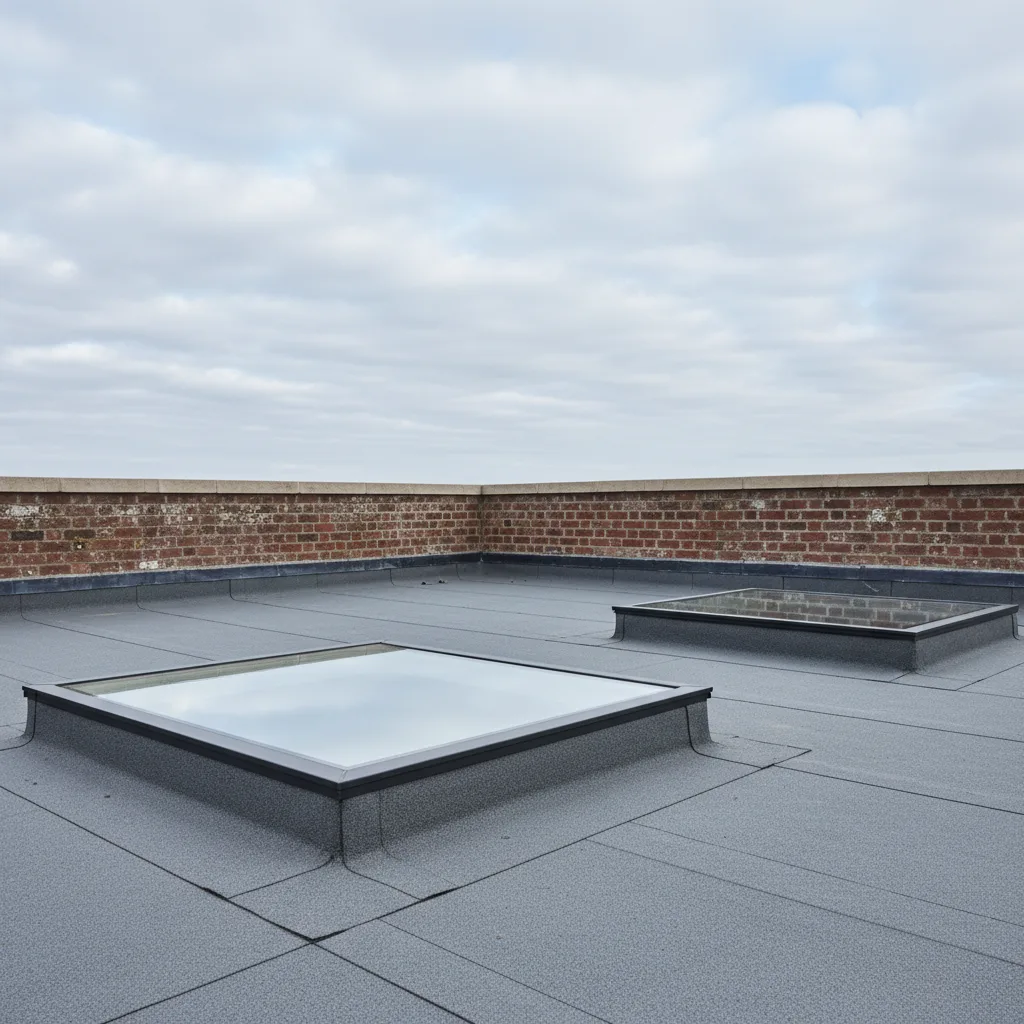
Timber, usually laminated pine, finished with a clear lacquer or a white paint. The traditional construction and still the most common.
Polyurethane, which is not a plastic window. It is a timber core encased in a moulded polyurethane skin, so it has the structural properties of wood and a seamless, non porous, moisture resistant surface with no joints for water to enter.
Both are clad externally in aluminium, so the difference the owner experiences is entirely internal.
Where polyurethane wins clearly
Bathrooms, kitchens, utility rooms, and any space with sustained high humidity.
A lacquered timber window in a bathroom will need its finish maintained on a much shorter cycle than one on a landing, and the point at which people notice is usually the point at which water has already reached the wood at a joint.
The polyurethane skin has no joints at the corners, so there is no route in. It wipes clean, it does not need redecorating, and it does not discolour.
For a bathroom rooflight, it is the straightforward choice.
Where timber wins
Appearance, in a room where it matters. A clear lacquered pine window in a loft bedroom or a study has a warmth that a white moulded frame does not, and it sits with timber floors and exposed structure in a way white plastic looking finishes do not.
Flexibility, because it can be repainted or restained to suit a redecoration. A polyurethane frame is the colour it is.
And on a period property or a listed building, where the internal appearance may be part of what is under discussion, timber is frequently what is expected.
Maintenance compared honestly
Polyurethane: wipe it. That is the whole regime.
Timber: inspect the finish annually, particularly at the bottom corners of the sash and at any joint, and renew it before it fails rather than after. In a dry room that might be every several years. In a bathroom, considerably more often.
Neither is difficult. The difference is that timber requires you to remember, and the consequence of forgetting is water in the wood.
Cost and availability
Polyurethane usually carries a modest premium, and both are held in stock sizes by mainstream manufacturers, so lead times are comparable.
Choosing on one roof
Where several windows are visible together from the same room, keep them consistent. Where they are in different rooms, matching the frame to the room is sensible: polyurethane in the bathroom, timber in the bedroom, both from the same range so the external appearance is identical.
What each looks like after twenty years
A well maintained timber frame ages gracefully and can be refinished to look new. A neglected one goes dark at the joints and eventually rots at the bottom corners.
A polyurethane frame looks much the same at twenty years as at one, provided it has been wiped occasionally. It cannot be refinished, so any damage is permanent, but there is very little to damage it.
More on Roof Window Installation
Ready to bring the daylight in?
Tell us about your project and we’ll send a clear, fixed written quote, no pressure, no surprises.
- Fixed written price before any work starts
- No pressure, no obligation, no sales calls
- Flexible survey times that suit you
- A reply within one working day