Daylight factor, and how much light you actually gain
A rooflight delivers far more light than a window of the same area, and there is a reason.
Part of our Energy Efficient Rooflights guide
Daylight factor is the ratio of internal illuminance to the unobstructed outdoor illuminance, expressed as a percentage. It lets you compare rooms without worrying about the weather on the day.
Rough guide

- Under 1 per cent: gloomy, lights on most of the day
- 1 to 2 per cent: adequate for circulation
- 2 to 5 per cent: good for living space
- Above 5 per cent: bright, and glare and overheating become the concern
Why rooflights beat windows
A rooflight of a given area typically delivers two to three times the daylight of a wall window of the same area. Three reasons.
It sees the whole sky. A wall window sees roughly half the sky dome and half the ground. A rooflight sees the sky directly, and the sky is far brighter than the ground.
Nothing obstructs it. A window looks at a fence, a hedge, a building opposite. A rooflight has clear view unless there are overhanging trees.
It lights the middle of the room. Light from a window falls away rapidly with distance; light from a rooflight lands where it is placed.
This is why one modest rooflight transforms a room that two windows leave dim.
What reduces it

Deep reveals that are not splayed, dark reveal colours that absorb rather than reflect, heavy solar control on a north facing unit, and overhanging trees.
A working rule
For a habitable room, glazing of around 20 per cent of floor area is a common starting point, and a rooflight counts for more than its area. In a room with wall windows already, a rooflight of 10 per cent of floor area makes a substantial difference.
Distribution beats total

Two rooflights spread along a long room give a better result than one of twice the size in the middle. It is the same principle as the daylight factor itself: what matters is the light where you are, not the total entering the room.
Why a rooflight beats a wall window
The usual figure quoted is that a rooflight admits around twice as much daylight as a vertical window of equal area, and in the right conditions rather more. The reason is geometry rather than product quality.
A wall window sees a hemisphere of which roughly half is ground, and it looks at the sky at a shallow angle near the horizon. A rooflight faces the sky directly and sees the zenith, which on an overcast day is around three times brighter than the horizon.
That last point matters enormously in this country, because overcast is the normal condition. The advantage of a rooflight is greatest on exactly the days when you most want the light, which is not true of a south facing wall window whose advantage is greatest when you least need it.
What daylight factor means

Daylight factor is the ratio of the light inside a room to the light outside under an overcast sky, expressed as a percentage. It is a way of describing how well a room is daylit that does not depend on the weather at the moment you measure it.
Rules of thumb rather than regulations: below about 1 percent a room reads as poorly daylit and needs artificial light most of the time. Around 2 percent it is adequately lit. Around 5 percent it reads as genuinely bright, and a room does not really need artificial light during the day.
The useful thing about the measure is that it accounts for the whole room rather than the window, so it captures the difference between light that lands usefully and light that lands on one patch of floor.
The practical rule
Glazed area of around 15 to 20 percent of floor area gives a bright room without turning it into a greenhouse.
Below about 10 percent the room reads as adequately lit rather than bright. Above 25 percent you are into overheating territory on any south or west facing aspect, and you are paying for solar gain and heat loss rather than for useful daylight.
That is a starting point, and three things shift it: a deeper plan justifies more, a north facing aspect allows more because there is no gain to manage, and a lot of existing vertical glazing means the roof is supplementing rather than providing.
What reduces the gain

The reveal. The biggest avoidable loss and the one nobody prices in.
A rooflight in a thick insulated roof sits at the end of a tunnel. A square boxed reveal throws a narrow beam straight down and blocks a surprising amount of what the window collects. A splayed reveal, cut back at an angle at the head and the sill, opens the beam out and distributes light across the room.
It costs a little more in plastering and it frequently means a smaller unit does the job. On a shallow pitch roof, where the reveal is longer, it is the best value decision available on the whole installation.
Pitch. A shallow roof gives a longer reveal and less headroom gain, so the same unit delivers less usable light than it would in a steep slate roof.
Glass specification. Solar control reduces light transmission from around 75 to 80 percent down to 60 to 70. Triple glazing reduces it noticeably. Obscure glazing reduces it further. Each is a deliberate trade rather than a fault, and each is a reason not to specify a coating on a slope that does not need it.
Dirt. A rooflight faces the sky and collects everything that falls out of it. On a pitched unit rain does most of the cleaning; on a near flat one it does very little, because water sits and evaporates leaving behind whatever it was carrying.
Room surfaces. A white ceiling and pale walls bounce light around and materially raise the daylight factor. A dark room absorbs it. That is not a rooflight decision and it changes the result.
Distribution, which matters more than total
Two units of the same total area as one large one will light a room better in almost every case.
One large unit gives a bright pool with the corners darker by contrast, and the contrast makes the dark parts feel worse than they would with no rooflight at all. Two spaced across the slope read as ambient daylight.
They also have the practical advantages: each can frequently sit clear of the structure without trimming, cost per square metre of glazing rises steeply with pane size, and they fail independently.
On a long narrow room a run of three modest units beats one large one comfortably.
Orientation and what it does to the character of the light

Total daylight over a year does not vary as much with orientation as people expect, because diffuse skylight dominates in this climate. What varies is the character.
North gives even, cool, glare free light through the whole day, with no moving patch of brightness. It is the best working light in any building, which is why studios have always used north lights, and it should be specified for thermal performance alone with no solar control coating.
South gives the highest peak and the most variation, with direct sun through the middle of the day. Solar control is not optional on anything substantial.
West gives low angle afternoon light that penetrates deep into a room, which is dramatic and is the hardest to control.
East gives early morning light, welcome over a kitchen and difficult over a bedroom.
Sun tunnels, for comparison
A different order of magnitude, and worth stating so the comparison is honest.
A 350mm sun tunnel has an aperture of under a tenth of a square metre. No amount of reflective efficiency turns that into a rooflight, and light loss compounds along the tube.
What a tunnel delivers, on a dull afternoon in a windowless bathroom, is enough soft daylight not to reach for the switch. That is a genuinely useful result in a room that has never had any, and it is not comparable with the daylight factor a rooflight achieves.
How to think about it before ordering

Start with the floor area and aim at 15 to 20 percent glazed. Adjust for aspect and for how much other glazing the room has.
Then decide distribution before size: how many units, spaced where, so the light lands across the room rather than in one place.
Then let the structure constrain it, because on a trussed rafter roof a unit narrow enough to sit between trusses needs no structural work and anything wider does.
Then specify the glass by orientation.
And finally, splay the reveals. It is the cheapest daylight you will buy.
What daylight factor measures
The ratio of the light indoors at a given point to the light outdoors under an unobstructed overcast sky, expressed as a percentage.
Using an overcast sky as the reference is deliberate. It removes the sun from the equation, so the figure describes the geometry of the opening rather than the weather on a particular day, and it makes different designs comparable.
As a rough sense of scale, a room with a daylight factor of a couple of percent reads as adequately lit for general purposes, and rooms at half that feel gloomy and need the lights on through the day.
Why a rooflight beats a window of the same area
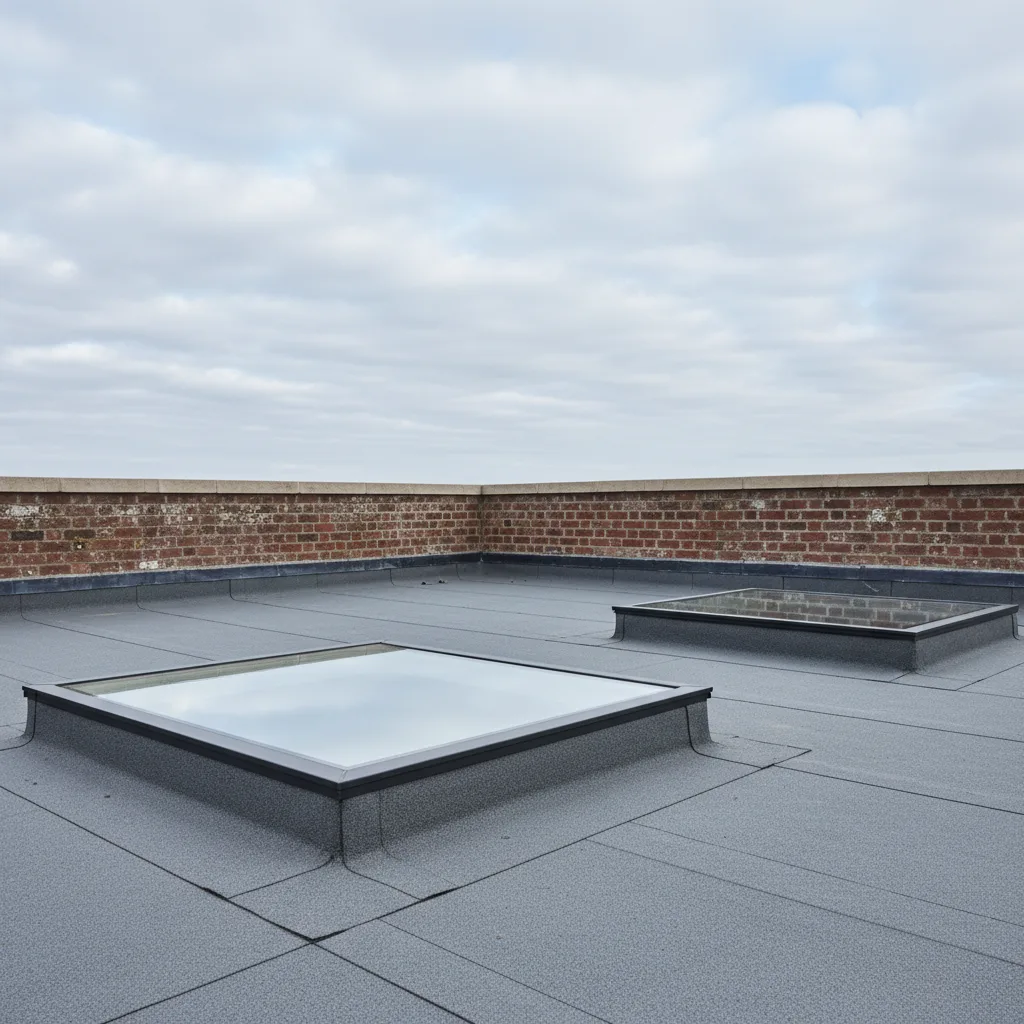
Because it faces the whole sky.
A vertical window sees roughly half the sky at best, and in practice far less once you subtract the ground, neighbouring buildings, fences and vegetation. The brightest part of an overcast sky is directly overhead, and a wall window sees none of it.
A horizontal rooflight sees the whole hemisphere, including the brightest part. That is why a modest rooflight transforms a room that a similarly sized window would barely improve.
The multiple varies with obstruction, but the direction of the effect is consistent and large.
The diminishing return people do not expect
Perceived brightness does not track measured light linearly. The eye adapts, and it adapts logarithmically.
Which means doubling the glass area does not make a room feel twice as bright. It makes it noticeably brighter, and considerably less so than the arithmetic suggests.
Meanwhile solar gain and heat loss do scale with area, linearly.
So beyond a certain point, additional glass buys a small perceptual gain at a full thermal cost. That is the argument for a smaller unit with better glass rather than a larger one with standard glass.
Distribution matters more than quantity
A single large opening produces a bright zone and dark corners. Two smaller openings spread across a room produce a more even result and read as better lit, even where the total glass area is the same or less.
This is why two modest rooflights frequently beat one large one, and why the position relative to the room matters as much as the size.
What increases the delivered light without more glass
Splayed reveals, which bounce light sideways instead of dropping it in a shaft.
Pale matt finishes on the reveal and the ceiling around it.
And clear rather than heavily coated glass where the orientation permits, since every coating and every additional pane costs transmission.
More on Energy Efficient Rooflights
Ready to bring the daylight in?
Tell us about your project and we’ll send a clear, fixed written quote, no pressure, no surprises.
- Fixed written price before any work starts
- No pressure, no obligation, no sales calls
- Flexible survey times that suit you
- A reply within one working day