Are flat rooflights secure?
More than they look. The laminated pane that makes them safe overhead also makes them hard to break through.
Part of our Flat Roof Rooflight Installation guide
The concern comes up most on single storey rear extensions, where the roof is reachable from a garden. The specification that makes a rooflight safe overhead happens to make it a poor way into a house.
The glass
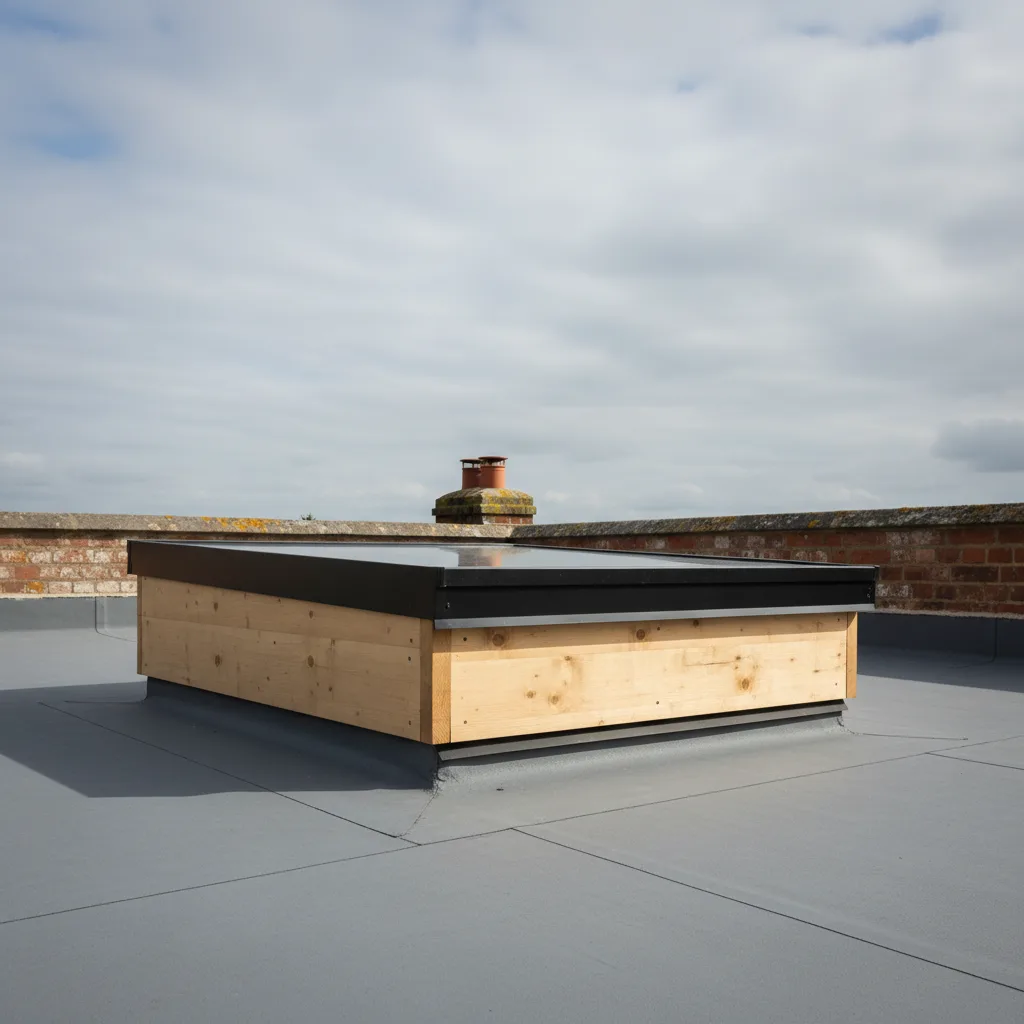
Overhead glazing is normally toughened outer, laminated inner. The laminated pane exists so that if the outer breaks, nothing falls into the room.
The same property defeats a break-in. The outer shatters loudly into granules; the laminated pane behind then has to be cut through rather than smashed, because the interlayer holds it together. It is slow, extremely noisy and conspicuous, which is the opposite of what anybody breaking into a house wants.
Where the weakness is

Fixings. A unit held by screws reachable from outside can be unfixed. Correct installation uses concealed fixings.
Opening units. A mechanism can be forced where a fixed pane cannot. Multi-point locking matters, and on an electric unit an actuator that holds position under load.
When to specify more

Ground floor or garage roofs, secluded positions, or a property that has been targeted before. A thicker laminated inner pane is a modest cost at order and cannot be added later.
If your insurer specifies a standard for accessible glazing, tell us at survey and we will meet it.
What we would not do

Fit bars or a grille over a domestic rooflight. It defeats the purpose, it creates a fire escape problem, and the glass already does the job.
More secure than most people assume

A modern flat roof rooflight is a harder point of entry than a ground floor window, and there are four reasons.
The glass. The outer pane is toughened and the inner pane is usually laminated, which means two plies bonded with an interlayer. Laminated glass does not simply break out: it cracks and stays in place, and getting through it takes sustained, loud, visible effort with tools.
The fixing. The unit is mechanically fixed to a kerb and bonded, not clipped in. There is no bead to lever off from outside as there is on some older window designs.
Access. Getting onto a flat roof is itself an obstacle, and doing it is conspicuous.
Exposure. Someone working on a roof is visible from further away and for longer than someone at a back door.
Where the weak points actually are

Old polycarbonate domes. This is the real vulnerability and it is what gives flat rooflights their reputation. A twenty year old multiwall polycarbonate dome, sometimes simply screwed down or held by clips, is a genuinely weak point and it degrades with ultraviolet exposure. If that is what you have, replacing it with a modern glass unit is a security improvement as well as a thermal one.
Opening units without a proper locking mechanism. A manual vent that latches rather than locks. Check what yours actually does.
Electric units, in a specific sense. They are not easier to force. But a unit that opens by remote or app is a unit whose controls should not be left accessible, and a chain actuator held only by its own mechanism should be specified with a locking function where security matters.
What to specify if it concerns you

Laminated inner pane as a minimum, which most quality units have as standard. Where the unit is genuinely accessible from a flat roof reachable from a garden, ask for a security rated laminate.
Multipoint locking on an opening unit rather than a single catch.
Mechanical fixing to the kerb specified, not just bonding.
And keep the ladder locked away, because the commonest way anybody gets onto a domestic flat roof is a ladder left in the garden.
Insurance

Insurers do not generally treat a rooflight as a special risk, and a modern glass unit properly fitted will not prompt any question. Where a policy specifies particular glazing standards for accessible openings, tell us at quotation stage and we will specify to it.
The upgrade worth making
If what you have is an old polycarbonate dome, replacing it with a modern glass unit improves security, thermal performance and appearance in one job.
Multiwall polycarbonate degrades under ultraviolet, discolours, and on older fixings is genuinely the weakest point on a domestic flat roof. It is also the cheapest thing on a roof to replace properly.
Ask us
If your insurer has specified a glazing standard for accessible openings, tell us at quotation stage and we will specify to it rather than leaving you to check afterwards.
What we specify as standard
A laminated inner pane, mechanical fixing to the kerb rather than bonding alone, and multipoint locking on any opening unit. Where a rooflight is genuinely accessible from a flat roof reachable from a garden, we will recommend a security rated laminate and say why.
One last point
The commonest way anybody gets onto a domestic flat roof is a ladder left in the garden. Locking it away does more for the security of a rooflight than any glazing specification will.
The realistic risk
A flat rooflight on a single storey extension, reachable from a garden wall or a flat roof, is a plausible entry point in a way a rooflight on a second storey slope is not.
Whether it deserves attention depends on access. If somebody can get onto the roof without a ladder, the rooflight matters. If they cannot, it is a low priority.
What actually resists attack
Laminated glass. This is the measure that matters. Toughened glass shatters into small fragments and clears the opening entirely. Laminated glass holds together on the interlayer, so an attacker is left with a cracked but intact pane and a great deal more noise and time.
Specify laminated on the inner pane at minimum, and on both where the risk is real.
Frame fixings and mechanism. On an opening unit, multi point locking and secure hinges matter. On a bonded fixed unit, the glass is the attack surface.
Bonded construction. A structurally bonded flat rooflight has no beads to lever, which is an advantage over a mechanically glazed unit.
What to check on an opening unit
That a powered unit cannot be driven open from outside, and that the actuator holds the sash closed rather than merely resting it there.
Some manufacturers publish security ratings against recognised standards, and where security is a genuine concern that is what to ask for rather than a general assurance.
The wider point
Laminated glass is a modest cost at order and cannot be added afterwards without replacing the unit. On any rooflight that could be reached, it is worth taking.
More on Flat Roof Rooflight Installation
Ready to bring the daylight in?
Tell us about your project and we’ll send a clear, fixed written quote, no pressure, no surprises.
- Fixed written price before any work starts
- No pressure, no obligation, no sales calls
- Flexible survey times that suit you
- A reply within one working day