Are rooflights bad for insulation?
Glass will never match 150mm of insulation. What matters is that the loss is small and the gain is real.
Part of our Energy Efficient Rooflights guide
Honestly, a rooflight loses more heat per square metre than the insulated roof it replaced. Glass is not going to match 150mm of insulation and nobody should pretend otherwise.
The question is whether that matters, and mostly it does not.
The arithmetic

A well insulated flat roof might be around 0.15. A good rooflight is around 1.2. So per square metre it loses roughly eight times as much.
But the area is small. A 1200 by 1800 rooflight in a 25 square metre extension roof is about nine per cent of the area, and the additional loss over an insulated roof works out modest in the context of the whole building.
What you get back

Daylight, which reduces lighting load through the day.
Winter solar gain, which on a south facing rooflight is genuinely useful. Overhead glazing collects more winter sun than a vertical window because it faces the sky.
A room people use, which is the actual point.
Where it goes wrong

Not usually the glass. Two other things.
An uninsulated kerb, which frequently loses more than the glass and appears on no specification.
Too much glass with no solar control, where the summer overheating cost outweighs any winter benefit.
The comparison worth making

Against the old rooflight, if there is one. A unit from twenty five years ago at around 3.0, replaced by a modern one at 1.2, is a large improvement rather than a loss.
Against a solid roof, a rooflight costs a little heat and buys a lot of daylight. That is a trade most people are content with once it is stated plainly.
They are a deliberate trade

A rooflight performs worse thermally than the insulated roof it replaces. A good roof is around 0.15; a good rooflight is 1.2 to 1.4 whole unit. That is a large ratio and there is no point pretending otherwise.
What makes it reasonable is area and purpose. A rooflight is a small proportion of a roof, and it delivers two to three times the daylight of the same area of wall window. You are exchanging a modest amount of thermal performance for a large amount of daylight over a limited area.
Where the real losses are

Not usually the glass, which is why fixating on U-values misses the point.
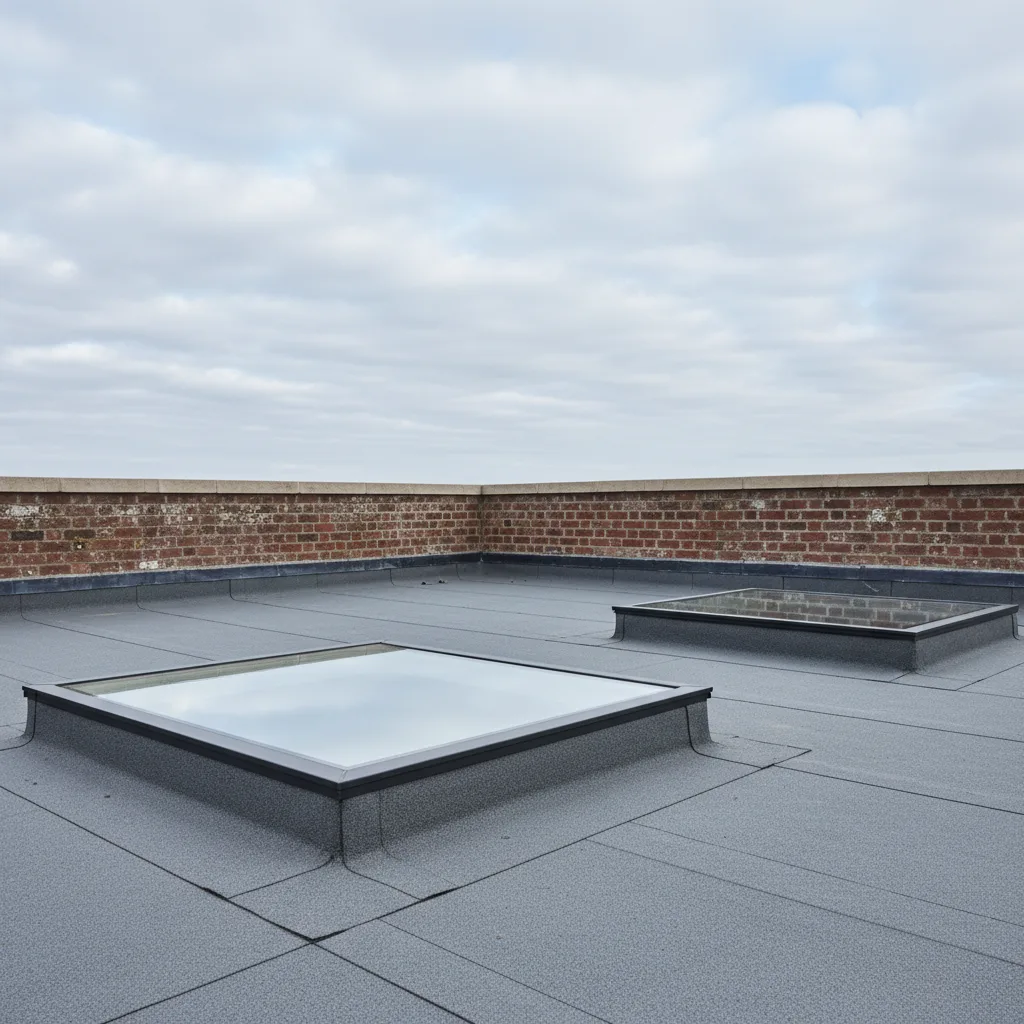
The kerb, on a flat roof. A 1200 by 1800 rooflight has six metres of perimeter, and an uninsulated timber kerb punches straight through the roof insulation around all of it. That presents close to a square metre of poorly performing envelope, which is comparable to leaving a patch of the roof uninsulated. Insulating the outer face is a sheet of rigid board and an hour, and it disappears under the covering, which is exactly why it gets skipped.
The insulation collar, on a pitched roof. Its absence leaves the reveal cold enough for room air to condense on it, which is both a heat loss and the commonest cause of water on a plaster reveal.
Air leakage. Gaps around an opening lose more heat than conduction through a small area of glass. A properly sealed vapour control layer, continuous and taped to the frame, prevents it.
The spacer bar. A traditional aluminium spacer conducts heat around the whole perimeter of every pane, showing as a band of condensation at the edge of the glass on cold mornings. A warm edge spacer removes most of it.
What to do about it

Specify a good whole unit U-value and a warm edge spacer. Insist on the insulation collar or the insulated kerb, named on the quotation. Make sure the vapour control layer is continuous and sealed.
Then specify solar control glass where the unit faces the sun, because a rooflight loses heat in winter and gains it in summer, and the summer side is what people actually complain about.
What not to do
Reach for triple glazing as the answer. It takes the whole unit figure from around 1.2 to around 0.8, at the cost of weight, daylight transmission and a good deal of money, and it does very little about solar gain.
The same money spent on the kerb and the glass coating does more for how the room feels through the year.
The honest position
A rooflight loses heat faster than the insulated roof it replaces. Glass is not insulation, and no glazing specification changes that.
What is negotiable is how much faster, and it varies enormously. A poorly specified unit in a badly detailed opening can lose several times what a good one in a well detailed opening loses.
Where the loss actually is
Less in the glass than people assume, and more at the edges.
A rooflight is frequently small, and a small unit has a great deal of perimeter relative to its glass area. The spacer, the frame, and the junction between the frame and the roof insulation carry a disproportionate share.
Which is why the whole unit U value and the centre pane figure diverge, and why the perimeter detailing on site matters as much as the product specification.
What actually reduces it
A warm edge spacer. A low emissivity coating and a gas fill. An insulation collar around the frame on a pitched roof, or a fully insulated kerb on a flat one. Insulation carried continuously around the reveal. And a vapour control layer sealed to the frame, which prevents the hidden condensation that ruins insulation performance from within.
The other side of the ledger
Daylight replaces electric light, and a room that is naturally lit through the day uses less.
Solar gain in winter is a genuine heat input on a south facing slope, and it arrives free.
And a well lit room gets used, which is worth something that does not appear in a U value calculation. The honest framing is that a rooflight is a thermal cost bought deliberately for a benefit, and the job is to keep the cost as low as it can reasonably go.
More on Energy Efficient Rooflights
Ready to bring the daylight in?
Tell us about your project and we’ll send a clear, fixed written quote, no pressure, no surprises.
- Fixed written price before any work starts
- No pressure, no obligation, no sales calls
- Flexible survey times that suit you
- A reply within one working day