Can you fit a flat rooflight to a felt roof?
Yes, and felt is one of the more forgiving coverings to work into.
Part of our Flat Roof Rooflight Installation guide
Yes. Torch-on reinforced bitumen membrane is one of the easier coverings to detail a rooflight into, and it is very common on extensions in this area.
How the detail works
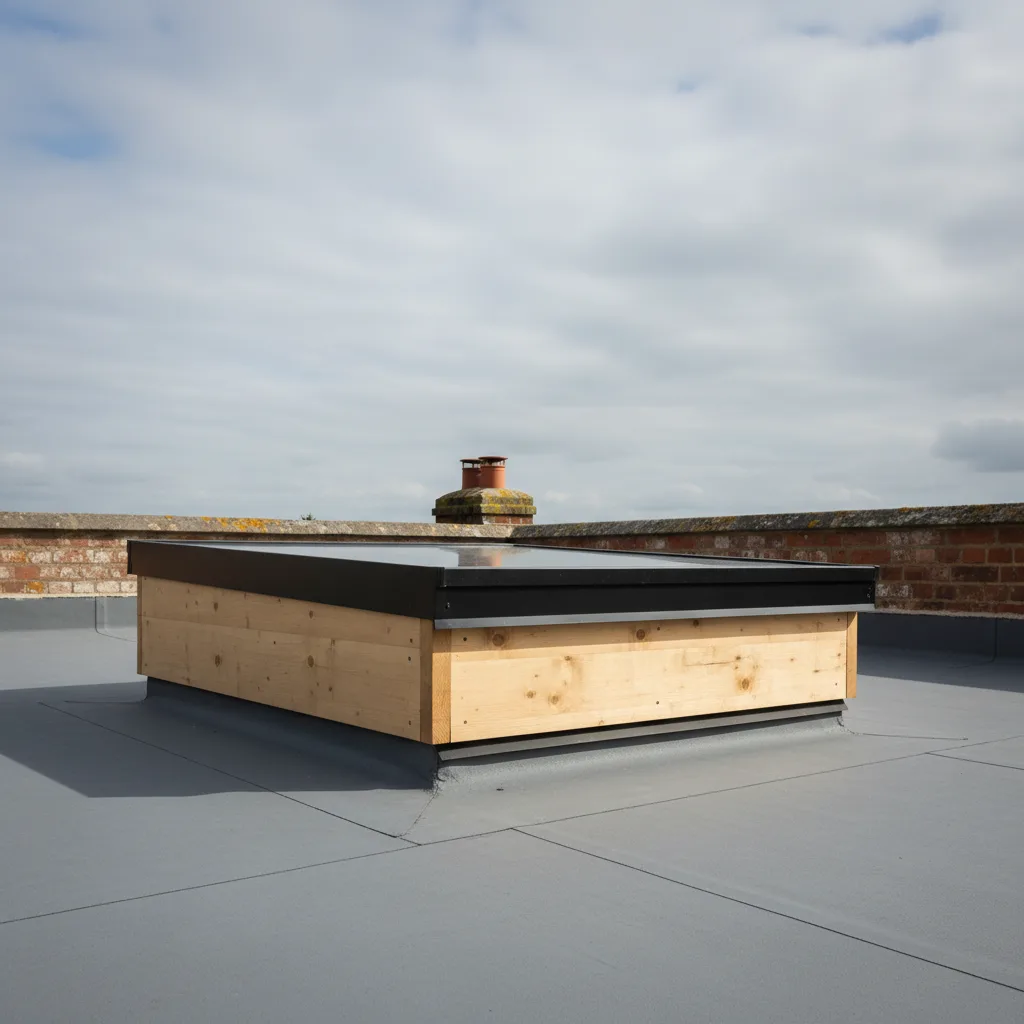
The felt is dressed up the full face of the kerb and terminated under the rooflight frame flange. On a good installation the upstand detail uses the same layers as the field of the roof, with the cap sheet carried up and finished neatly at the top.
New felt bonds to old with heat, so a joint made into an existing roof can be as good as the original provided the existing material is sound.
When it is not straightforward

Age. Felt has a life, typically twenty to twenty five years for a good three layer system. On an older roof the surface has weathered and the bond a new joint achieves is less reliable.
Blistering or splitting. Where the existing membrane has failed generally, cutting a neat hole in it solves nothing. The honest recommendation is recovering rather than patching.
Mineral surface. The chippings or mineral finish has to be cleaned back at the joint for a proper bond.
The economics

If the roof is near the end of its life, doing the rooflight and the recovering together is much cheaper than doing them separately, because the access, the setting up and the making good are shared.
We will say so at survey rather than cutting into a roof you will replace in two years.
Cold roofs

Older felt roofs are frequently cold roof construction, ventilated above the insulation. A rooflight kerb must not block that ventilation path, and the vapour control layer at ceiling level must be sealed around the opening.
Yes, and it is a common installation

Built up felt, torch on felt and modern high performance bituminous membranes all take a rooflight perfectly well. The principles are the same as on any flat roof and the detail is well established.
What matters is the kerb and the way the felt is dressed to it, not the fact that the covering is felt.
Building the kerb and dressing the felt

The kerb is built up from the deck, at least 150mm above the finished surface, square and level, with rigid insulation on its outer face. The felt is then dressed up the full height of the kerb and terminated properly at the top, usually under a welted edge or a trim.
The rooflight sits on top with its own flange overlapping that termination, so water running down the pane and the frame lands on felt rather than at a joint.
Getting the order right matters. The felt goes up the kerb before the rooflight sits on it, not after.
Where felt roofs cause trouble

Age. Older built up felt becomes brittle and can crack when disturbed. On a roof approaching the end of its life, forming a new opening means working with a material that does not want to be worked with, and it is worth asking honestly whether the covering should be renewed at the same time.
Poor falls. Older felt roofs were frequently laid with minimal fall, and standing water is what kills a flat rooflight seal. That has to be corrected locally around the kerb rather than accepted.
Blisters and laps. Existing defects near the opening are worth putting right while the roof is open, because doing it later means disturbing the new work.
Compatibility

Bituminous membranes are not compatible with every material. Certain plastics and some sealants react badly with bitumen, and a rooflight system designed for single ply may need a different detail on felt.
That is a specification question rather than a problem, and it is one reason we survey rather than pricing from a photograph.
Torching near a rooflight
Where torch on felt is being used, there is a fire risk around combustible materials and around the rooflight frame itself. Competent roofers work cold or use a heat resistant detail close to the unit, and that is worth confirming rather than assuming.
If the roof is due for renewal
Doing both together is considerably cheaper than doing them separately, because the access, the setting up and the making good are shared, and because the kerb and the covering can be detailed as one job rather than one being retrofitted into the other.
If your felt roof is over fifteen years old and you are considering a rooflight, ask for both to be priced together before deciding.
Yes, and the covering type sets the method
Built up felt roofing is a layered system, and the waterproofing at a rooflight is formed by dressing the felt up the kerb and terminating it into the unit, with each layer lapped correctly.
On a torch on system that means heating and bonding the upstand detail properly, which is roofing work rather than something to be improvised around a unit that is already fixed.
The sequence
Kerb built, square, level and insulated. Felt dressed up the kerb and terminated. Then the unit set on and sealed. Not the other way round.
Felt dressed over the top of an installed unit runs the wrong way and cannot be corrected without stripping back.
The question worth asking first
How old the felt is.
Built up felt has a finite life, and on a roof approaching the end of it, cutting a new opening and forming a new detail is spending money on a covering that is about to be replaced. The rooflight then has to come out to recover the roof.
Where the felt has five years left, do both together. It costs less than doing them separately and the rooflight detail is formed as part of a new covering rather than patched into an old one.
Fall
Many older felt roofs have lost their fall through deflection, and standing water is what ends felt.
A kerb is an obstruction in that water path, so on a roof with marginal fall the rooflight creates a permanent pond on its upslope side. Correct the fall first, with firrings or tapered insulation, before the rooflight goes in.
Blistering
Blisters near the intended position indicate moisture trapped in the build up. Worth investigating before cutting into it.
More on Flat Roof Rooflight Installation
Ready to bring the daylight in?
Tell us about your project and we’ll send a clear, fixed written quote, no pressure, no surprises.
- Fixed written price before any work starts
- No pressure, no obligation, no sales calls
- Flexible survey times that suit you
- A reply within one working day