Do rooflights work on a north facing slope?
They give the best light in the building. Even, cool and glare free all day.
Part of our Energy Efficient Rooflights guide
Yes, and north light is the best light in the building for a great many purposes. The question usually comes from an assumption that no direct sun means no light, and that is not how daylight works.
What you get

Diffuse light from the sky rather than direct sun. It is even, it does not move through the day, it produces no glare and no hard shadows, and it is consistent in colour.
Artists’ studios face north for exactly this reason, and it has been the preferred light for detailed work for centuries.
The practical advantages

No overheating. No direct sun means no solar gain problem, which on a south facing rooflight is the main design constraint.
No glare on a screen or a work surface.
No fading of furnishings from direct sun.
Cheaper glass. No solar control needed, which is a real saving.
What to specify

Specify for U-value alone: low emissivity coating, argon fill, warm edge spacer.
Do not fit solar control glass. There is nothing to control, and it reduces the daylight you fitted the rooflight to get. It is one of the few genuinely wrong specification choices in this trade, and it happens when solar control goes on a whole quotation without checking orientation.
The trade-off

No winter solar gain, so no free heat on a cold bright day. Against that, no summer overheating.
Where north light is best

Studios, home offices, kitchens where you work at a surface, and any room where consistent light matters more than sunshine.
Better than most people assume

A north facing rooflight never sees direct sun. What it gives instead is even, cool, glare free daylight from first light to dusk, with no moving patch of brightness across the room and no need for shading.
That is the best working light in any building, and it is why artists’ studios and industrial buildings have always used north lights. On a kitchen work surface, a desk or a bench it is worth more than a south facing unit twice the size.
What you actually notice

Consistency. A south facing rooflight is dramatic at midday and dimmer at each end of the day. A north facing one is steady, and in a working room that is the more useful behaviour.
No glare. No direct beam means no patch of sun moving across a screen or a worktop, and no need to close a blind at a particular hour.
No overheating. Nothing to control, which removes the single most common complaint about rooflights entirely.
Overcast days are the same. On a cloudy day the whole sky is the light source, so a north facing unit performs almost identically to a south facing one. In this country that is most of the year.
How to specify it
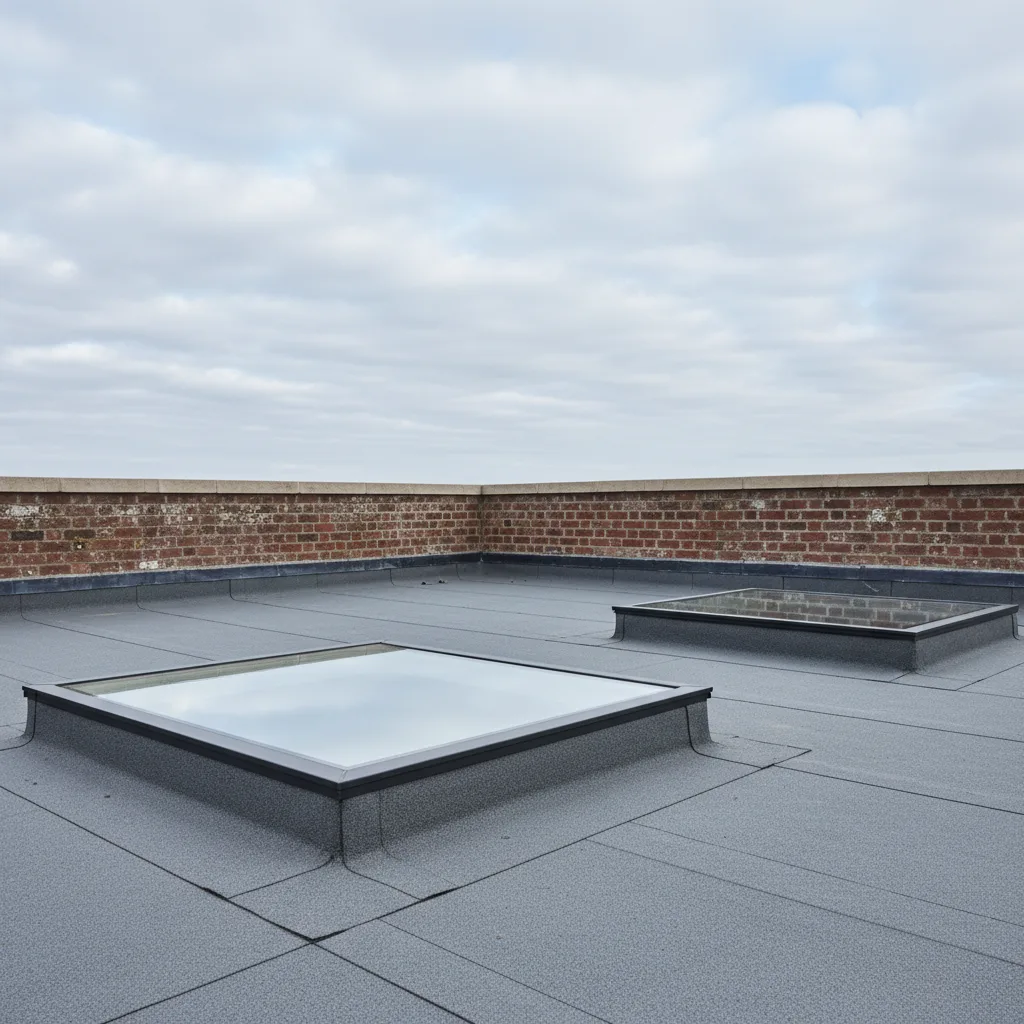
For thermal performance alone. A good whole unit U-value, a warm edge spacer, and an insulated kerb or insulation collar.
Do not fit solar control glass. There is no direct sun to control, and the coating reduces visible light transmission. On a north facing rooflight it makes a good room slightly darker and delivers nothing at all. It is one of the commonest wasted upgrades we see on quotations, where the same glass has been specified across every unit regardless of which way it faces.
Spend the saving on the kerb insulation instead.
The one practical difference
North facing slopes hold moss and algae more readily, because they dry more slowly. Rain does less of the cleaning, so a north facing rooflight benefits from being cleaned when the gutters are done.
Self cleaning glass helps less on a north slope than a south one for the same reason.
The choice worth making deliberately
On a hipped roof, or any property with slopes facing more than one way, you frequently have a genuine choice. It is worth making on the merits rather than defaulting to whichever slope faces the garden.
Put the working light on the north, and put solar control glass on anything facing south or west.
Where north facing is actively the better choice
Over a kitchen work surface, a desk, a workbench or a studio. Even, cool, glare free light through the whole day with no moving patch of brightness across the surface and no need to close a blind at a particular hour.
Over any room that already gets sun from elsewhere and does not need more heat.
And on any project where the budget matters, because a north facing unit needs no solar control glass and no external shading, which is a genuine saving rather than a corner cut.
Where to put the money instead
On the kerb insulation, or the insulation collar on a pitched roof, which is where the heat actually leaves and which is the first thing dropped from a cheap quotation.
On a warm edge spacer, which removes the band of edge condensation an aluminium spacer produces on cold mornings.
And on splaying the reveal, which opens the beam out and makes a modest window feel considerably larger. On a north facing unit, where every bit of light is useful and none of it is unwanted, that is the best value decision available.
They work very well, and differently
A north facing rooflight receives no direct sunlight, so what it delivers is diffuse skylight: even, steady, and consistent through the day with no glare and no moving patches of sun.
That is why artists traditionally wanted north light. It renders colour consistently and it does not change hour by hour.
The advantages people underestimate
No overheating. The single most common regret with rooflights does not apply here at all, and specifying solar control glass on a north slope would make the room darker for no benefit.
No glare on screens, which matters in a study or a home office.
No fading of furnishings from direct sun.
The trade
Less total light, and no winter solar gain, so the heat loss is not offset the way it is on a south facing slope. That argues for prioritising the thermal specification: a good whole unit U value, a warm edge spacer, and careful perimeter detailing.
And it argues for going somewhat larger, or for a second unit, since there is no overheating penalty for doing so. On a north slope, more glass is a straightforward gain in a way it is not elsewhere.
More on Energy Efficient Rooflights
Ready to bring the daylight in?
Tell us about your project and we’ll send a clear, fixed written quote, no pressure, no surprises.
- Fixed written price before any work starts
- No pressure, no obligation, no sales calls
- Flexible survey times that suit you
- A reply within one working day