Matching a discontinued frame profile
Where several windows share a roof and only one has failed, matching matters more than it seems.
Part of our Replacing a Failed or Misted Rooflight guide
Replacing one window out of three on a visible slope raises a question the price list does not answer: will it look like the others.
What differs between generations

External cladding colour and finish. Manufacturers have changed standard greys several times. A new window beside a twenty year old one can be visibly different in tone even from the same maker.
Frame proportions. Sightlines have generally slimmed. A modern unit shows more glass and less frame, which is better in isolation and obvious in a pair.
Projection. Older units often sit differently relative to the covering, so a new one can sit slightly higher or lower.
Glazing bar position on units that have one.
The options
Accept the difference. On a rear slope nobody sees, entirely reasonable and the cheapest answer.
Match the cladding colour to the existing where the manufacturer offers it. This gets you most of the way for very little.
Replace them all. Where the others are the same age they will fail within a few years anyway, and the access cost is shared across all of them in one visit.
That last option is frequently better value than it first sounds, and it is the honest recommendation on a front elevation.
Where matching is genuinely required

On a listed building or in a conservation area, where a replacement may be conditioned to match the existing. Then a bespoke or specialist unit may be the only route, and it is worth establishing before ordering anything.
What we do
Say at survey how visible the difference will be, from where, and what the options cost. It is your decision, and it should be made with the information rather than discovered on the day.
Why sizes and profiles disappear

Manufacturers revise their ranges every decade or so. Sizes are rationalised, profiles are slimmed to show more glass and less frame, cladding colours change, and occasionally a whole range is withdrawn when a factory retools.
None of that is a problem while a window is working. It becomes one at the point of replacement, and since a sealed unit lasts fifteen to twenty five years, most replacements arrive well after the original went out of production.
On anything fitted before about 2000 you should expect the size to be obsolete. It is normal rather than unlucky, and it is entirely solvable.
Start with the data plate
Every unit carries a plate identifying manufacturer, model and size code, usually on the top edge of the sash or on the frame beside the hinge. On a centre pivot window, rotating the sash brings it into easy view.
Photograph it rather than transcribing it. The characters are small, several are easily confused, and a mistyped code buys the wrong window.
The size code describes the structural opening, which is not a dimension you can take from inside the room. Measuring the visible glass or the internal reveal gives a number and it is not the number the manufacturer works from.
From that photograph we can normally tell you what it is, whether the size is still made, what the options are if not, and a realistic price, without anybody visiting.
Where the plate has gone

Painted over, weathered away, or removed at some point. Then it comes down to measurement, and that means a survey rather than a phone call, because the dimension that matters is the structural opening behind the lining.
A photograph of the window from inside and outside still helps a great deal. The profile of the frame, the hinge position, the flashing type and the cladding colour frequently identify the range even without a plate, and narrowing it to two candidates makes the survey quicker.
Route one: adapt the opening
Usually the right answer, and the one we recommend most often.
Current sizes are frequently within 40mm or 60mm of an old one. Adapting means packing out or trimming back the structural opening and making good the reveal, which is invisible when finished.
The real advantage is what it leaves behind. After this, the opening is a standard current size, so the next person replacing it in twenty five years has a straightforward job rather than the one you are having now.
Where the reveal is being replastered anyway, which on a replacement it usually is, the additional work is modest.
Route two: another manufacturer at the old dimension

Ranges from different makers overlap, and a size discontinued by one may still be current with another.
This is worth it where the opening is genuinely awkward to alter: tight against a purlin, a steel, a party wall, or a historic timber that cannot be cut. In those situations altering the opening is not a matter of a few millimetres of packing.
The trade is a mixed set of windows on one roof. On a rear slope nobody sees, that is irrelevant. On a front elevation or a matched row it may not be, and it is worth looking at the two units side by side in a brochure before committing.
Route three: reframe to a current size
More work now, and the right answer in two situations.
Where several windows on one slope are being standardised, so that future replacements are all the same and the flashing kits and blinds are interchangeable.
And where the timber around the opening needs replacing anyway. If we are cutting out decayed trimmers regardless, reframing to a standard size costs very little more and it solves the problem permanently.
What never to do

Force a modern unit into an old opening and pack the difference.
It survives about a year. The packing settles, the frame goes out of square, the sash stops closing evenly against the compression gasket, and water gets past. By then the covering is back on and nobody can see what was done.
Where a quotation for a replacement with an obsolete size is noticeably cheaper than the others, this is sometimes why, and it is worth asking directly how the size difference is being dealt with.
Matching the appearance
Separate from matching the size, and it comes up when replacing one unit out of several on a visible slope.
Even a same manufacturer replacement will not look identical to a twenty five year old window. Cladding colours have changed several times. Sightlines have generally slimmed, so a modern unit shows more glass and less frame. Older units frequently sit differently relative to the covering.
Where a manufacturer offers a matching cladding colour, that gets you most of the way for very little. Ask for the reference rather than a colour name, because two makers’ versions of the same nominal colour can differ.
Where a property is listed or in a conservation area, a replacement may be conditioned to match the existing, and that is worth establishing before anything is ordered.
The argument for doing them all

Units fitted at the same time fail at about the same time, because they have taken the same weather and the same thermal cycling.
Access is a fixed cost shared across everything done in the same visit, so on a slope with two or three units of the same age, replacing them together costs meaningfully less than replacing them one at a time as each fails.
It also removes the matching question entirely, standardises the openings for the future, and leaves you with a consistent elevation rather than one new window alongside two survivors.
We quote the whole slope itemised so you can see what each one costs and make the decision on real numbers.
What to record afterwards
The manufacturer, model, size code and glazing specification of whatever goes in, with the house paperwork rather than in a drawer.
In twenty five years somebody will be standing in this room with a torch trying to read a plate at height, and a piece of paper saves them a survey. We keep our own record of what we fitted for the same reason.
What you are actually trying to match
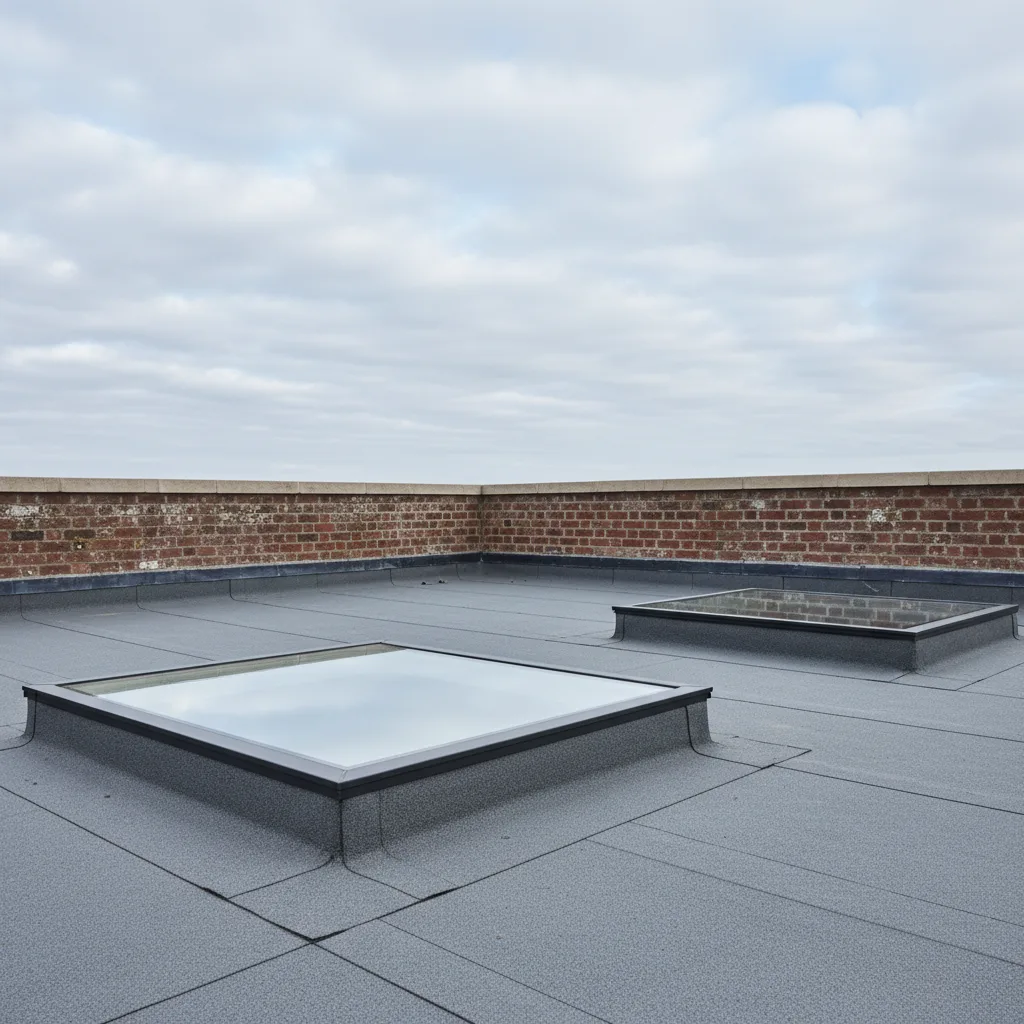
Not the size, which is a separate problem, but the appearance. And the appearance of a roof window is made of four things.
The external cladding profile. The pressed aluminium that covers the timber, and its shape and how it turns at the corners is what identifies a generation of product from the ground.
The frame to sash proportion. How much frame is visible around the glass, and how deep the sash sits within the frame. This is what you notice from inside.
The colour and finish of both the external cladding and the internal timber or coating.
The handle and control bar position and form, which is a small thing that reads surprisingly strongly in a room.
Where an exact match is impossible
Frequently, on anything more than fifteen years old. Manufacturers revise profiles when they revise ranges, and an obsolete profile is not reintroduced.
The realistic question becomes how close is close enough, and that depends entirely on where the windows are seen from.
The two viewing positions
From the ground outside. At an oblique angle across a roof, only the cladding profile and the colour register. Modern equivalents from the same manufacturer are usually indistinguishable at that distance, and a different manufacturer is frequently acceptable too.
From inside the room. Far more revealing, because the windows are seen side by side at close range in the same light. Frame proportions, handle position and the way the lining meets the plaster all show.
So the decision hinges on whether the replacement is on a slope with other windows visible from the same room.
The strategies
Same manufacturer, current equivalent. Usually close enough for both viewing positions and the default answer.
Replace them all. Where three or four are visible together and one has failed, doing them together while the access is up removes the matching problem entirely and shares the scaffold cost across all of them.
Put the odd one where it is not seen. Where only one window can be replaced now, and the roof has a hidden slope, consider whether the failing unit and a sound one can be swapped so the mismatch lands out of view. Rarely practical, occasionally elegant.
Accept it. On a rear slope with one window, matching is not a real requirement and buying a bespoke unit to achieve it is money spent on nothing.
Recording it for the future
When new windows go in, write down the manufacturer, model designation, size code, finish and glazing specification. In fifteen years that document turns a matching problem into a phone call.
Photographing a window for identification
Four images settle most cases. The data plate close up with the flash on. The whole window from inside showing the full frame and how the sash sits within it. The handle or control bar. And the external cladding profile from outside if it can be photographed safely.
A supplier who fits these regularly will identify most mainstream products from that set, and it takes five minutes rather than a survey.
More on Replacing a Failed or Misted Rooflight
Ready to bring the daylight in?
Tell us about your project and we’ll send a clear, fixed written quote, no pressure, no surprises.
- Fixed written price before any work starts
- No pressure, no obligation, no sales calls
- Flexible survey times that suit you
- A reply within one working day