Opening rooflights and the stack effect
Why one opening at the top of a room beats two windows in the walls.
Part of our Electric and Opening Rooflights guide
The reason an opening rooflight is worth so much more than its size suggests is not the area of the opening. It is where the opening is.
How it works

Warm air is less dense than cool air and rises. In a room with an opening at its highest point, that warm air leaves, and as it does it draws cooler air in through any lower opening: a door, a window, a trickle vent.
That creates a continuous flow driven by temperature difference rather than by wind. The greater the temperature difference and the greater the height between inlet and outlet, the stronger the flow.
Why it beats open windows
Two open windows in the same wall, at the same height, rely on wind to move air. On a still summer evening they do very little, which is exactly when a kitchen is hottest.
Stack effect works without wind. It is driven by the temperature difference the room has created itself.
Why a rooflight is ideal

It is at the highest point in the room by definition, so it is the best possible outlet position. In an open plan kitchen-diner with a high ceiling, the height difference between a door and a rooflight is substantial, and that height is what powers the flow.
Getting the most from it
Give it an inlet. A rooflight opening on its own has to draw air from somewhere. A door ajar or a window open at low level completes the circuit.
Open it early. Ventilating in the evening and overnight, when outside air is cooler, purges heat the building fabric has absorbed during the day.
The ridge of a lantern is the best position of all, being the highest point of the highest thing in the room.
Winter

The same effect works against you: a rooflight left open in winter empties warm air out of the top of the house quickly. Brief purge ventilation rather than leaving it ajar.
Why an opening in a roof beats a window in a wall
Warm air is less dense than cool air, so it rises. In a heated room, the warmest and wettest air in the space collects at the ceiling.
An opening at the highest point lets that air leave. As it goes it lowers the pressure slightly at the top of the room, and cooler denser air is drawn in through anything open lower down to replace it. Once started, the process is self sustaining as long as there is a temperature difference and openings at two heights.
That is stack ventilation, and it is why a rooflight ventilates a room in minutes where a wall window alone takes hours.
A wall window has no such driver. It exchanges air with the still layer immediately outside it, largely by wind pressure and diffusion, and on a calm day it does very little.
The condition people forget

It only works if something at low level is open too.
A rooflight open in an otherwise sealed room moves very little air. There is nowhere for replacement air to come from, so the flow stalls almost immediately. People then conclude the rooflight does not ventilate, when what they have built is half a system.
The inlet does not have to be large or dramatic: a wall window on the latch, a door to another room, a trickle vent. What matters is that it exists and that it is lower than the outlet.
The greater the height difference between inlet and outlet, the stronger the effect. A rooflight over a stairwell with a window open at ground floor level is the most effective arrangement in a house, because it uses the whole height of the building as the driver.
Night purge, which is the practical application
The most useful thing stack ventilation does in a domestic setting.
Through a summer day, a building absorbs heat: through glazing, through the fabric, and from cooking and occupancy. By evening the structure is warm and it will radiate that heat back into the rooms all night.
Open a rooflight late, with something open low down, and the accumulated heat leaves the building overnight while the outside air is cool. Close it in the morning before the outside air warms up, and the building starts the next day cooler than it otherwise would.
On a south or west facing extension that is the difference between a room used in July and one avoided.
It is also the single strongest argument for a motorised unit with a rain sensor, because night purge requires leaving a window open unattended. A window you have to remember to close before rain stays shut, and a window that closes itself gets left open.
Moisture, which is the winter application

Same mechanism, different problem.
Every home produces moisture: cooking, washing, drying clothes, breathing. Modern homes are airtight, so that moisture stays in the building until something removes it, and it condenses on the coldest surface available.
In a room with a rooflight that is frequently the rooflight, because it faces the cold night sky. So the window gets blamed for a problem it is merely revealing.
An opening at the highest point removes the moist air directly, and it does so far faster than a wall window. A few minutes of stack ventilation after a shower or while cooking removes more moisture than an hour of a window ajar downstairs.
In a bathroom or a kitchen it does not replace the extract fan, which should be sized for the room, on an over run timer or humidity sensor, and ducted outside rather than into a loft. It supplements it, and it is particularly effective at clearing the room quickly.
What Part F asks
Building Regulations separate two provisions.
Background ventilation: a small continuous provision to keep air moving and control moisture. On a roof window this is the trickle ventilator at the top of the sash, frequently with a filter behind it.
Purge ventilation: the ability to clear a room rapidly. This is what opening the window does, and it is calculated on free open area rather than on the size of the unit.
That distinction matters when choosing. A top hung window that swings clear gives a larger free open area than a centre pivot of the same size, because the centre pivot sash sits across the middle of the aperture.
Ask for the free open area figure for the specific model rather than assuming two units of the same nominal size are equivalent.
Where to put the opening unit

At the highest point of the room, which on a pitched roof means as far up the slope as the escape and access constraints allow, and on a flat roof means the high side of the fall.
Where there are several rooflights, only one needs to open. One opening vent among three fixed units gives you the ventilation without paying for three mechanisms, three actuators to maintain and three future actuator replacements at ten to fifteen years.
In a room with a lantern, the vent belongs in the lantern rather than in a flat unit alongside it, because the lantern apex is the highest point and that is where the warm air collects.
Multi storey stack
Worth mentioning because it is the most powerful version and the least exploited.
A rooflight over a stairwell, with the stair connecting to the ground floor, turns the whole house into a chimney. Open a ground floor window and the rooflight at the top, and the house ventilates through its full height.
On a warm summer evening that clears a house faster than anything else available, and it is why rooflights over stairwells are worth motorising even though they are the most awkward to reach.
The same principle works against you in winter if the rooflight leaks air, which is another reason the insulation collar and the sealed vapour control layer matter.
What stops it working

No low level inlet, which is the main one.
Internal doors closed, which isolates the room from the rest of the house and removes the inlet path.
A very small opening. A trickle vent provides background ventilation, not purge. Clearing a room needs the sash properly open.
No temperature difference. On a still, muggy evening where inside and outside are the same temperature, the driver disappears. That is when mechanical ventilation earns its place.
A window that is never opened, which brings the argument back to where it started: a rooflight above easy reach that needs a pole will not be opened, and a motorised one with a rain sensor will.
What the stack effect is
Warm air is less dense than cool air, so it rises. In a room, warm air collects at the ceiling and the coolest air sits at floor level.
Give that warm air an opening at the top and it leaves. As it does, it draws replacement air in through any opening at low level. The movement is driven by the temperature difference itself rather than by wind, so it works on a still day when opening a window achieves nothing.
That is stack ventilation, and it is the most effective passive cooling mechanism available in a house.
Why a rooflight is the ideal outlet
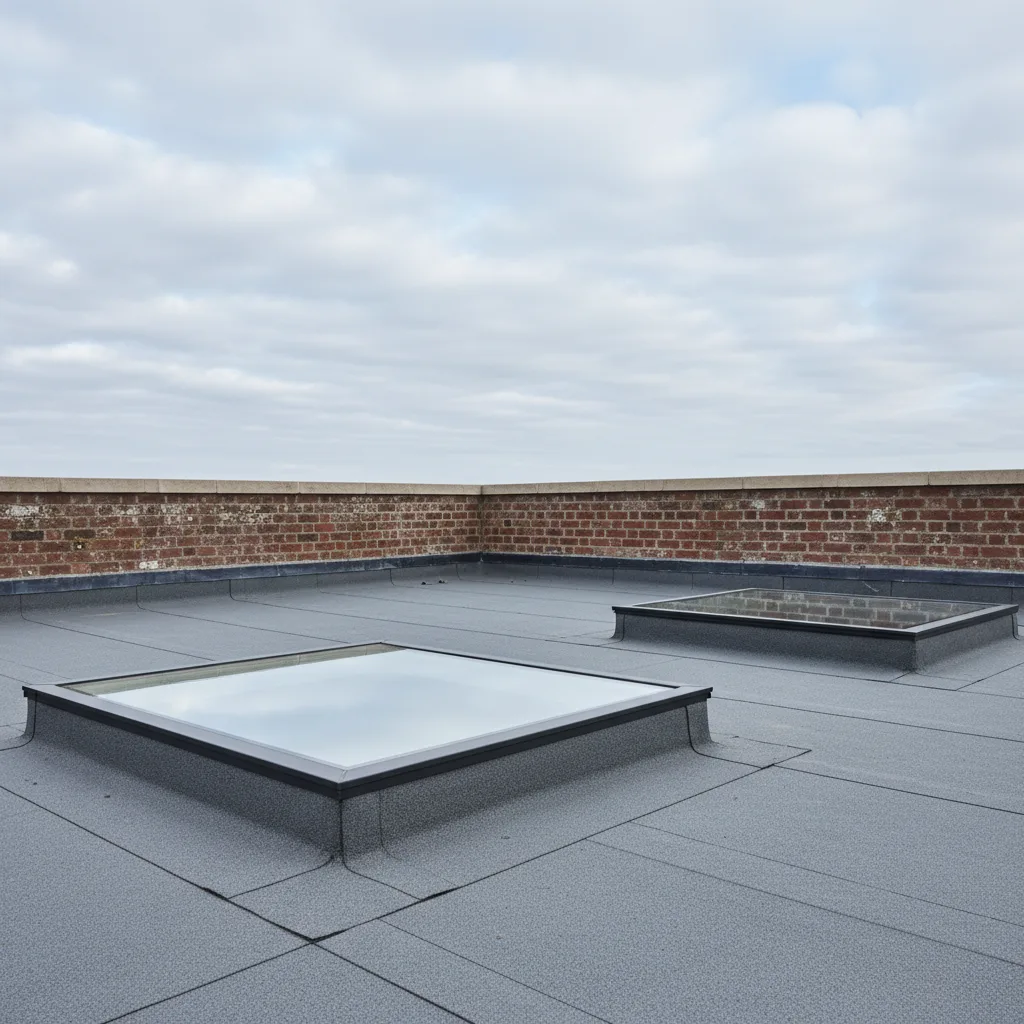
Because it is at the highest point in the room, which is exactly where the warm air has gathered.
A window in a wall, even a tall one, has its opening well below the ceiling. It vents the middle of the room and leaves the warmest layer sitting above it.
A rooflight vents the top of the volume. On a single storey extension with a lantern, the apex vent removes air from the warmest point in the building.
What it needs to work
An opening at low level, and this is the half people forget.
An open rooflight on its own achieves a fraction of what the same rooflight achieves with a door or a low window open elsewhere. Without an inlet, air cannot leave, because nothing can replace it.
The greater the vertical distance between inlet and outlet, the stronger the effect. A rooflight at the top of a stairwell with a door open on the ground floor drives a substantial flow through the whole house.
Using it properly
Purge in the early morning, when the outside air is coolest. Opening a rooflight at two in the afternoon in August brings in hot air; opening it at six in the morning brings in cool air and flushes out the heat stored overnight.
That is precisely what makes scheduling worthwhile on a powered unit. It happens before anybody is awake to do it.
The winter version
The same physics works against you. A rooflight left open in winter loses warm air continuously, and the stack effect makes it efficient at doing so.
Background ventilation through a trickle vent or ventilation flap is the winter equivalent: enough air exchange to remove moisture, not enough to empty the room of heat.
What to specify
An opening rooflight rather than a fixed one wherever summer comfort matters, a rain sensor so it can be left open safely, and a control arrangement that allows a timed early morning purge.
More on Electric and Opening Rooflights
Ready to bring the daylight in?
Tell us about your project and we’ll send a clear, fixed written quote, no pressure, no surprises.
- Fixed written price before any work starts
- No pressure, no obligation, no sales calls
- Flexible survey times that suit you
- A reply within one working day