Why is my flat rooflight leaking?
Four causes, and only one of them is the rooflight.
Part of our Replacing a Failed or Misted Rooflight guide
Start by establishing whether it is a leak at all. Rain leaks follow rain. Condensation follows cold weather and internal humidity, and appears on dry mornings. If it happens on a cold dry day, it is not a leak.
Assuming it is, four causes account for nearly all of them.
1. The kerb is too low
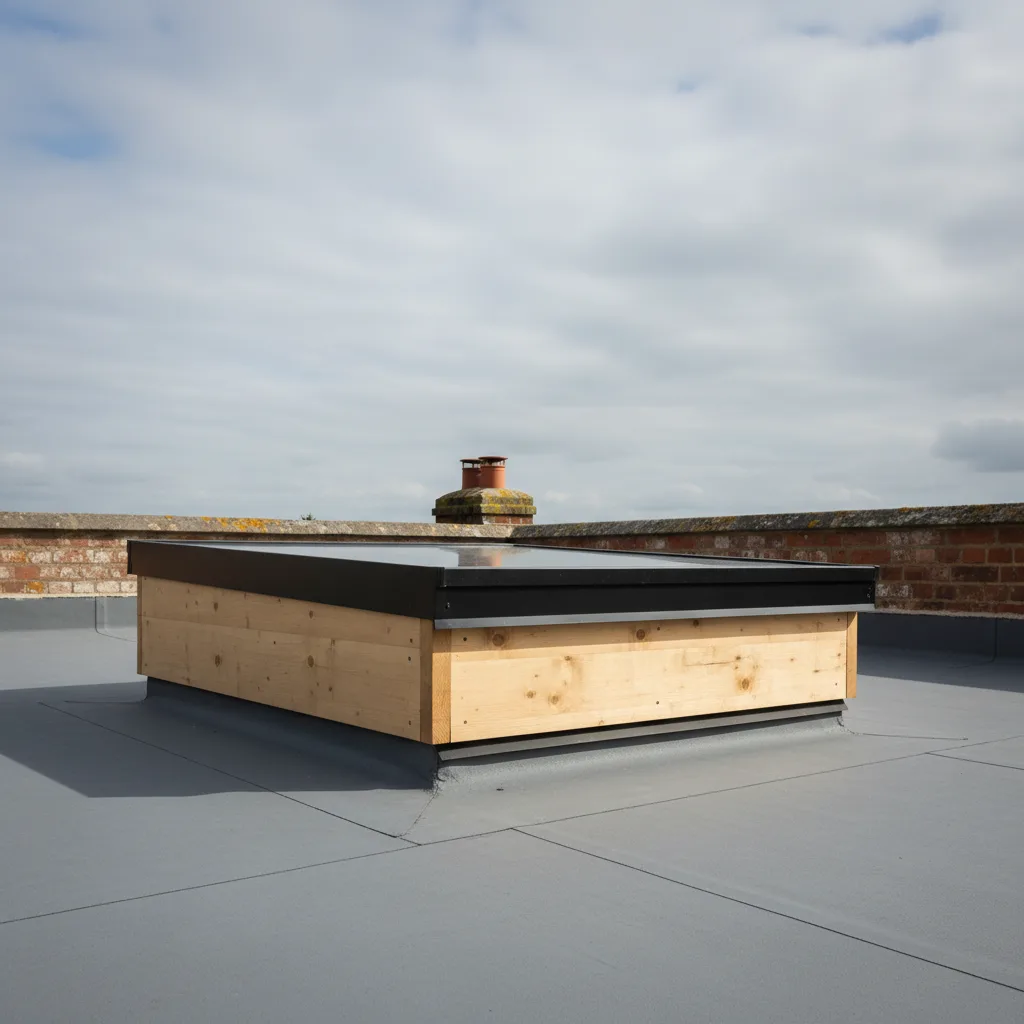
The roof covering has to be dressed up the face of the kerb and terminated under the frame flange. A kerb that is too low leaves nowhere to do that properly, and water gets behind the termination.
The most common cause we find, and it cannot be sealed away.
2. There is no roof margin
A unit pushed out towards the walls to gain glass leaves no flat roof around the kerb for the covering to work with. The detail becomes impossible rather than merely difficult.
3. Water ponds against the upstand

Inadequate fall, or a unit positioned where water collects. Standing water works at the termination for days rather than minutes, and eventually finds any weakness.
4. The vapour control layer was never sealed
Which is not a leak, but produces damp in the ceiling that looks exactly like one. Warm moist room air enters the roof build up at the perimeter and condenses inside it.
What we do

Establish which of the four before quoting a remedy. Replacing a sound unit to fix a kerb problem means paying twice and still having the problem.
Where water is actively entering, the priority is stopping it. We do that first and settle the question of cause afterwards.
Five causes, in order of likelihood
Before assuming a leak at all, check whether the water is on the inside face of the glass and appears on cold mornings unrelated to rain. That is condensation, not a leak, and no roofing work will fix it.
If it follows rain, arrives at one point rather than evenly, and leaves a mark that stays after drying, it is a leak. Here is where they come from.
1. Standing water against the kerb

The commonest cause by a distance. Every flat roof holds some water, and if the deck does not fall away from the kerb, or the fall was never built in, the unit sits in a puddle after every shower.
A seal designed to shed water is not designed to be submerged, and over a few winters it works loose. The fix is correcting the fall locally around the kerb, not resealing.
2. A blocked outlet
Related and easier to fix. A perfect fall discharging into a gulley full of leaves and silt produces exactly the same pond. Check the outlet before assuming the rooflight is at fault, particularly on a plot with trees.
3. No kerb, or one that is too low

A unit bedded straight onto the deck, or on a kerb of 50mm or 75mm, has no margin. 150mm is the working minimum, and on a self built or older extension it is frequently absent entirely.
This is not repairable by sealant. The unit has to come out and a proper kerb has to be formed.
4. The covering dressed incorrectly
The roof membrane should be dressed up the full height of the kerb and terminated properly under the rooflight’s own upstand. Where it stops short, or where it was dressed after the unit was set rather than before, water gets behind it.
This is invisible from above once finished, which is why it survives inspection and fails in year three.
5. The unit itself

Least common, and it happens. A failed perimeter seal on the glazing, a split gasket on an opening unit, or a cracked outer pane. On an opening unit, check the gasket first: grit, leaves and moss on the compression seal stop the sash seating properly, and that is reported as a leak far more often than it is a fault in the window.
How we diagnose it
Establish which of the five it is before quoting anything, because the fixes range from clearing a gulley to lifting the unit and rebuilding the kerb, and the difference in cost is large.
Send a photograph of where the water appears inside and, if it is safe, one of the roof around the unit showing where the water sits after rain. That second picture answers most of the question.
First, establish whether it is a leak at all

Timing is the diagnostic, and it costs nothing.
Water appearing during or shortly after rain is ingress. Something on the roof is wrong.
Water appearing in cold weather, regardless of rain is condensation. Nothing on the roof will fix it, and a roofer sent up to look will find nothing wrong.
A great many reported rooflight leaks are the second, and the money spent chasing them on the roof is wasted.
If it is condensation
The usual cause is an uninsulated kerb. The internal face runs cold, sits at the top of a warm humid room, and collects moisture.
The other cause is a vapour control layer that was never sealed to the frame, letting warm damp air into the construction where it condenses out of sight.
Both are fixed at the kerb and reveal, not on the roof.
If it is ingress

In order of likelihood.
Ponding water against the kerb because the fall is inadequate or arranged so water collects beside the unit rather than passing it.
A blocked outlet turning a drained roof into a pond in one autumn.
The membrane terminated over the unit rather than dressed up the kerb and into it, so the lap runs the wrong way.
A failed perimeter seal, particularly at the corners, which is where sealant joints give up first.
An out of square kerb with the gap taken up in sealant, which is a temporary arrangement from the day it was built.
What not to do
Apply more sealant over the outside of the junction. It hides the evidence, traps water behind it, and makes the real diagnosis harder next time.
More on Replacing a Failed or Misted Rooflight
Ready to bring the daylight in?
Tell us about your project and we’ll send a clear, fixed written quote, no pressure, no surprises.
- Fixed written price before any work starts
- No pressure, no obligation, no sales calls
- Flexible survey times that suit you
- A reply within one working day