Replacing an obsolete VELUX size
Three routes, in order of preference, and none of them is forcing a unit into an opening it does not fit.
Part of our VELUX Window Installation guide
Size ranges change over decades. A window fitted in the 1980s or 1990s is often a size no longer manufactured, and on Colchester’s older loft conversions this comes up constantly.
Route one: nearest current size, adapt the opening
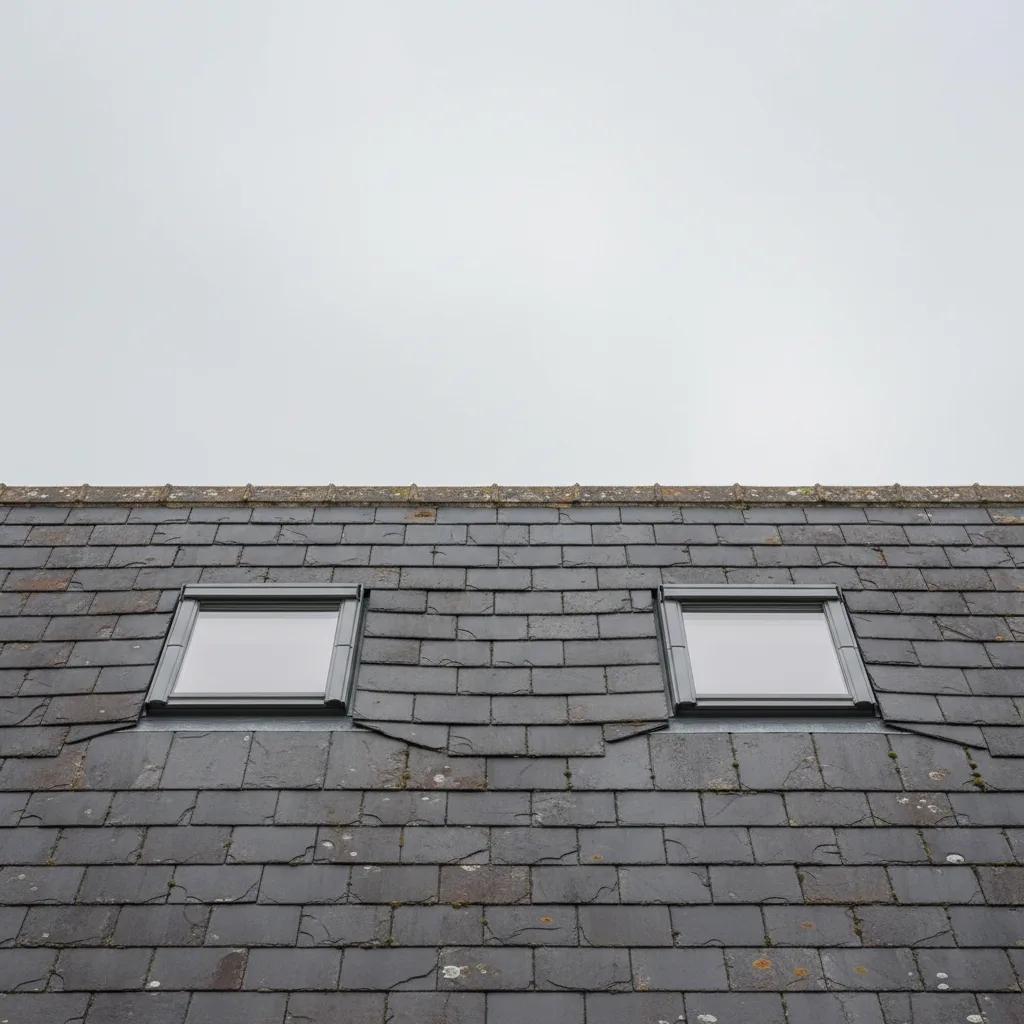
Usually the best answer. The nearest current size is often within 40mm or 60mm of the old one, and adapting the opening is a modest amount of carpentry: packing out or trimming back, then making good.
Invisible when finished, and it leaves you with a standard size for the next thirty years, so the following replacement is straightforward.
Route two: another manufacturer
Sometimes another manufacturer still makes something at or very near the old dimension. Worth checking, particularly where the opening is awkward to alter, for example where it sits tight against a purlin or a steel.
The trade is that you now have a mixed set of windows on the roof, and if others need replacing later you are matching to a different system.
Route three: reframe to a current size

Alter the structural opening properly to suit a standard size. More work now, and on a trussed roof it needs care about what is being cut.
Right where the existing opening is genuinely awkward, where several windows are being done together and standardising them makes sense, or where the timber around the opening needs replacing anyway.
What we will not do
Force a unit into an opening it does not fit and pack the difference with foam and sealant. It looks acceptable for about a year, then the packing settles, the frame is no longer square, the sash stops closing properly and water finds the gap.
If somebody quotes noticeably less for an obsolete size replacement, this is usually why.
Doing several together

Where a loft has three or four windows of the same obsolete size, doing them in one visit shares the access cost and lets you standardise the whole roof on a current size.
Why the size you have no longer exists
Manufacturers revise their ranges every decade or so. Sizes get added, sizes get dropped, and the dimensional grid shifts as products change.
A sealed unit lasts fifteen to twenty five years. Put those two facts together and the arithmetic is unavoidable: by the time a roof window needs replacing, there is a good chance the size it occupies is no longer made.
On anything fitted before roughly 2000 you should expect it rather than be surprised by it. It is not a fault, and it does not mean the original was unusual.
How you find out

From the data plate on the top edge of the sash or the frame beside the hinge. Photograph it rather than transcribing it, because the characters are small, frequently faded, and easily confused.
A supplier can tell you within a minute whether that size is current. If the plate is unreadable, a survey establishes the structural opening dimensions directly, and on a job of any value that half hour is worth paying for.
Route one: adapt the opening
Usually the right answer.
Current sizes are frequently within 40mm or 60mm of a discontinued one. Closing that difference means packing out the opening with timber, or trimming it back, and then making good the reveal.
The work involved is modest. And critically, the reveal is being replastered on a replacement anyway, because taking the old unit out disturbs the plaster at the frame regardless. So the making good is largely happening whether the size changes or not.
When it is finished nobody can tell. The window is centred where the old one was, the reveal is clean, and the difference of 50mm is invisible from inside and invisible from the ground.
The lasting benefit is that the opening is now a current standard size. In twenty five years the next replacement is an off the shelf order, and the accessories, blinds and flashing kits all fit without a special order.
Sourcing the dimension elsewhere

Ranges from different makers overlap without matching, and a dimension one manufacturer has dropped may be a current size for another.
Worth investigating where the opening is genuinely difficult to alter: hard against a purlin, tight to a party wall, or in a listed building where the surrounding fabric is protected.
The trade off is a mixed set of windows on one roof. If there are three other windows on the same slope from the original manufacturer, a fourth from a different maker will not match: the frame proportions, the external finish, the way the sash sits and the opening action will all differ slightly. From the ground that may be invisible. From the room it usually is not.
So this route is at its best for a single window, or for a window on a slope of its own.
Reframing the opening
Open up the roof, alter the trimmers, and set the opening to a current standard.
More work and more cost now, and the right answer in three situations.
Where several windows on one slope are being replaced together and you want them standardised. Doing all of them at once shares the access cost and produces a consistent result.
Where the surrounding timber needs attention anyway. Rot in the trimmers around an old window is common, particularly where the original leaked slowly for years. If that timber is coming out, resizing the opening while it is open costs very little extra.
Where the difference between the old size and the nearest current one is too large to pack out sensibly.
What not to do

Force a modern unit into an old opening and pack the difference loosely.
This is the shortcut that appears when a quotation is unexpectedly cheap, and it fails predictably.
The packing settles under thermal movement and load. The frame goes out of square. The sash stops meeting the compression gasket evenly around its perimeter. Then it draughts, then it leaks, and by that time the tiles are back on and the reveal is plastered.
The failure typically shows in the first or second winter, and the remedy is to do the job again properly.
If a replacement quotation for a known obsolete size is noticeably cheaper than the others, ask directly how the size difference is being handled. A good answer describes packing out and reframing in specific terms. A vague one is a warning.
Timber condition, while the opening is open
Worth planning for, because an obsolete window is by definition an old one.
The trimmers and rafter ends around a twenty five year old rooflight have had a long time to be exposed to any slow leak. Once the unit is out, that timber is visible for the only time in its life.
Anything soft comes out and is replaced. Doing that while the roof is open is straightforward. Discovering it later, after the covering and the plaster are back, is a second job.
Sensible practice is to price a provisional allowance for timber repair on any replacement of an old unit, so that finding rot is a variation rather than a stoppage.
Sequence and lead time

Identify the existing size from the plate. Confirm with a supplier whether it is current. Choose the route. Order.
A current stock size arrives in days. A made to measure unit at the original dimension runs to several weeks. That lead time difference is frequently the deciding argument for adapting the opening, particularly where the room is unusable in the meantime or where the roof cannot be left open.
Then, once it is in, record the manufacturer, model, size code and glazing specification with the house paperwork, so the person who does this in twenty five years starts from a piece of paper rather than a torch and a ladder.
Working out how far out you actually are
Before choosing a route, establish the number. A supplier reading the size code from your data plate can give the structural opening dimensions of the discontinued unit and of the nearest current sizes, and the difference is usually smaller than people fear.
Forty or sixty millimetres in one direction is common. That is a packing piece and a plaster repair.
A hundred and fifty millimetres is a different conversation and may point towards reframing or towards another manufacturer.
Get the numbers in writing before committing to an approach, because the whole decision turns on them.
Making the opening smaller against making it larger

The two directions are not equivalent.
Reducing an opening means adding timber inside it: packing pieces or a new liner fixed to the existing trimmers. Straightforward, and the only requirement is that it is properly fixed and square rather than wedged.
Enlarging an opening means moving a trimmer. Up or down the slope, between the same rafters, that is ordinary carpentry. Across the slope it means cutting a rafter, and on a trussed rafter roof it needs an engineer and a designed repair.
So where the current size is slightly larger than the old one in width, the cost can step up sharply. Where it is slightly smaller, or larger only in height, it usually does not.
That asymmetry is worth knowing when a supplier offers you two candidate sizes.
The flashing has to match the new size
Flashing kits are size specific, so a new one is needed regardless of which route you take. There is no version of this where the old flashing is reused.
That also means the covering comes off around the opening whatever happens, which is worth understanding when comparing a like for like quotation with one that adapts the opening. Much of the work is common to both.
Mixing manufacturers on one roof
Where you go to another maker to find the original dimension, be clear about what you are accepting.
From the ground, on a rear slope, probably nothing visible. From inside the room, the difference is usually noticed: frame proportions, the depth of the sash within the frame, the position of the handle, and the way the lining meets the plaster.
On a slope with one window, immaterial. On a slope with three matching windows and one replacement, it will be seen every day.
Using the moment
An obsolete size means the window is old, which means the specification is old. The access is being paid for once.
A warm edge spacer, a better coating, an insulation collar, insulation carried around the reveal and a vapour control layer taped to the frame all cost a modest amount on top of work that is happening anyway, and none of them can be added later without opening everything up again.
And carry a provisional allowance for timber, because a rooflight that is old enough to be an obsolete size is old enough to have wet the trimmers.
More on VELUX Window Installation
Ready to bring the daylight in?
Tell us about your project and we’ll send a clear, fixed written quote, no pressure, no surprises.
- Fixed written price before any work starts
- No pressure, no obligation, no sales calls
- Flexible survey times that suit you
- A reply within one working day