Do flat rooflights cause condensation?
A well detailed one does not. A poorly detailed kerb does, and it gets blamed on the glass.
Part of our Flat Roof Rooflight Installation guide
A rooflight does not create moisture. It provides a cold surface for moisture already in the room to condense on, and how cold that surface is depends on the specification and the detailing.
Telling it from a leak
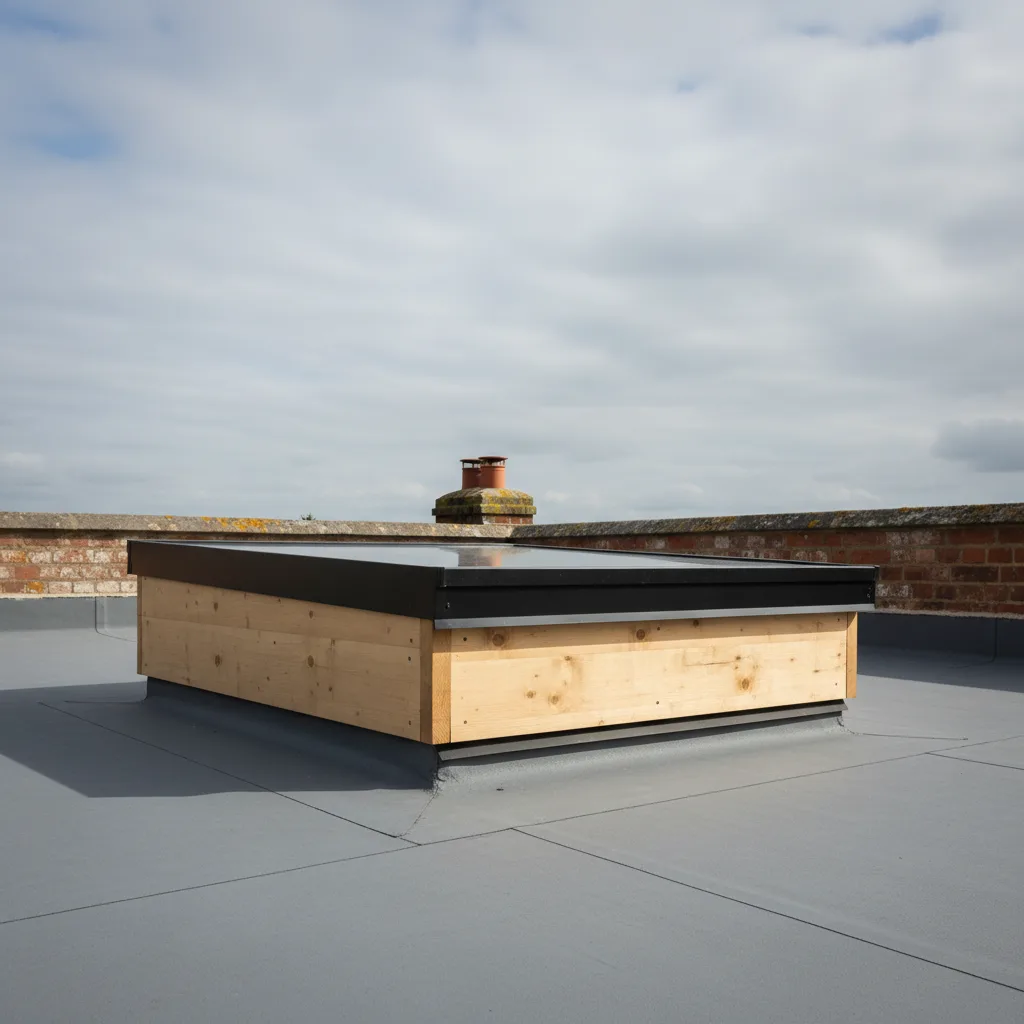
Condensation appears in cold weather, worst first thing, often on dry days, and it is worse when you cook, shower or dry washing. It forms on the coldest surfaces first: the frame, the glass edge, the corners of the reveal.
A leak follows rain and does not care about temperature.
If it happens on a cold dry morning, it is condensation.
The four things that reduce it

A warm edge spacer. An aluminium spacer conducts heat around the perimeter of every pane and makes the glass edge the coldest point of the unit. A low conductivity spacer raises that temperature.
An insulated kerb. An uninsulated upstand is a cold bridge around the whole opening. Cheap during construction, impossible afterwards.
A sealed vapour control layer. If it is not carried up the kerb and sealed to the frame, moist air enters the roof build up and condenses inside it, producing damp in the ceiling rather than droplets on the frame.
Ventilation. Extraction at source in a kitchen or bathroom, and ideally an opening rooflight to let humid air out at the highest point.
Condensation between the panes

Different problem entirely. Misting inside the sealed unit means the seal has failed and the unit needs replacing. It cannot be cleaned or dried out.
What does not help

Replacing a sound unit when the cause is an uninsulated kerb. The new one will do exactly the same thing on the same kerb.
They do not cause it, they reveal it

A rooflight does not produce moisture. What it does is introduce a surface colder than the ceiling around it, and the moisture already in the room condenses there first.
On a flat roof that effect is stronger than on a pitched one, for two reasons. The unit faces straight up at the open sky, which is the coldest thing available on a clear night. And warm air collects at the highest point of a room, so the air touching it is the warmest and wettest in the room.
Where it forms, and what each means

Evenly on the inner face of the glass. Ordinary room condensation. Cold mornings, worst in winter, nothing to do with rain. Not a fault.
A band around the edge of the pane with a clear centre. An aluminium spacer bar conducting heat around the perimeter. Common on older units and mistaken for a failed unit; a warm edge spacer removes most of it.
On the plaster or the reveal around the unit. Usually an installation fault, and on a flat roof the cause is nearly always an uninsulated kerb. An uninsulated timber kerb punches straight through the roof insulation around the whole perimeter of the opening, and the inner face of that cold bridge is where the water forms.
Inside the roof build up, which you may only discover as staining. That is interstitial condensation, caused by warm moist air passing through a vapour control layer that is not continuous or not sealed to the frame.
The three details that prevent the fixable ones

An insulated kerb. Rigid insulation on the outer face, a sheet of board and an hour, invisible under the covering, and the first thing left off a cheap quotation.
A continuous vapour control layer, sealed to the frame, so moist room air cannot reach the cold side of the construction.
A warm edge spacer and a good whole unit U-value, so the glass itself runs warmer.
And ventilation, which is the rest of it

Where the room genuinely produces a lot of moisture, no amount of glazing specification stops condensation. An opening rooflight lets it leave at the highest point, and an extract fan does the work in a kitchen or a bathroom.
A fixed flat rooflight over a shower room with a fan that does not run is a recipe for water on the glass every morning, and the fan is the problem rather than the window.
The mechanism, plainly
Warm air holds moisture. When that air meets a surface cold enough, the moisture condenses onto it. A rooflight is the coldest surface in most ceilings, so it collects the moisture first.
The rooflight is not creating moisture. It is revealing where the coldest surface is, and frequently telling you that the room has more humidity in it than its ventilation can remove.
Which surface is wet tells you the fault
Condensation on the glass itself, internally, points at the glazing specification and the room humidity. Better glass with a warm edge spacer raises the internal surface temperature; better ventilation lowers the humidity.
Condensation at the frame edge or on the kerb reveal, while the glass stays clear, points at a thermal bridge. The kerb is uninsulated, or the insulation does not run continuously from the roof up to the frame.
Water inside the sealed unit, between the panes, is a failed unit and no amount of ventilation will change it.
Damp appearing in the ceiling around the opening in cold weather, without rain, is interstitial condensation inside the construction, and it means the vapour control layer is not sealed to the frame.
What actually fixes it
Insulate the kerb continuously with the roof insulation. Seal the vapour control layer to the frame with tape. Specify a warm edge spacer and a good whole unit U value. And give the room a way to lose moisture, which in a kitchen or bathroom means extraction that runs long enough to be useful.
More on Flat Roof Rooflight Installation
Ready to bring the daylight in?
Tell us about your project and we’ll send a clear, fixed written quote, no pressure, no surprises.
- Fixed written price before any work starts
- No pressure, no obligation, no sales calls
- Flexible survey times that suit you
- A reply within one working day