Powder coat colours and how they weather in Essex
The colour is a preference. The coating specification is not, and on this coast it decides how long the frame looks new.
Part of our Roof Lantern Installation guide
Two separate decisions get confused here. The colour is aesthetic. The coating specification is technical, and near the water it matters far more.
The colours people actually choose

Anthracite grey (RAL 7016). The default on modern extensions by a wide margin. It reads as dark without being black, and it works against brick, render and grey aluminium windows.
Black (RAL 9005). Sharper and more graphic. Right on a period property and on anything where the glazing is meant to look like steel.
White (RAL 9010). Less common now, but correct on a Victorian or Edwardian property with white joinery, where anthracite can look anachronistic.
Matching existing windows is usually the right instinct, and where the lantern is the only aluminium on the building, anthracite is the safe answer.
The part that matters more
Powder coating comes in grades, and the grade decides how the finish survives.
A standard architectural coating is entirely adequate inland. At Braintree, Witham or Halstead, specifying anything more is spending money for nothing.
On the coast it is different. Airborne salt attacks a standard coating, and the failure mode is chalking: the surface goes matt and powdery, the colour lightens, and the frame that was anthracite becomes a dusty lighter grey. It takes three or four years and it cannot be corrected without recoating at height.
A marine grade specification resists it. On Mersea, at Brightlingsea, Clacton, Frinton, Walton, Harwich and Dovercourt, it is the baseline rather than an upgrade.
Fixings

Frequently overlooked. Plated fixings in a coastal environment corrode and streak rust down a frame that is itself fine. Stainless costs very little more.
Dual colour
Most systems will coat the inside and outside differently: anthracite outside to match the windows, white inside to disappear against a ceiling. It costs a little more and it is often the right answer in a room with white joinery.
What powder coating is

A dry finish applied electrostatically as a powder and then cured in an oven, forming a hard continuous film bonded to the metal beneath.
It is applied under factory conditions, which is why it outperforms anything that can be brushed on site, and it is why the external cladding on a roof window and the frame of a conservation rooflight or a lantern should be left alone rather than repainted.
Painting over a factory powder coat gives you a finish that will not last and voids any manufacturer warranty on the coating.
What actually degrades a powder coat
Ultraviolet. The main agent. It breaks down the resin at the surface, which shows first as loss of gloss and then as chalking: a fine powdery bloom that comes off on a finger.
South facing surfaces get it worst. On a rooflight that means the visible face of the frame and the flashing, and on a lantern the whole structure.
Salt. Relevant across a great deal of this county. Salt laden air attacks the coating at any point where it is already damaged, and then attacks the metal beneath.
Mechanical damage. A chip from a dropped tool, a scrape during installation, or abrasion from a badly chosen cleaning method. That is where corrosion starts.
Standing water and debris. Anywhere organic material sits against a coated surface for months, particularly under trees.
The Essex conditions that matter

The coast and the estuaries. Mersea, Brightlingsea, Harwich, Walton, Tollesbury, Maldon and the Blackwater and Stour shores are genuinely aggressive environments. Salt is in the air most days of the year.
On any of those, specify a higher durability coating where the manufacturer offers one as a coastal option. It is a modest premium at the point of order and it may be a condition of the warranty on an exposed site.
Specify stainless steel fixings rather than plated, without exception. Plated fixings corrode within a few years in salt air, and once a fixing has failed the flashing it held is loose. The cost difference is trivial and it cannot be corrected later without opening the work up.
Inland. Colchester, Braintree, the Colne valley villages and the Stour border towns are ordinary conditions, and standard coatings perform well for decades.
Under trees. Common on the wooded plots at Danbury, Braiswick and Gosfield. Leaf litter, sap and bird droppings sitting on a coated surface do more damage than the weather does, and the answer is cleaning rather than a better coating.
How colours behave differently
Dark colours absorb more solar energy and run hotter. Thermal cycling is harder on a coating than steady temperature, so dark finishes on a south facing surface work harder than light ones.
Against that, dark colours hide dirt, algae and general weathering far better, and on a roof that is a real practical advantage. Anthracite grey and matt black are the current standards for good reasons.
Light colours, particularly white, show everything. On a horizontal or near horizontal surface, which is where roof glazing sits, white shows algae, pollen and atmospheric grime within a season. It also reads as dated on most houses.
Strong colours, reds and blues in particular, are the ones most prone to visible fading under ultraviolet, because the pigments are less stable than the carbon and iron oxide pigments in blacks and greys.
Matt finishes chalk more visibly than gloss, because there is less resin at the surface to begin with. On a conservation rooflight, matt is required for appearance and it is worth knowing that it will need looking at.
Steel against aluminium

The consequence of coating failure differs entirely between the two, and it is the reason conservation rooflights need more attention than roof window cladding.
Aluminium forms its own protective oxide layer. Where a powder coat is chipped, the exposed metal dulls and does not rot. Unsightly rather than structural.
Steel corrodes. A chip in the coating on a steel conservation rooflight admits moisture to the metal, rust forms and spreads under the surrounding coating, and it lifts the film progressively from the damaged point outward.
That is why the maintenance advice on a steel unit is to check the coating every few years and touch up damage promptly. It is a five minute job at the point it is spotted and a considerably larger one two years later.
On a coastal or exposed site, make that check annual rather than occasional.
Cleaning without damaging it
Warm water, a mild detergent and a soft cloth or sponge. Rinse thoroughly.
Not abrasives, scouring pads or abrasive creams, which remove the surface resin and accelerate chalking.
Not solvents, which attack the resin directly.
Not a pressure washer at close range, which damages the film and drives water into the perimeter seal, which is a problem well beyond the finish.
On a coastal property, rinsing salt deposits off exposed frames once or twice a year with fresh water extends the life of a coating considerably, and it is the single most useful thing an owner can do.
Choosing colours in practice

External: anthracite grey or black. They recede against the sky, they hide weathering, and they suit almost every house. On a conservation or listed property, matt black or a very dark finish is what an officer will expect and gloss white will not get through.
Internal: white on a lantern, because it reflects light back into the room and disappears against a white ceiling, making the frame members read as thinner. Dual colour, white inside and dark outside, is offered as standard by most lantern manufacturers.
Matching: where a lantern sits alongside aluminium bifold doors, take the colour reference from the actual product rather than a name. Two manufacturers’ versions of the same nominal colour can differ noticeably side by side.
Avoid matching a colour to a current kitchen scheme. A lantern lasts decades and a kitchen does not.
What to specify on an exposed site
A higher durability or marine grade coating where it is offered. Stainless fixings throughout. And on a steel conservation unit, an inspection of the coating built into the annual routine alongside cleaning the gasket.
Tell us at quotation stage where the property is. On the Essex coast that changes what we specify, and it costs very little to get right at order compared with putting it right in ten years.
What a powder coat actually is

A dry polyester powder applied electrostatically to a prepared aluminium surface and then cured in an oven, where it flows and forms a continuous film chemically bonded to the metal.
It is not paint applied afterwards. It is a factory process, and its durability comes from the pretreatment of the aluminium as much as from the powder itself.
That is why quality varies and why it is worth asking what specification the coating is rather than only what colour.
The coastal question
Much of this county is within reach of salt laden air, and the Essex coast and estuaries are a genuinely aggressive environment for coated aluminium.
Salt attacks the interface between coating and metal, and once it gets a foothold at a cut edge or a scratch, it works underneath the film and lifts it.
Manufacturers offer marine or coastal grade specifications, which involve a more thorough pretreatment and frequently a two coat system. Within a few miles of the water they are worth the difference, and on a lantern or a large rooflight they are worth it further inland than people assume, because the prevailing wind carries salt a long way up the estuaries.
How colours age
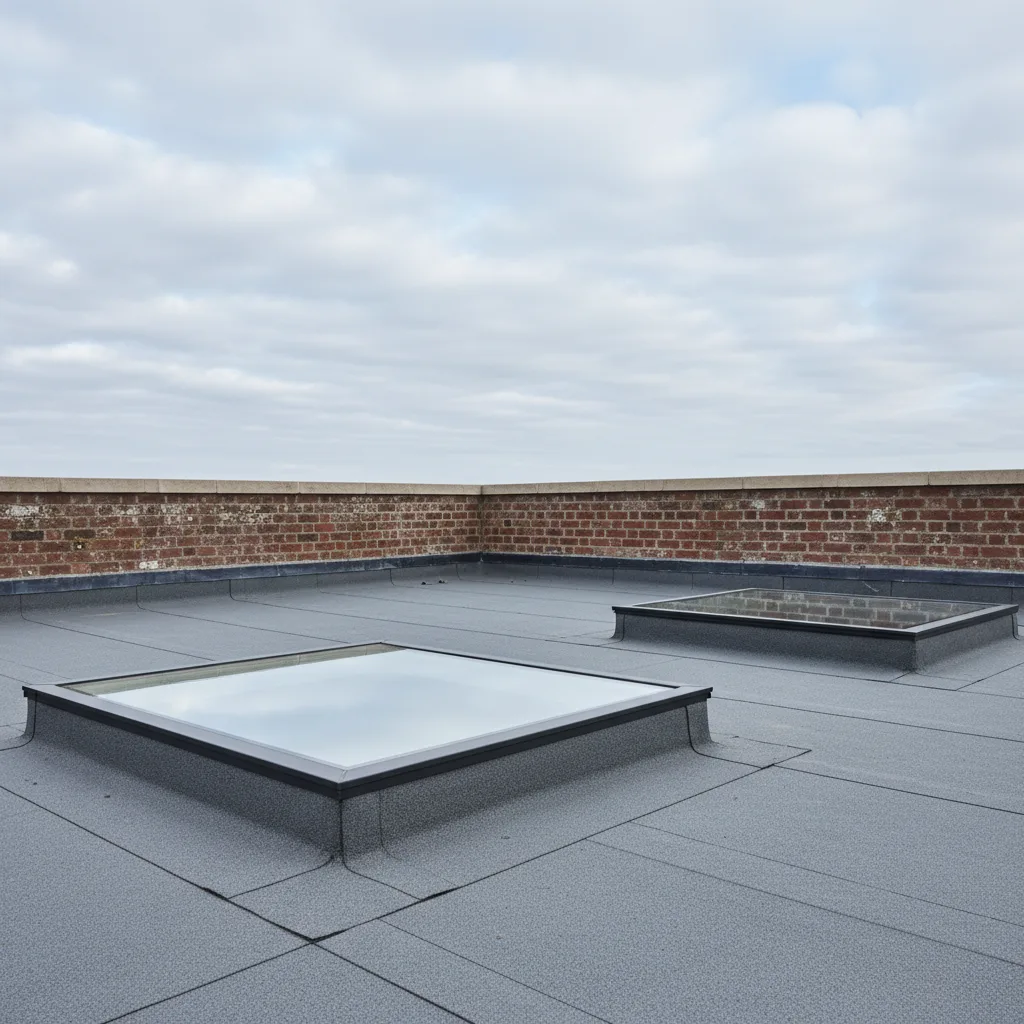
Dark greys and blacks hold their appearance well and are the most common choice on rooflights and lanterns for good reason. What ages them is chalking, a fine surface powdering caused by ultraviolet breaking down the resin, which dulls the finish gradually.
Strong colours, particularly reds and bright blues, are the most vulnerable to fading because their pigments are less UV stable.
Whites and off whites hold colour well and show dirt more, which on a horizontal or near horizontal surface is a real consideration.
Metallic and textured finishes generally hide both chalking and dirt better than a flat gloss.
Gloss level, which matters more than people think
Matt and satin finishes suit a roof. A high gloss coating on a horizontal or near horizontal surface catches every reflection and draws the eye to the frame rather than through it.
Matt also ages more gracefully, because chalking on a gloss surface is far more visible than on a matt one.
Looking after it
Wash it. Warm water and mild detergent, a soft cloth, a rinse. Near the coast that means more often, because the point is removing salt before it works.
Never solvent based cleaners, and never abrasives. Both damage the film and the damage is permanent.
And never paint over a powder coat. Adhesion is poor, moisture gets trapped at the interface, and it looks tired within a couple of years. Where the colour is wrong, the answer is a manufacturer finish specified at order.
More on Roof Lantern Installation
Ready to bring the daylight in?
Tell us about your project and we’ll send a clear, fixed written quote, no pressure, no surprises.
- Fixed written price before any work starts
- No pressure, no obligation, no sales calls
- Flexible survey times that suit you
- A reply within one working day