Sightlines, and how much frame you actually see
The width of aluminium you look at rather than through, and what a slimmer bar really costs.
Part of our Roof Lantern Installation guide
Sightline is the width of frame you look at rather than through. On a lantern it is quoted for the glazing bars and for the ridge, and it is the number that most affects how the finished thing looks.
What the numbers mean

A budget lantern might have bars around 70mm wide. A premium system gets to around 40mm, and the slimmest to under 30mm.
On a lantern with four bars, the difference between 70mm and 40mm is roughly 120mm of aluminium removed from your view and replaced with sky. That is more noticeable than the numbers suggest.
Why slim costs more
The bar is structural. It carries the glass, the wind load and the snow load down to the perimeter. Making it narrower while keeping the same strength means better alloy, a more sophisticated extrusion, and often a steel or composite reinforcement inside the aluminium.
That is a genuine engineering cost rather than a brand premium, which is worth knowing when comparing quotations that look similar but are not.
Depth, not just width

A slim bar is often deeper to compensate. From directly below you see the width; from an angle you see the depth. A system quoting a very slim sightline with a deep section can look heavier in use than the number implies.
It is worth looking at a real one rather than a specification sheet.
When it is worth paying for
On a lantern in the main living space of the house, where it is the architectural feature and will be looked at every day, yes. On a lantern over a utility room or a hallway, the money is better spent on solar control glass.
The ridge

Worth asking about separately. Some systems have an elegant slim ridge, others have a chunky capping that undoes the slim bars beneath it. The ridge is the most visible line on the lantern from inside.
What a sightline is
The sightline is the width of frame visible from inside, measured from the edge of the glass to the edge of the plaster reveal. It is what you actually look at, as distinct from the overall size of the unit or the size of the structural opening.
Three dimensions describe a rooflight and they are frequently confused.
The structural opening, which is what the size code describes and what the roof has to accommodate.
The overall frame size, slightly smaller, sitting within that opening with a tolerance for packing and squaring.
The visible glass area, smaller again, which is what delivers the daylight.
The difference between the first and the last is frame, and on a small rooflight it is a surprisingly large proportion.
Why it matters more on a small unit

Frame width is roughly constant regardless of the size of the window. A 60mm sightline on a large unit is a thin border. The same 60mm on a small unit is a substantial part of what you see.
Take a modest roof window in a 780 by 1400 opening. Deduct frame all round and the visible glass may be a third less area than the opening suggests. On a 1340 by 1400 unit the same deduction is proportionally much smaller.
That is why two small rooflights do not deliver the same glass area as one unit of twice the size, even though the structural openings add up. It is an argument in favour of larger units on daylight grounds, running against the arguments in favour of several smaller ones on cost, structure and light distribution grounds.
Which wins depends on the room, and it is worth knowing the trade rather than assuming.
The same arithmetic on U-values
Frame proportion is also why whole unit U-values and centre pane figures diverge more on a small rooflight than a large one.
Centre pane measures the glass away from the edges and excludes the spacer and the frame. Whole unit includes them weighted by area. On a unit with a lot of frame relative to glass, the frame drags the whole unit figure further from the centre pane one.
So a small rooflight is doubly penalised: less glass than its opening suggests, and a whole unit figure further from the headline number.
What makes sightlines slim

Frame material. Steel is stronger in bending than timber or aluminium for a given section, which is why conservation rooflights achieve genuinely slim profiles while carrying a double glazed unit.
Thermal break design. An aluminium frame needs a thermal break to avoid being a cold bridge, and that break takes width. A well engineered break achieves the performance in less section than a crude one.
Bonded glazing. Where the sealed unit is structurally bonded into the sash rather than held by a bead, the bead width disappears and the sightline slims noticeably. That is how many modern flat roof rooflights achieve a very thin visible frame.
The trade is that a bonded unit cannot be reglazed: the glass and sash are one component, so a failed sealed unit means a new sash or a new unit rather than a new pane.
Cavity width. A narrower cavity allows a slimmer overall unit, at some cost to thermal performance. It is why very slim sightline products sometimes use krypton fill: it performs better than argon in a narrow gap.
How sightlines have changed
Worth knowing when replacing an older window, because it explains why a new unit looks different alongside old ones.
Sightlines have generally slimmed over the past thirty years. A modern unit in the same opening as a 1990s one shows more glass and less frame, which reads as a lighter, more contemporary window.
On a rear slope nobody sees, that is simply an improvement. On a visible slope with two older windows alongside, it is a mismatch, and it is one of the reasons replacing a whole slope at once frequently makes sense.
The reveal, which affects it more than the frame does

Here is the point that matters most, and it is not about the window at all.
In a thick insulated roof, the rooflight sits at the end of a tunnel through the construction. What you see from the middle of the room is not just the frame: it is the frame plus the reveal.
A square boxed reveal, running perpendicular to the window on all four sides, makes the opening read as a deep shaft with a small bright rectangle at the end of it. It also throws a narrow beam of light straight down.
A splayed reveal, cut back at an angle at the head and the sill, opens the aperture out toward the room. It reads as a much larger opening, it distributes the light across the room rather than onto one patch of floor, and it makes the frame far less prominent.
The window is identical. What changes is everything about how it reads and how much light lands usefully.
Splaying costs a little more in plastering and it is the best value decision available on any rooflight installation. On a shallow pitch roof, where the reveal is longer, it is transformative.
Colour, and how it reads
A white internal frame against a white ceiling largely disappears. The same frame in a dark finish is a defined line around the opening.
Neither is wrong, and it is worth choosing deliberately. In a room where the rooflight is meant to be a feature, a dark frame defines it. In a room where you want an uninterrupted ceiling with a hole of sky in it, white recedes.
A white internal frame also bounces light back into the room, which raises the daylight factor marginally.
On a conservation rooflight the frame is dark by requirement, and the central glazing bar is a further visual division. That is the point of the product rather than a drawback, and it is worth seeing one from below before committing if you have not.
What to ask for

The visible glass dimensions rather than only the size code, so you know what you are actually getting.
The whole unit U-value rather than centre pane, for the same reason.
And whether the reveal will be splayed or boxed square, which is a conversation with whoever is doing the making good rather than with the window supplier, and which will do more for the result than any comparison of frame widths between brands.
Why the frame looks heavier in a roof than in a wall
A rooflight is seen against the sky, which is the brightest thing in the room. The frame is therefore a dark silhouette against maximum contrast, and the eye registers it far more strongly than it would the same section in a wall.
And because rooflights are frequently small, the frame occupies a larger proportion of the total aperture. On a modest unit, a wide frame consumes a real share of the view and the light.
Those two effects together are why sightlines are discussed more in roof glazing than in windows generally.
The trade against performance
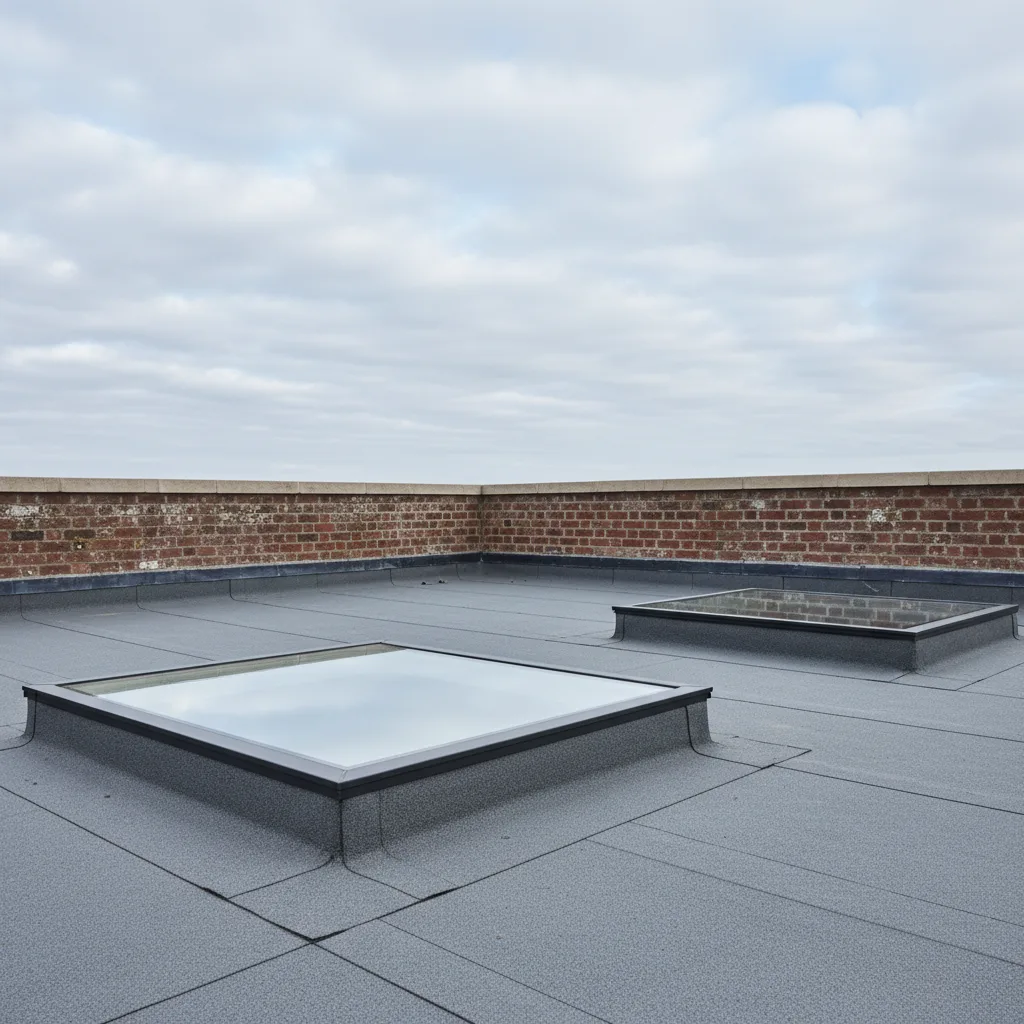
Slimmer is not automatically better, and this is the part sales material tends to skip.
A slim frame has less room for a thermal break, less depth to accommodate insulation within the section, and less structural capacity for the load it carries. Pushing sightlines down usually costs something in the whole unit U value.
On aluminium that matters particularly, because the thermal break is what keeps the internal frame face warm enough not to collect condensation. A very slim aluminium section with a token break will run cold in January.
So the honest comparison is sightline and whole unit U value together, at the size you are actually buying.
Where slim is worth paying for
On a lantern, where the frame is multiplied by rafters, hips and a ridge. Reducing each section makes a visible difference to how much sky you see, and on a finely divided lantern the cumulative frame area is substantial.
On a large flat rooflight where the point is an uninterrupted view.
And where units sit side by side, because the frame between them is doubled and reads as a heavy bar across the opening.
The detail that does more than the product
The reveal, and it costs less than a slimmer frame.
A splayed reveal in a pale matt finish softens the transition from bright glass to dark ceiling, and makes the aperture read as considerably larger. A square reveal in a dark colour makes the same window look small and the frame look heavy.
On most domestic jobs, splaying the reveal improves the perceived sightline more than choosing a marginally slimmer product would.
The figures to request
Published sightline dimensions from each manufacturer on the shortlist, alongside the whole unit U value at your size. And a splayed reveal from the builder, specified rather than assumed, because a square tunnel is quicker to board.
More on Roof Lantern Installation
Ready to bring the daylight in?
Tell us about your project and we’ll send a clear, fixed written quote, no pressure, no surprises.
- Fixed written price before any work starts
- No pressure, no obligation, no sales calls
- Flexible survey times that suit you
- A reply within one working day