Do rooflights lose more heat than windows?
Per square metre, slightly. The difference is the sky rather than the glass.
Part of our Energy Efficient Rooflights guide
A modern rooflight and a modern window at the same specification have similar U-values. What differs is what they face.
The sky is colder than a building

A wall window faces a house opposite, a fence, trees. Those surfaces are at roughly air temperature.
A rooflight faces the sky, and on a clear night the effective sky temperature is well below air temperature. Glass radiates heat to it directly, which is the same reason frost forms on a car roof and not on its sides.
So a rooflight loses somewhat more on a clear cold night than an identical window would.
The same effect works in reverse

In summer the sun is high, and overhead glass receives far more solar energy than a vertical window does. That is why solar control matters more on a rooflight than on a window, and why a rooflight can overheat a room a window would not.
The practical figures

Both a modern rooflight and a modern window land around 1.2 to 1.4 whole unit. The rooflight will perform slightly worse in practice than the number implies, and slightly better in winter sun.
The difference is not large enough to change a decision about whether to fit one.
What does change the decision

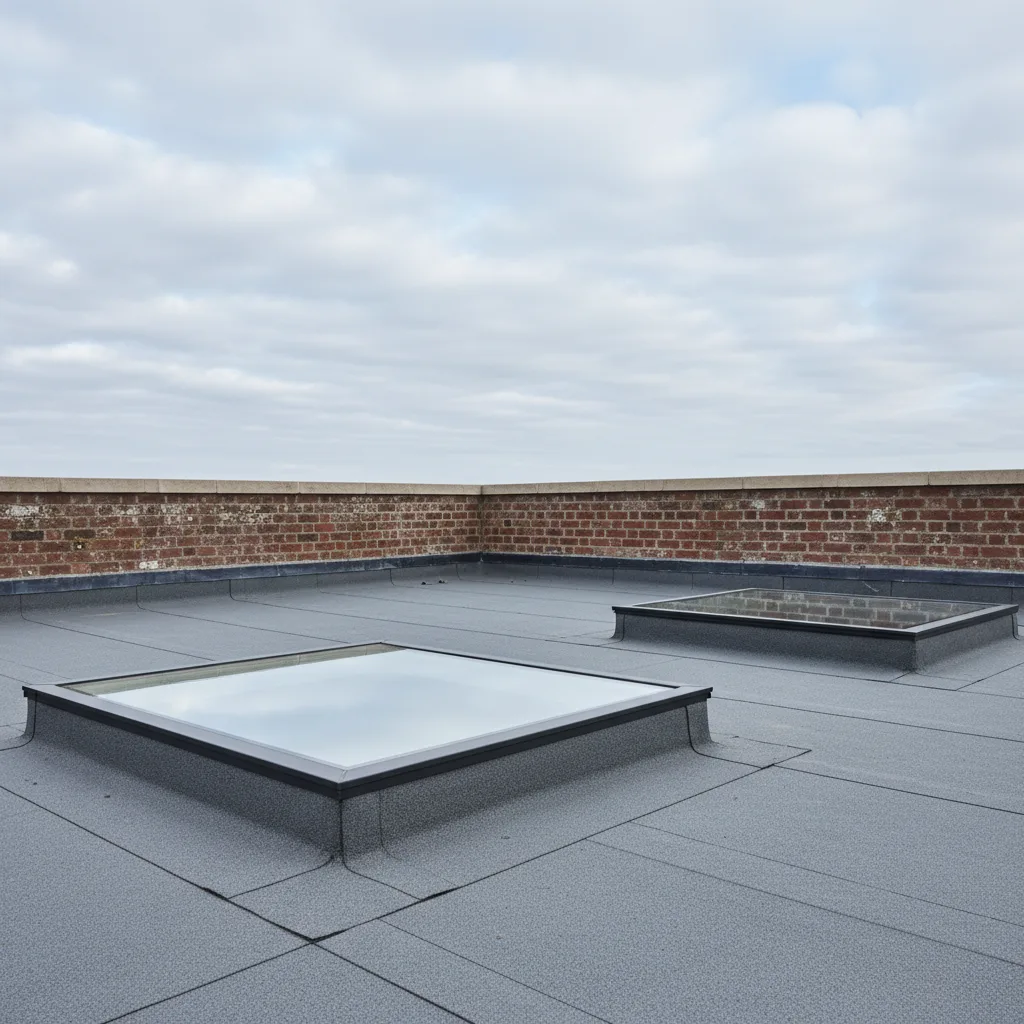
The kerb, which has no equivalent on a window. A wall window sits in a wall with insulation either side of it. A rooflight sits on an upstand that interrupts the insulation entirely, and unless that upstand is insulated it loses more than the glass.
That is the real answer to this question: a rooflight is not much worse than a window, but a rooflight on an uninsulated kerb is.
Per square metre, slightly more

A rooflight and a wall window of similar construction have similar centre pane performance, but the rooflight loses more in practice, for three reasons that have nothing to do with the glass itself.
It faces the sky. A wall window radiates toward the ground, other buildings and the horizon, all of which are warmer than the open sky. A rooflight radiates toward the coldest thing available, particularly on a clear night, which is why frost forms on rooflights before it forms on wall windows.
Warm air collects at the ceiling. The temperature difference across a rooflight is greater than across a wall window in the same room, because the air touching it is the warmest in the room.
More frame relative to glass. Rooflights are generally smaller than wall windows, and a smaller unit has proportionally more perimeter, where the spacer bar and the frame are.
What you should compare against instead

Not a wall window. The insulated roof you are removing.
A well insulated roof performs at around 0.15, and a good rooflight at 1.2 to 1.4. That is a large ratio, and it is the honest way to think about it: a rooflight is a deliberate trade of thermal performance for daylight over a limited area.
The area is what keeps it reasonable. A modest rooflight is a small proportion of a roof, and the daylight it delivers is two to three times what the same area of wall window would give.
Where the loss actually is

The spacer bar. A traditional aluminium spacer conducts heat around the whole perimeter of every pane, showing as a band of condensation at the edge of the glass on cold mornings. A warm edge spacer runs several degrees warmer and largely removes it.
The kerb, on a flat roof. Frequently the largest loss and it appears on no specification. An uninsulated timber kerb punches straight through the roof insulation around the whole perimeter of the opening.
The insulation collar, on a pitched roof. Its absence leaves the reveal cold enough to condense, which is both a heat loss and the commonest cause of water on a plaster reveal.
What to do about it
Specify a warm edge spacer and a good whole unit U-value, insist on the insulation collar or the insulated kerb, and specify solar control glass where the unit faces the sun so the summer side of the equation is handled too.
Triple glazing is usually the wrong answer: modest thermal gain at the cost of weight, daylight transmission and a good deal of money.
Two reasons they lose more, and one that is often overlooked
Orientation. A horizontal or steeply raked surface faces the whole cold sky rather than a portion of it, and radiant loss to a clear night sky is greater than to a wall opposite.
Convection inside the cavity. In a sealed unit tilted toward horizontal, the gas in the cavity circulates more freely than it does in a vertical unit, which slightly reduces the insulating effect of the cavity. This is why the same glass specification tests better vertically than in a roof.
The edge ratio. Rooflights are frequently small, and a small unit has a great deal of perimeter relative to its glass area. The spacer and frame carry a disproportionate share of the loss, which is why the whole unit U value diverges so much from the centre pane figure on a rooflight.
What closes the gap
A warm edge spacer, which addresses the third point directly.
A low emissivity coating and a gas fill, which address the first two.
And the perimeter detailing on site, which is not in any published figure: an insulation collar, an insulated kerb, insulation carried around the reveal, and a vapour control layer sealed to the frame.
The other side
A horizontal opening admits far more daylight per square metre than a vertical window, because it sees the whole sky. So a rooflight delivers more light for less glass area, and less glass area means less total loss.
Compared like for like on area, a rooflight loses more. Compared on the daylight actually delivered, the picture is considerably closer.
More on Energy Efficient Rooflights
Ready to bring the daylight in?
Tell us about your project and we’ll send a clear, fixed written quote, no pressure, no surprises.
- Fixed written price before any work starts
- No pressure, no obligation, no sales calls
- Flexible survey times that suit you
- A reply within one working day