Retrofitting an opener to a manual unit
Often possible with a kit, and solar is usually the right power source for an existing room.
Part of our Electric and Opening Rooflights guide
Frequently possible, and much cheaper than replacing the window. Whether it can be done depends on the model.
Whether a kit exists

Most major manufacturers make conversion kits for their own manual windows. The actuator mounts to fixing points already present in the frame, and the sash and hinges are usually already rated for it.
The code on the data plate tells us whether yours is a model with a kit. Photograph the plate and send it.
Solar, almost always
The room is finished, so running a cable means lifting flooring or ceiling and making good. A solar opener needs no wiring at all: panel on the sash, battery in the frame, fitted in a couple of hours.
That is why solar exists, and on a retrofit it is usually both cheaper and less disruptive than mains.
Mains, if a supply is close

Where there is already a suitable supply within easy reach, for instance in an accessible loft directly above, mains is quicker to operate and has no battery to replace.
When it is not possible
Older windows predating the manufacturer’s electric range. Obscure or discontinued brands with no kit. Frames with no mounting provision. And units where the hinges and stays are not rated for powered operation.
When replacement is better

If the window is more than about twenty years old, putting a new motor on it is spending money on a worn unit. Replacing it with an electric version gives current glazing, new seals and new hinges, with a warranty on all of it.
Flat roof rooflights
Less often convertible. Many fixed flush glazed units are bonded assemblies with no opening provision at all, so there is nothing to motorise and replacement is the route.
Frequently possible, and the motor is not the question

Most manufacturers make conversion kits that add a chain actuator to an existing manual roof window without replacing it. Where a kit exists for your model, fitting takes a couple of hours and nothing on the roof is disturbed at all, because the actuator sits inside on the frame.
Whether a kit exists depends on the model and its age, and the data plate on the sash tells us in one step. Photograph it rather than transcribing it: the characters are small and several are easily confused.
The motor is the easy part. Getting power to it is not.
The three power routes
Mains. A spur from a convenient circuit to a control unit, then a low voltage run from there to the actuator, plus a cable to a wall switch if one is wanted.
Into a finished room that means lifting flooring above or ceiling below, chasing a wall for the switch drop, making good and redecorating, plus an electrician and certification. A day and a half plus decoration, and frequently several times the cost of the conversion kit.
Solar. A solar retrofit kit carries its own photovoltaic panel and rechargeable battery and needs no connection at all. Fitting is a couple of hours with no disruption below and no electrician.
For a conversion in a finished room this is almost always the sensible answer, and the reason is arithmetic rather than preference: the unit costs more than a mains one and the total job costs far less because there is no cable route.
An existing capped cable. If somebody ran one at first fix, mains becomes straightforward and cheap, and this is exactly the situation it was run for.
Does solar actually work here

Yes, and better than the scepticism suggests.
The panel needs daylight rather than direct sun, so it functions on a north facing slope and through an English winter. The energy required to open a window a few times a day is small, and the battery buffers the difference between a bright week and a dull one.
It opens more slowly than mains, thirty to sixty seconds against fifteen to thirty, which nobody notices in use. And it keeps working in a mains power cut, which a wired unit does not.
The battery is a consumable good for several years and it is replaceable. It does not fail suddenly: the unit becomes slower to respond and less able to cope with a run of dull days, which is clear enough warning.
Where no kit exists
On an older or discontinued model the choice is between a new motorised window and leaving it manual.
The honest arithmetic usually points one way. If the unit is over twenty years old, the sealed unit is approaching the end of its fifteen to twenty five year life anyway. Fitting a motor to a window you will be replacing within a few years is spending money on the wrong component, and most of the cost of that replacement will be the access rather than the window.
Where the frame is sound and under fifteen years old and no kit exists, a solar powered replacement unit is worth pricing against a manufacturer’s own solution, because the labour is comparable.
What to specify with the conversion

A rain sensor, without hesitation. It is the feature that actually makes a motor worth having, because a window that closes itself when it starts raining is a window you can leave open.
A window you have to remember to close before rain stays shut, and a window that stays shut does not ventilate, which is the reason you wanted the motor.
A wall switch, where a cable allows one, positioned beside the light switches at the room entrance rather than under the rooflight. A handheld remote is permanently in another room; a switch is always in the same place and anyone can use it without being shown.
On a solar system a wireless switch achieves most of that without a cable, and it is worth fitting rather than relying on a remote.
Preparation before the kit goes on
Two things are worth doing while somebody is at the window, and both extend the life of the new actuator.
Clean the gasket properly. Grit, leaves and moss on the compression seal mean the actuator will fight an obstruction on every cycle for the rest of its life. A person closing a window by hand feels that resistance; a motor does not, it simply strains and keeps going.
This is the single biggest determinant of actuator life and it is trivial to deal with at the outset.
Check the sash still closes squarely. If the window catches at one corner or needs a shove, the frame may have moved or the timber may have gone. Fitting a motor to a window that does not close properly guarantees a strained mechanism and a leak reported as a fault.
Press the frame at the sill and the lower corners while you are there. Timber that gives under a thumb is decayed, and that changes the conversation from a conversion to a replacement.
What the conversion does not change

The weathering. The flashing kit, the underlay collar and the covering are untouched, so a window that leaks before the conversion leaks after it.
If water has been appearing, establish which of the four situations you have before adding a motor: condensation on the glass, edge misting from an aluminium spacer, a failed sealed unit, or water on the plaster reveal from a missing insulation collar. Only the last of those is an installation fault, and none of them is fixed by an actuator.
Blinds at the same time
If you are converting the window and running power to it, consider whether an electric blind is wanted too. There may be a spare output on the control unit, and doing both on one visit costs less than two.
Where the room overheats, note that a blind is a light and privacy product rather than a heat one, and the answer to summer heat is solar control glazing and an opening at the highest point rather than fabric.
The advice that avoids all of this
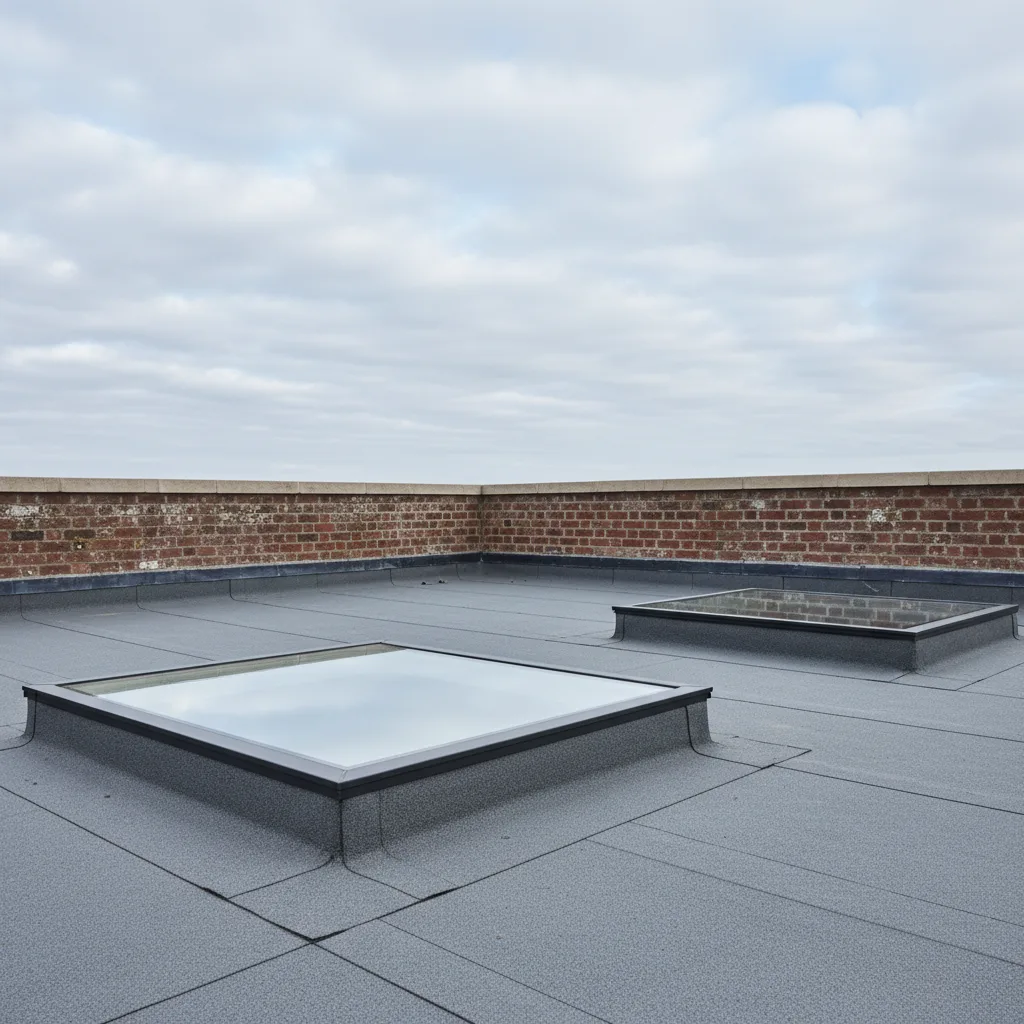
During any work near a rooflight position, run a capped cable to it even if you are fitting a manual unit.
Twenty minutes at first fix, terminated in an accessible enclosure, photographed before the ceiling closes. It turns exactly this job from a disruptive exercise into a trivial one, and it covers a future blind and a future rain sensor as well.
The single most common regret in this trade is saving the electric premium during a build and wanting a motor two years later.
First question: does a kit exist for your window
Several manufacturers design their manual and powered units around a common frame, and offer a retrofit actuator kit that fits an existing window. Where that applies, the conversion is straightforward mechanically.
Others build the powered version as a distinct product with different hinges and a different sash, and on those there is nothing to convert.
The model designation on the data plate settles it in one phone call, which is why photographing that plate is the first step rather than measuring anything.
Age is the practical constraint. Kits exist for current and recent ranges. On a twenty year old window they usually do not, and by that age the window itself is approaching replacement, at which point the sensible move is a new powered unit rather than a conversion.
The real obstacle is power, not the motor
The actuator is the easy part. Getting a supply to it is not.
In a finished room a cable to a rooflight means either surface trunking, which is visible, or opening up the ceiling and the reveal, which means replastering and redecorating.
That is why the cabling, rather than the hardware, is what makes most conversions uneconomic. The motor is a modest cost; the making good is not.
Solar, which is the answer most of the time
A solar opening kit carries a small photovoltaic panel on the outside of the unit, a battery, and a remote handset. No cable at all.
On a retrofit that is nearly always the sensible route, and it is precisely why the product category exists.
The trades are a battery with a service life of a few years, slower operation, and a panel that needs to stay reasonably clean and not permanently shaded.
What to add while you are at it
A rain sensor. On a powered unit in a house that is empty during the day it is the function that actually matters, and adding it with the kit costs far less than a separate visit later.
The honest comparison
Against a manual opener on a pole, which costs very little, never fails, needs no power and has nothing to maintain.
Powered operation earns its place where the window is genuinely out of reach, or where a rain sensor is wanted. Within easy reach, the pole is the better answer and the money is better spent elsewhere.
More on Electric and Opening Rooflights
Ready to bring the daylight in?
Tell us about your project and we’ll send a clear, fixed written quote, no pressure, no surprises.
- Fixed written price before any work starts
- No pressure, no obligation, no sales calls
- Flexible survey times that suit you
- A reply within one working day